
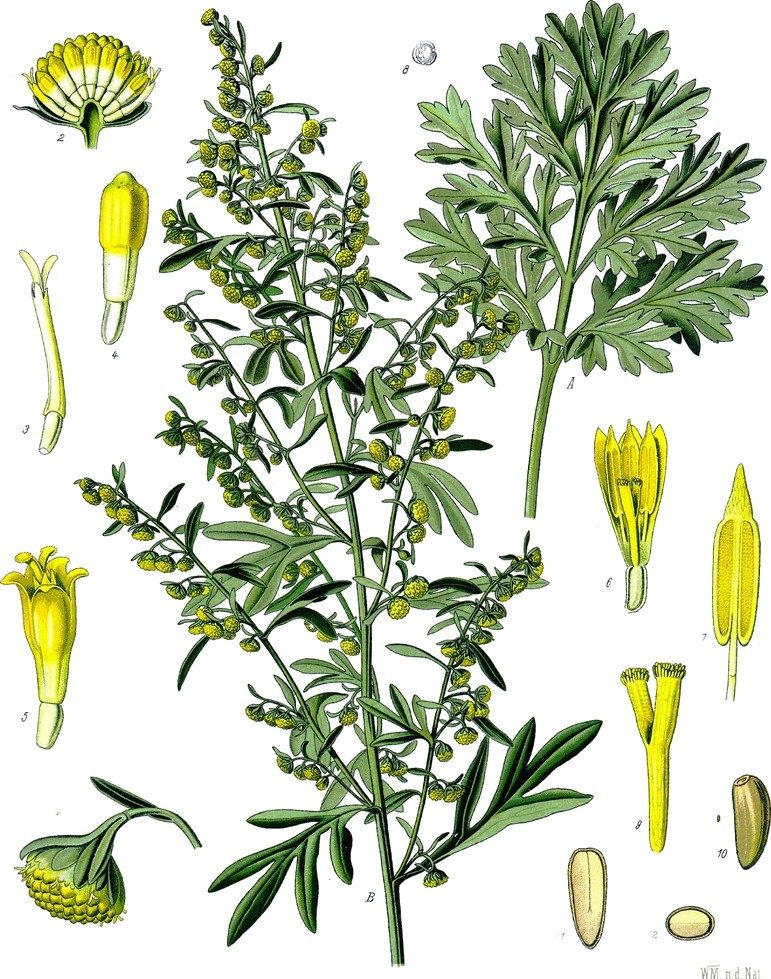
Wormwood, oil of
Oglio d’assenzo
- Known today as
- Artemisia absinthium.
- Kind
- Plant, in 2 older authorities
- Constituents
- thujone, absinthin
- Earliest authority here
- Dioscorides (c. AD 40–90)
- Qualities
- Hot in the first degree, dry in the third (Galenic tradition). What the degrees mean
- In other databases
- Plants of the World Online search · GBIF search · Wikidata search
- In the Canale glossary
- On the Manner of Discerning and Healing the Bewitched, Appendix A: Part Three, Chapter 5: Vomitory Medicines
Wormwood, oil of: what did Canale use it for?
Rubbed on the stomach after vomiting; its tops in the cockerel (chs. 5–6).
Wormwood, oil of: what does modern science say?
A stomach bitter. Its thujone is toxic in quantity. (In ch. 6 the powder Canale commends is of artemisia, mugwort, not wormwood.)
Pharmacognosy & Toxicology
- Constituents
- Mechanism
- Thujone, a GABA-A antagonist; the bitters stimulate the stomach.
- Toxic dose
- Absinthe of the nineteenth century held up to 260 mg of thujone per litre by some estimates, far less by others; the modern limit is 35 mg.
- Syndrome
- Convulsant terpenes (thujone, pinocamphone, camphor)
- Standing
- Approved in Europe as a traditional bitter for the appetite, with the thujone limited.
- Lachenmeier, D. W., et al. (2008). “Chemical composition of vintage preban absinthe.” Journal of Agricultural and Food Chemistry 56. Verified against its record · doi:10.1021/jf703568f
The abstract of each source, beneath its citation. For Club members. About the Club or sign in.
Constituent names open the compound’s record at PubChem, and “ChEMBL” beside a name opens its record at ChEMBL, the European Bioinformatics Institute’s database of bioactive molecules. Where a mechanism line was checked against ChEMBL (ChEMBL 37, read 1 October 2026), the check is shown with the measured value and its source paper, or says plainly that nothing has been measured. Doses are as the references give them, for description only; this is not medical advice. Each source carries the result of its check against Crossref, PubMed, or the authority’s page: see Verification.
Wormwood, oil of: what lore surrounds it?
Wormwood’s reputation now rests mainly on absinthe, the “green fairy” blamed for driving nineteenth-century artists and drinkers mad and often linked to Van Gogh. Analysis of sealed bottles from before 1915 found only small amounts of thujone in the genuine article, and toxicologists now lay absinthe’s notoriety chiefly on its high alcohol and the drinking it encouraged; some historians see the panic that banned it across Europe as closer to a moral crusade than a scientific finding.
Used in These Compounds
Wormwood, oil of is an ingredient of 1 compound medicine in the database. For Club members. Create a free account or sign in.
Wormwood, oil of: what did the older authorities say?
- Dioscorides
- Notes that ink mixed with wormwood keeps mice from gnawing the written page.
- Revelation 8:11
- The star called Wormwood falls on the waters and makes them bitter.
Sources
- [41] European Medicines Agency, Committee on Herbal Medicinal Products (HMPC). Herbal monographs, assessment reports and public statements, ema.europa.eu, cited under the herb concerned: aniseed (summary, EMA/305345/2016); Aristolochia (public statement, EMEA/HMPC/138381/2005); asarone (public statement, EMEA/HMPC/139215/2005); caraway (EMA/HMPC/715092/2013); centaury (EMA/HMPC/277493/2015); chicory root (assessment report, EMA/HMPC/113041/2010); cinnamon (EMA/HMPC/246774/2009); clove (assessment report, EMA/HMPC/534946/2010); ethanol in herbal products (reflection paper, EMA/HMPC/85114/2008); fennel (EMEA/HMPC/372839/2016, Rev. 1, 2024); fumitory (draft assessment report, EMA/HMPC/367013/2021); greater celandine (public statement, EMA/HMPC/743927/2010); hops (EMA/HMPC/682384/2013); horehound (EMA/HMPC/604271/2012); mallow (assessment report, EMA/HMPC/749518/2016); marshmallow root (Althaeae radix); melissa (summary, EMA/HMPC/310761/2013); myrrh (assessment report and monograph, EMA/HMPC/96910/2010 and 96911/2010); peppermint oil (assessment report, EMEA/HMPC/349465/2006); pyrrolizidine alkaloids (public statement, EMA/HMPC/893108/2011); rhubarb (EMA/HMPC/113700/2019); sage (Salviae officinalis folium); wormwood (EMA/HMPC/751490/2016). Read in full · the text read
- The History Blog, “The green fairy is really just hooch.” Book, not indexed
Verification
- Checked
- October 1, 2026
- Passes
- Every sentence read against its sources, in the pass over the remaining 343 entries
- The Standing line checked against the authority it names (EMA, WHO, FDA, CITES, Commission E)
- Every dated or regulatory claim checked by category across the database
- Sources
- 3 cited: 1 read in full, 1 verified against its record, 1 book, not indexed. 1 with the abstract on file.
- Corrections
- None were needed.
What was checked, how, and what was found is set out on the Verification page. A checked source is one whose record was found; it does not make the entry medical advice.
Cite This Entry
Version 1 · first published September 25, 2026
- Chicago
“Wormwood, oil of.” In Materia Medica, edited by B. C. P. Statema. Version 1. The Thinking Press, 2026–. Last modified September 25, 2026. https://thethinkingpress.org/materia-medica/wormwood-oil-of.
- MLA
“Wormwood, oil of.” Materia Medica, edited by B. C. P. Statema, version 1, The Thinking Press, 25 Sept. 2026, thethinkingpress.org/materia-medica/wormwood-oil-of. Accessed 8 Oct. 2026.
- APA
Wormwood, oil of. (2026, September 25). In B. C. P. Statema (Ed.), Materia medica (Version 1). The Thinking Press. Retrieved October 8, 2026, from https://thethinkingpress.org/materia-medica/wormwood-oil-of
Club members keep entries on a shelf with private notes, print the plates as cards, and receive an entry by email each week. Create a free account before January 1, 2027 and all of it is yours for good. About the Club
See Also
Poisoned alike: convulsant terpenes (thujone, pinocamphone, camphor)
Camphor · Tansy · Hungary water · Sage · Hyssop · Rosemary · Mint, oil of · Mugwort · the syndrome, with all of them →
Sharing thujone
Also in Dioscorides
Calamine in Dioscorides · Walnut, middle bark of in Dioscorides · Cantharides in Dioscorides · Vine ash in Dioscorides · everything Dioscorides names →
Also in Scripture
Cumin in Scripture · Spikenard in Scripture · Dill in Scripture · Frankincense in Scripture · everything Scripture names →
Of the same qualities: hot and dry
Aniseed · Thyme · Asafoetida · Theriac · Balm · Sulfur · what the degrees mean →
Nearby in the alphabet
Yarrow (Achillea millefolium) · Woody nightshade · Yellow dock (Rumex crispus) · Woodlouse · Yellow stainer · Wood sorrel (Oxalis acetosella) · Yew (Taxus baccata) · Woad (Isatis tinctoria)
Historical description, not medical advice.