
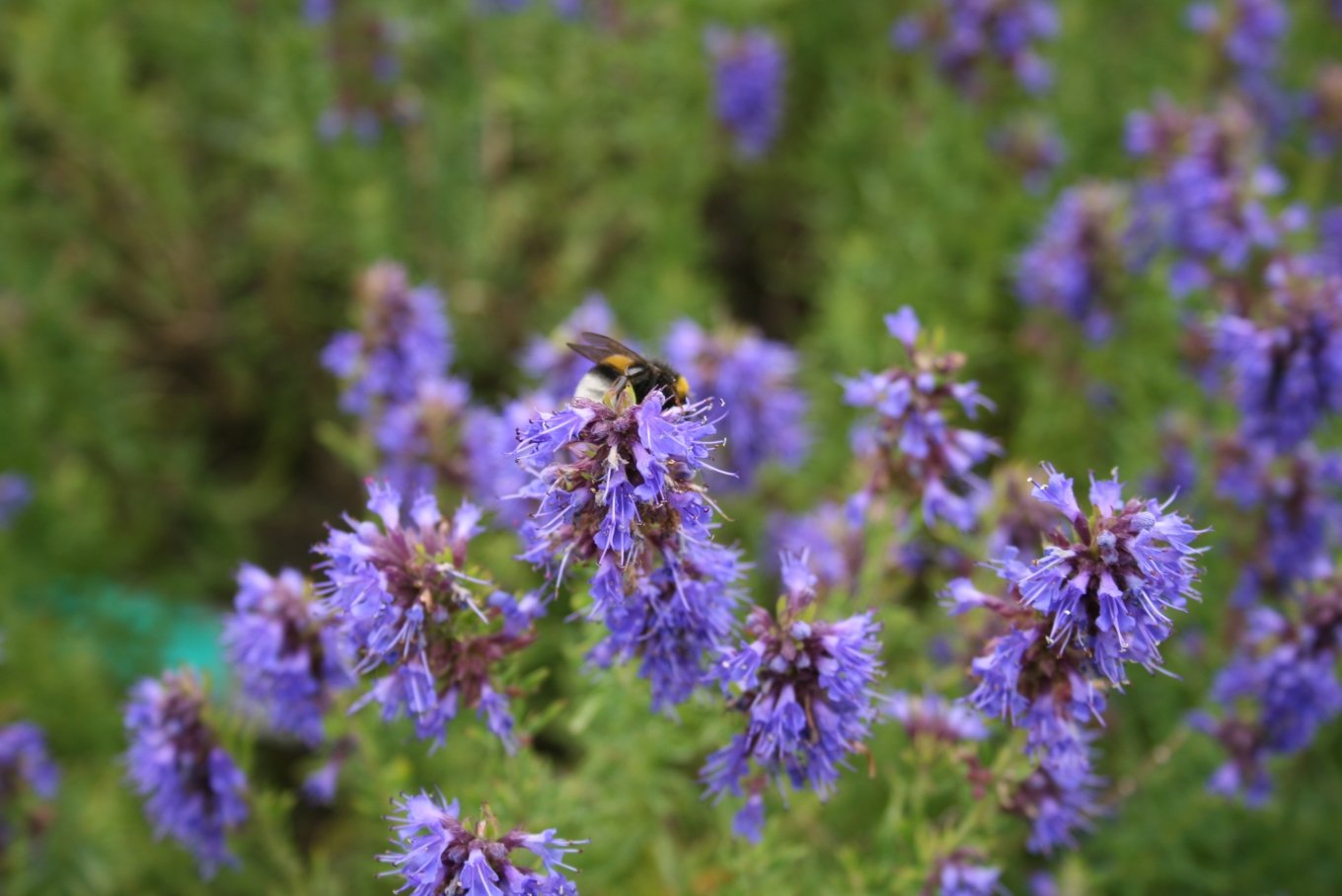
Hyssop
Greek hyssopos; Hebrew ezov
- Known today as
- Hyssopus officinalis; the hyssop of Scripture was probably a wild marjoram, Origanum syriacum.
- Kind
- Plant, in 4 older authorities
- Constituents
- pinocamphone, isopinocamphone
- Earliest authority here
- Exodus
- Qualities
- Hot and dry (Galenic tradition). What the degrees mean
- In other databases
- Plants of the World Online search · GBIF search · Wikidata search
Revised October 1, 2026: Tradition, lore, modern assessment, and sources extended. Version 1, first published September 25, 2026.
Hyssop: what was it used for?
For coughs and the chest, in syrups and decoctions.
Hyssop: how is it taken as a tea?
A warm infusion of the green tops, often with horehound, taken frequently: a grateful drink for a feeble stomach, and drunk several times daily one of the old country remedies for rheumatism.
All the herbal teas of the database. Historical directions, not medical advice.
Hyssop: what does modern science say?
Its oil contains pinocamphone, which can cause seizures in excess; the herb itself is mild. A tea of the leaf is safe and mildly expectorant; the distilled oil contains pinocamphone, which has caused convulsions in children given a few drops and in adults who took it for epilepsy, and France restricts its sale.
Pharmacognosy & Toxicology
- Constituents
- Mechanism
- The pinocamphones are convulsant at the GABA-A receptor.
- Toxic dose
- A few drops of the oil have convulsed children; the tea is safe.
- Syndrome
- Convulsant terpenes (thujone, pinocamphone, camphor)
- Standing
- The oil is restricted in France; the herb is a food.
- Millet, Y., et al. (1981). Clinical Toxicology 18. Book, seen in reviews
The abstract of each source, beneath its citation. For Club members. About the Club or sign in.
Constituent names open the compound’s record at PubChem, and “ChEMBL” beside a name opens its record at ChEMBL, the European Bioinformatics Institute’s database of bioactive molecules. Where a mechanism line was checked against ChEMBL (ChEMBL 37, read 1 October 2026), the check is shown with the measured value and its source paper, or says plainly that nothing has been measured. Doses are as the references give them, for description only; this is not medical advice. Each source carries the result of its check against Crossref, PubMed, or the authority’s page: see Verification.
Hyssop: what lore surrounds it?
The herb of purification, it joins the materia medica to the rite: see Holy water.
The hyssop of Scripture is a puzzle, since Hyssopus officinalis does not grow in Palestine: the Syrian oregano, za’atar, is the likeliest, and the caper is the other candidate for the hyssop that “springeth out of the wall.” Hyssop was strewn in sickrooms against the plague, and Gerard says the Hebrews used it in the baths.
Hyssop: what did the older authorities say?
- Exodus
- A bunch of hyssop was dipped in the blood of the Passover lamb to mark the doorposts.
- Psalm 51
- “Purge me with hyssop, and I shall be clean”: the verse sung as Asperges me while holy water is sprinkled before Mass.
- Hippocrates
- Gives hyssop for the chest and pleurisy, and Dioscorides with figs and honey for the cough and the breath.
- The Benedictines
- Grew it in every cloister garden, and it is among the hundred and thirty herbs of the Chartreuse liqueur of the Carthusians, whose recipe of 1605 is still kept by the monks.
Sources
- Exodus 12:22. Book, seen in reviews
- Psalm 51 (Vulgate 50). Book, seen in reviews
- Grieve, M. A Modern Herbal, “Hyssop.” As published on botanical.com.
- 1 Kings 4:33. Book, seen in reviews
- Millet, Y., et al. (1981). “Toxicity of some essential plant oils: clinical and experimental study.” Clinical Toxicology 18. Verified against its record · doi:10.3109/15563658108990357
Verification
- Checked
- October 1, 2026
- Passes
- Every sentence read against its sources, in the pass over the remaining 343 entries
- The Standing line checked against the authority it names (EMA, WHO, FDA, CITES, Commission E)
- Every dated or regulatory claim checked by category across the database
- Sources
- 6 cited: 1 verified against its record, 4 book, seen in reviews, 1 not yet checked. 2 with the abstract on file.
- Corrections
- None were needed.
What was checked, how, and what was found is set out on the Verification page. A checked source is one whose record was found; it does not make the entry medical advice.
Cite This Entry
Version 1 · first published September 25, 2026 · last revised October 1, 2026
- Chicago
“Hyssop.” In Materia Medica, edited by B. C. P. Statema. Version 1. The Thinking Press, 2026–. Last modified October 1, 2026. https://thethinkingpress.org/materia-medica/hyssop.
- MLA
“Hyssop.” Materia Medica, edited by B. C. P. Statema, version 1, The Thinking Press, 1 Oct. 2026, thethinkingpress.org/materia-medica/hyssop. Accessed 8 Oct. 2026.
- APA
Hyssop. (2026, October 1). In B. C. P. Statema (Ed.), Materia medica (Version 1). The Thinking Press. Retrieved October 8, 2026, from https://thethinkingpress.org/materia-medica/hyssop
Club members keep entries on a shelf with private notes, print the plates as cards, and receive an entry by email each week. Create a free account before January 1, 2027 and all of it is yours for good. About the Club
See Also
Poisoned alike: convulsant terpenes (thujone, pinocamphone, camphor)
Mint, oil of · Hungary water · Mugwort · Camphor · Rosemary · Wormwood, oil of · Sage · Tansy · the syndrome, with all of them →
Also in Scripture
Mandrake in Scripture · Galbanum in Scripture · Frankincense in Scripture · everything Scripture names →
Also in Hippocrates and the Hippocratic Writers
Valerian in Hippocrates and the Hippocratic Writers · Honeyed wine and honeyed water in Hippocrates and the Hippocratic Writers · Black hellebore in Hippocrates and the Hippocratic Writers · Honey in Hippocrates and the Hippocratic Writers · everything Hippocrates and the Hippocratic Writers names →
Drawing on the same sources: Grieve
Of the same qualities: hot and dry
Juniper · Lavender · Garlic · Long pepper · Galangal · what the degrees mean →
Nearby in the alphabet
Indian and Arabian pills (Two named compound pills of the Arabic-Latin tradition) · Indian electuary, greater and lesser (the greater and the lesser) · Human fat (Fat rendered from the bodies of the executed) · INRI · Houseleek (Sempervivum tectorum) · Houndstongue (Cynoglossum officinale)

Historical description, not medical advice.