
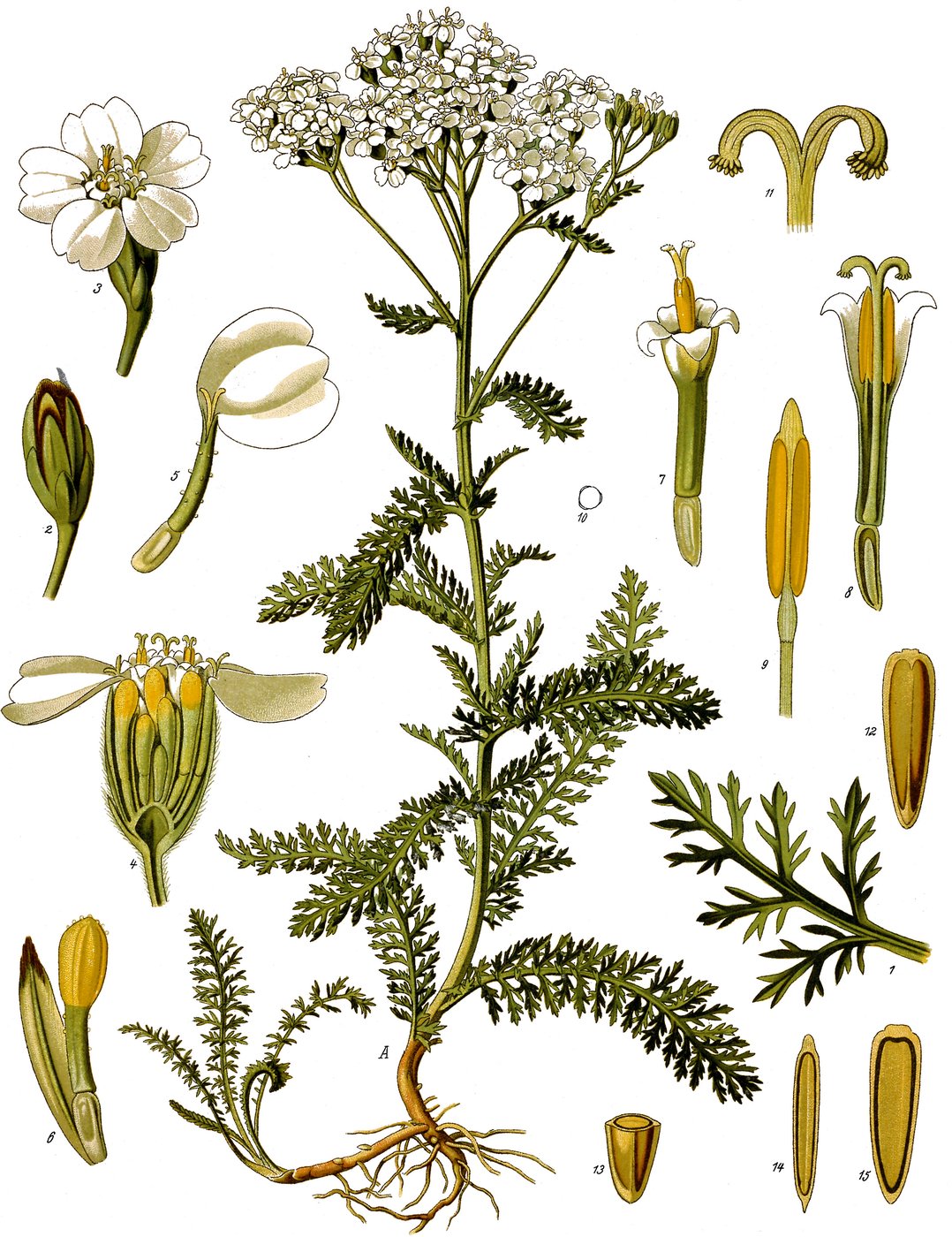
Yarrow
Achillea; millefolium, “thousand-leaf”
- Known today as
- Achillea millefolium.
- Kind
- Plant, in 2 older authorities
- Constituents
- achilleine, chamazulene, apigenin
- Earliest authority here
- Pliny (AD 23/24–79)
- Qualities
- Drying and binding (Galenic tradition). What the degrees mean
- In other databases
- Plants of the World Online search · GBIF search · Wikidata search
Yarrow: foraging it in the Midwest
- Part
- Flowering heads
- When
- Summer
The Pillager Ojibwe placed the florets on a bed of coals and inhaled the smoke to break a fever, and smoked the dried heads in ceremony; the Flambeau used the leaves as a poultice for a spider’s bite. Roadsides and dry fields.
After Smith. All the foragables of the Midwest. Historical record, not a field guide: identify before you gather, and read the whole entry.
Yarrow: how is it taken as a tea?
An ounce of the dried herb to a pint of boiling water, drunk warm in wineglassful doses: a good remedy for severe colds, most useful at the start of fevers and when perspiration is obstructed.
All the herbal teas of the database. Historical directions, not medical advice.
Yarrow: what does modern science say?
Stops minor bleeding and is mildly anti-inflammatory; can cause skin reactions in those sensitive to the daisy family.
Pharmacognosy & Toxicology
- Constituents
- achilleine ChEMBL
- chamazulene ChEMBLin the oil
- apigenin ChEMBL
- Mechanism
- The flavonoids and the azulene are anti-inflammatory; achilleine shortened bleeding time in animals, which fits the old wound use.
- Toxic dose
- Allergy in those sensitive to the daisy family; the plant photosensitises some.
- Standing
- Approved in Europe as a traditional remedy for the appetite and for small wounds.
- European Medicines Agency (2011). Assessment report on Achillea millefolium. Book, seen in reviews
Constituent names open the compound’s record at PubChem, and “ChEMBL” beside a name opens its record at ChEMBL, the European Bioinformatics Institute’s database of bioactive molecules. Where a mechanism line was checked against ChEMBL (ChEMBL 37, read 1 October 2026), the check is shown with the measured value and its source paper, or says plainly that nothing has been measured. Doses are as the references give them, for description only; this is not medical advice. Each source carries the result of its check against Crossref, PubMed, or the authority’s page: see Verification.
Yarrow: what lore surrounds it?
Its dried stalks were used in China to cast the hexagrams of the I Ching.
Yarrow was the favorite plant of love divination in the British Isles. Most commonly it was put under the pillow on May Eve to dream of a future spouse; in County Donegal young people cut a sod where it grew and slept on it in silence, girls in Ulster picked nine leaves reciting a charm to be shown their husband’s face, clothes, and first words, and a Devon version called for yarrow from a young man’s grave, taken at midnight and worn in a stocking while sleeping backward in the bed.
Yarrow: what did the older authorities say?
- Pliny
- Says Achilles discovered it and healed wounds with it, whence the name Achillea.
- Its folk names
- Soldier’s woundwort, staunchweed, nosebleed.
Sources
- Pliny, Natural History XXV. Primary text
- Plant-Lore, “Yarrow used in love divination.” Book, seen in reviews
- Grieve, M. A Modern Herbal, “Yarrow.” As published on botanical.com.
Verification
- Checked
- October 1, 2026
- Passes
- Every sentence read against its sources, in the pass over the remaining 343 entries
- The Standing line checked against the authority it names (EMA, WHO, FDA, CITES, Commission E)
- Every dated or regulatory claim checked by category across the database
- Sources
- 4 cited: 1 primary text, 2 book, seen in reviews, 1 not yet checked.
- Corrections
- None were needed.
What was checked, how, and what was found is set out on the Verification page. A checked source is one whose record was found; it does not make the entry medical advice.
Cite This Entry
Version 1 · first published September 25, 2026
- Chicago
“Yarrow.” In Materia Medica, edited by B. C. P. Statema. Version 1. The Thinking Press, 2026–. Last modified September 25, 2026. https://thethinkingpress.org/materia-medica/yarrow.
- MLA
“Yarrow.” Materia Medica, edited by B. C. P. Statema, version 1, The Thinking Press, 25 Sept. 2026, thethinkingpress.org/materia-medica/yarrow. Accessed 8 Oct. 2026.
- APA
Yarrow. (2026, September 25). In B. C. P. Statema (Ed.), Materia medica (Version 1). The Thinking Press. Retrieved October 8, 2026, from https://thethinkingpress.org/materia-medica/yarrow
Club members keep entries on a shelf with private notes, print the plates as cards, and receive an entry by email each week. Create a free account before January 1, 2027 and all of it is yours for good. About the Club
See Also
Sharing chamazulene, apigenin
Matricaria chamomilla · Agrimonia eupatoria · Petroselinum crispum
Also in Pliny the Elder
Yellow dock in Pliny the Elder · Woodlouse in Pliny the Elder · Wood sorrel in Pliny the Elder · everything Pliny the Elder names →
Drawing on the same sources: Pliny, Plant-Lore, Grieve
Alum · White lead · Amber · Ragwort · Wild carrot, seed of · Speedwell · Woody nightshade · the bibliography →
Nearby in the alphabet
Wormwood, oil of (Artemisia absinthium) · Yellow stainer · Yew (Taxus baccata) · Zedoary (of the ginger family, a bitter, camphor-scented root from India)

Historical description, not medical advice.