
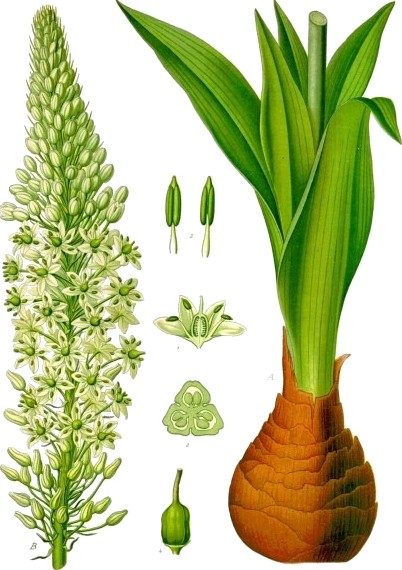
Squill
Scilla
- Known today as
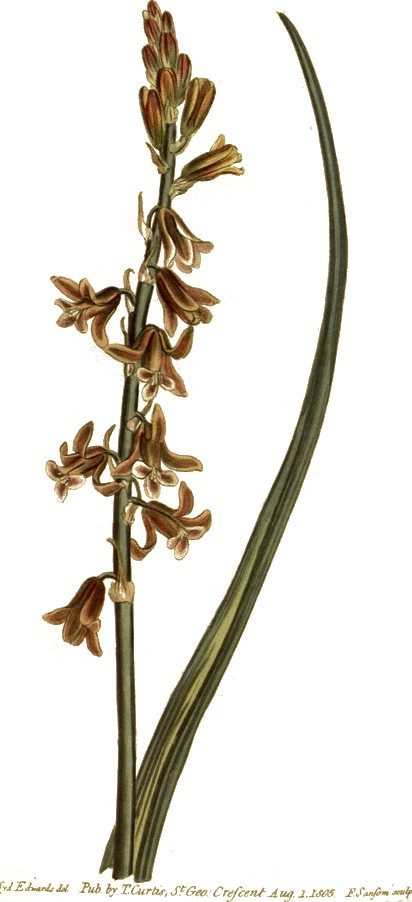
- Sea squill, Drimia maritima and its close relatives, large bulbs of the Mediterranean coasts.
- Kind
- Plant, in 1 older authority
- Constituents
- proscillaridin A, scillaren A
- Poisoning
- Cardiac glycoside poisoning
- Earliest authority here
- Dioscorides (c. AD 40–90)
- In other databases
- Plants of the World Online search · GBIF search · Wikidata search
- In the Canale glossary
- On the Manner of Discerning and Healing the Bewitched, Appendix A: Part Three, Chapter 5: Vomitory Medicines
Squill: what did Canale use it for?
As oxymel in vomits; placed above the door, so that the inhabitants “cannot be bewitched” (chs. 5, 10).
Squill: what does modern science say?
An emetic in large doses and an expectorant; its cardiac glycosides made it a heart drug, and it was later a rat poison. Hanging a squill over the door is an ancient custom: Pliny, citing Pythagoras, says it shuts out evil spells. It has no protective effect.
Pharmacognosy & Toxicology
- Constituents
- Mechanism
- The bufadienolide glycosides act on the heart as digitalis does, and were used for heart failure into the 1960s; the red squill’s scilliroside is a rat poison that rats, which cannot vomit, cannot survive.
- Checked against ChEMBL
- proscillaridin A: No measurement in ChEMBL for “act on the heart as digitalis does” (370 activities recorded, none against the target named); the line rests on its references.
- Toxic dose
- As the digitalis glycosides; a few grams of the bulb.
- Syndrome
- Cardiac glycoside poisoning
- Standing
- Proscillaridin survived as a drug in Germany until recently; squill remains in a few cough mixtures at small doses.
- Nelson, L. S., et al. (2007). Handbook of Poisonous and Injurious Plants. Verified against its record · doi:10.1007/978-1-4939-8926-3
Constituent names open the compound’s record at PubChem, and “ChEMBL” beside a name opens its record at ChEMBL, the European Bioinformatics Institute’s database of bioactive molecules. Where a mechanism line was checked against ChEMBL (ChEMBL 37, read 1 October 2026), the check is shown with the measured value and its source paper, or says plainly that nothing has been measured. Doses are as the references give them, for description only; this is not medical advice. Each source carries the result of its check against Crossref, PubMed, or the authority’s page: see Verification.
Squill: what lore surrounds it?
Hung above the door against enchantment, as Canale also directs: the bulb was believed to keep harm from the threshold.
Used in These Compounds
Squill is an ingredient of 2 compound medicines in the database. For Club members. Create a free account or sign in.
Squill: what did the older authorities say?
- Dioscorides
- Describes squill vinegar and squill wine, and the roasting of the bulb.
Sources
- [14] Bozorgi, M., Amin, G., Shekarchi, M., & Rahimi, R. (2017). Traditional medical uses of Drimia species in terms of phytochemistry, pharmacology and toxicology. Journal of Traditional Chinese Medicine 37(1): 124–139. doi:10.1016/S0254-6272(17)30036-5 Verified against its record · doi:10.1016/s0254-6272(17)30036-5
- [16] The British Pharmaceutical Codex (1911). London: Pharmaceutical Society of Great Britain. Monographs as transcribed at Henriette’s Herbal Homepage, henriettes-herb.com. Read in full · the text read
- [98] Pliny the Elder. The Natural History. Trans. J. Bostock and H. T. Riley. London, 1855. Perseus Digital Library, Tufts University. Cited by book and chapter. Primary text
Verification
- Checked
- October 1, 2026
- Passes
- Every sentence read against its sources, in the fifty-entry sample
- The Standing line checked against the authority it names (EMA, WHO, FDA, CITES, Commission E)
- Every dated or regulatory claim checked by category across the database
- The mechanism read against ChEMBL (ChEMBL 37): curated mechanisms and measured activity
- Sources
- 4 cited: 1 read in full, 2 verified against its record, 1 primary text.
- Corrections
- None were needed.
What was checked, how, and what was found is set out on the Verification page. A checked source is one whose record was found; it does not make the entry medical advice.
Cite This Entry
Version 1 · first published September 25, 2026
- Chicago
“Squill.” In Materia Medica, edited by B. C. P. Statema. Version 1. The Thinking Press, 2026–. Last modified September 25, 2026. https://thethinkingpress.org/materia-medica/squill.
- MLA
“Squill.” Materia Medica, edited by B. C. P. Statema, version 1, The Thinking Press, 25 Sept. 2026, thethinkingpress.org/materia-medica/squill. Accessed 8 Oct. 2026.
- APA
Squill. (2026, September 25). In B. C. P. Statema (Ed.), Materia medica (Version 1). The Thinking Press. Retrieved October 8, 2026, from https://thethinkingpress.org/materia-medica/squill
Club members keep entries on a shelf with private notes, print the plates as cards, and receive an entry by email each week. Create a free account before January 1, 2027 and all of it is yours for good. About the Club
See Also
Poisoned alike: cardiac glycoside poisoning
Toad · Oxymel, and oxymel of squill · Yew · Foxglove · Black hellebore · the syndrome, with all of them →
Also in Dioscorides
St. John’s wort in Dioscorides · Southernwood in Dioscorides · Valerian in Dioscorides · Sorrel, syrup of in Dioscorides · everything Dioscorides names →
Drawing on the same sources: Nelson
Nearby in the alphabet
St. Agatha’s bread (the feast of St) · Spirit of wine (Distilled alcohol) · St. Benedict medal (A medal of St) · Spikenard (a Himalayan valerian) · St. Blaise candles (crossed and held at the throat on 3 February, the feast of St) · Spermaceti (A white wax from the head of the sperm whale) · St. Christopher medal (An image of St) · Speedwell (Veronica chamaedrys and its relatives)
Historical description, not medical advice.