
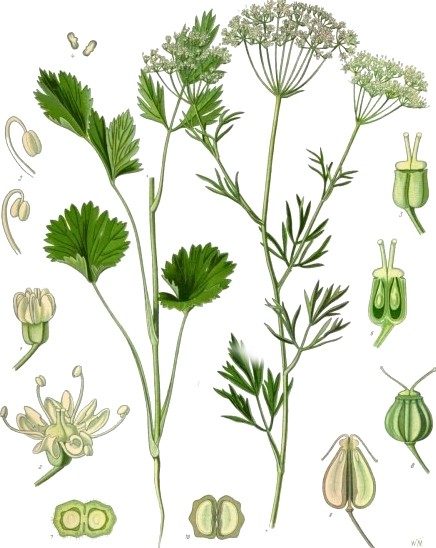
Aniseed
Anisi
- Known today as
- Pimpinella anisum.
- Kind
- Plant, in 1 older authority
- Constituents
- trans-anethole, estragole, anisaldehyde
- Earliest authority here
- Pliny (AD 23/24–79)
- Qualities
- Hot and dry (Galenic tradition). What the degrees mean
- In other databases
- Plants of the World Online search · GBIF search · Wikidata search
- In the Canale glossary
- On the Manner of Discerning and Healing the Bewitched, Appendix A: Treatise One, Part Three, Chapters 2–3: Purgative and Preparative Medicines
Revised October 1, 2026: An older authority added from a text read in full. Version 1, first published September 25, 2026.
Aniseed: what did Canale use it for?
Added to purges and hellebore infusions (chs. 2, 4–6).
Aniseed: how is it taken as a tea?
Half a pint of boiling water on two teaspoonfuls of bruised seed, for the catarrh of infants.
All the herbal teas of the database. Historical directions, not medical advice.
Aniseed: what does modern science say?
Anise is still accepted as a traditional remedy for wind and bloating, which is exactly why it was added to harsh purgatives.
Pharmacognosy & Toxicology
- Constituents
- trans-anethole ChEMBL80–95 per cent of the oil
- estragole ChEMBLa minor component, genotoxic in rodents
- anisaldehyde ChEMBL
- Mechanism
- Anethole relaxes gut smooth muscle and is mildly expectorant and antimicrobial; the oil has oestrogenic activity in animals, through anethole’s polymers.
- Toxic dose
- The oil at 1–5 ml has caused vomiting, seizures, and pulmonary oedema; the seed is safe in food and tea amounts; estragole limits the oil in children.
- Standing
- EMA monographs (2014) for the fruit and the oil for dyspepsia, wind, and as an expectorant; the oil is not for children under twelve.
- EMA/HMPC (2014). Community herbal monograph on Pimpinella anisum L., fructus (EMA/HMPC/321184/2012). Verified against its record
- Shojaii, A., and Abdollahi Fard, M. (2012). “Review of pharmacological properties and chemical constituents of Pimpinella anisum.” ISRN Pharmaceutics. Verified against its record · doi:10.5402/2012/510795
The abstract of each source, beneath its citation. For Club members. About the Club or sign in.
Constituent names open the compound’s record at PubChem, and “ChEMBL” beside a name opens its record at ChEMBL, the European Bioinformatics Institute’s database of bioactive molecules. Where a mechanism line was checked against ChEMBL (ChEMBL 37, read 1 October 2026), the check is shown with the measured value and its source paper, or says plainly that nothing has been measured. Doses are as the references give them, for description only; this is not medical advice. Each source carries the result of its check against Crossref, PubMed, or the authority’s page: see Verification.
Aniseed: what lore surrounds it?
Anise has been cultivated in Egypt for some four thousand years. Pliny recommended it to aid sleep and, mixed with wine, against the bite of the asp. In a modern afterlife, British steam-locomotive builders of the nineteenth and twentieth centuries packed capsules of aniseed oil into white-metal bearings, so that the smell, released when a capsule burst in the heat, would warn engineers of overheating before the bearing failed.
Used in These Compounds
Aniseed is an ingredient of 1 compound medicine in the database. For Club members. Create a free account or sign in.
Aniseed: what did the older authorities say?
- Pliny
- Counts anise among the garden plants of which “there is but a single kind, these plants being the same everywhere, and no better in one place than in another”; it comes up on the fourth day after sowing, and its seed, like that of parsley, coriander, fennel, and cumin, “has no covering at all.”
Sources
- [28] Culpeper, N. (1653). Pharmacopœia Londinensis, or, The London Dispensatory [the Royal College of Physicians’ pharmacopoeia in English, with Culpeper’s commentary]. London: Peter Cole. Text Creation Partnership edition A35381. Read in part · the text read
- [41] European Medicines Agency, Committee on Herbal Medicinal Products (HMPC). Herbal monographs, assessment reports and public statements, ema.europa.eu, cited under the herb concerned: aniseed (summary, EMA/305345/2016); Aristolochia (public statement, EMEA/HMPC/138381/2005); asarone (public statement, EMEA/HMPC/139215/2005); caraway (EMA/HMPC/715092/2013); centaury (EMA/HMPC/277493/2015); chicory root (assessment report, EMA/HMPC/113041/2010); cinnamon (EMA/HMPC/246774/2009); clove (assessment report, EMA/HMPC/534946/2010); ethanol in herbal products (reflection paper, EMA/HMPC/85114/2008); fennel (EMEA/HMPC/372839/2016, Rev. 1, 2024); fumitory (draft assessment report, EMA/HMPC/367013/2021); greater celandine (public statement, EMA/HMPC/743927/2010); hops (EMA/HMPC/682384/2013); horehound (EMA/HMPC/604271/2012); mallow (assessment report, EMA/HMPC/749518/2016); marshmallow root (Althaeae radix); melissa (summary, EMA/HMPC/310761/2013); myrrh (assessment report and monograph, EMA/HMPC/96910/2010 and 96911/2010); peppermint oil (assessment report, EMEA/HMPC/349465/2006); pyrrolizidine alkaloids (public statement, EMA/HMPC/893108/2011); rhubarb (EMA/HMPC/113700/2019); sage (Salviae officinalis folium); wormwood (EMA/HMPC/751490/2016). Read in full · the text read
- Hortus Medicus, on anise. Book, seen in reviews
- Crystal Vaults, on anise. Book, not indexed
- Grieve, M. A Modern Herbal, “Anise.” As published on botanical.com.
- Pliny the Elder, Natural History 19.35–37, trans. J. Bostock & H. T. Riley (1855), Perseus Digital Library. Primary text
Verification
- Checked
- October 1, 2026
- Passes
- Every sentence read against its sources, in the pass over the remaining 343 entries
- The Standing line checked against the authority it names (EMA, WHO, FDA, CITES, Commission E)
- Every dated or regulatory claim checked by category across the database
- Each quotation from the older authorities checked word for word against the text, read in full
- Sources
- 8 cited: 1 read in full, 1 read in part, 2 verified against its record, 1 primary text, 1 book, seen in reviews, 1 book, not indexed, 1 not yet checked. 1 with the abstract on file.
- Corrections
- None were needed.
What was checked, how, and what was found is set out on the Verification page. A checked source is one whose record was found; it does not make the entry medical advice.
Cite This Entry
Version 1 · first published September 25, 2026 · last revised October 1, 2026
- Chicago
“Aniseed.” In Materia Medica, edited by B. C. P. Statema. Version 1. The Thinking Press, 2026–. Last modified October 1, 2026. https://thethinkingpress.org/materia-medica/aniseed.
- MLA
“Aniseed.” Materia Medica, edited by B. C. P. Statema, version 1, The Thinking Press, 1 Oct. 2026, thethinkingpress.org/materia-medica/aniseed. Accessed 8 Oct. 2026.
- APA
Aniseed. (2026, October 1). In B. C. P. Statema (Ed.), Materia medica (Version 1). The Thinking Press. Retrieved October 8, 2026, from https://thethinkingpress.org/materia-medica/aniseed
Club members keep entries on a shelf with private notes, print the plates as cards, and receive an entry by email each week. Create a free account before January 1, 2027 and all of it is yours for good. About the Club
See Also
Sharing trans-anethole, estragole
Also in Pliny the Elder
Armenian stone, pills of in Pliny the Elder · Amber in Pliny the Elder · Arthritica in Pliny the Elder · Alum in Pliny the Elder · everything Pliny the Elder names →
Drawing on the same sources: Grieve
Of the same qualities: hot and dry
Asafoetida · Wormwood, oil of · Balm · Thyme · Betony · Theriac · what the degrees mean →
Nearby in the alphabet
Antimony (The metallic element and its compounds) · Angel’s wings (fan-shaped fungus that rots conifer wood) · The amulet herbs (See each above) · Armenian bole (colored by iron oxide) · Ambergris (A waxy substance formed in the gut of the sperm whale)
Historical description, not medical advice.