
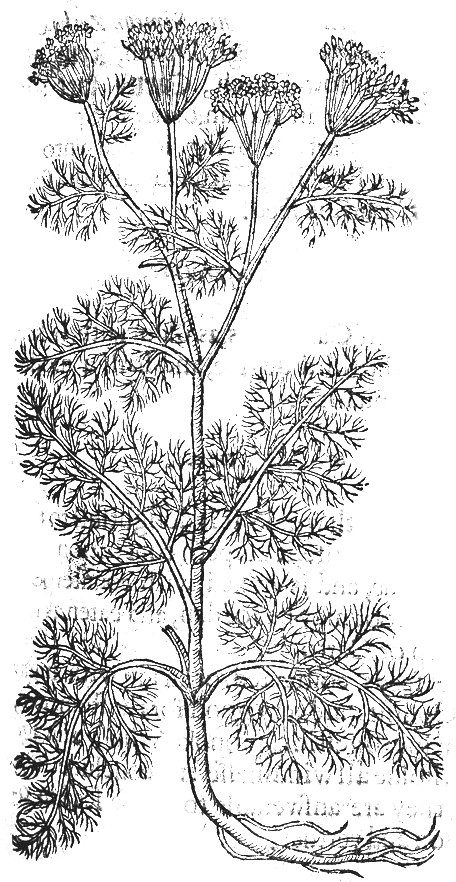
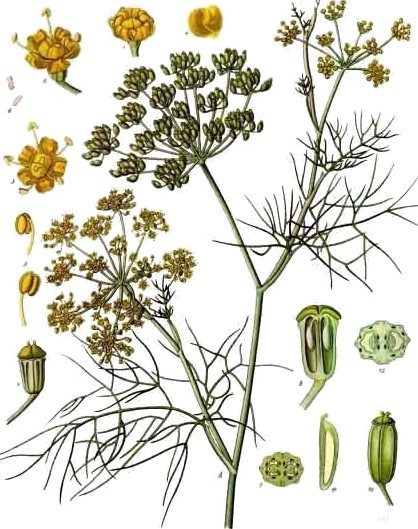
Dill
Aneto
- Known today as
- Anethum graveolens.
- Kind
- Plant, in 1 older authority
- Constituents
- carvone, limonene, dillapiole, and 1 more
- Earliest authority here
- Matthew 23:23 (the Hebrew Bible and the New Testament)
- In other databases
- Plants of the World Online search · GBIF search · Wikidata search
- In the Canale glossary
- On the Manner of Discerning and Healing the Bewitched, Appendix A: Part Three, Chapter 5: Vomitory Medicines
Revised October 1, 2026: Lore added from texts read in full. Version 1, first published September 25, 2026.
Dill: what did Canale use it for?
A decoction of dill with almond oil and rancid butter as a gentle vomit; its flowers and seeds likewise; in baths for cold complexions; blessed, in the oil of Treatise Two (chs. 5, 7, 9).
Dill: what does modern science say?
Dill is a carminative.
Pharmacognosy & Toxicology
- Constituents
- carvone ChEMBL40–60 per cent of the fruit oil
- limonene ChEMBL
- dillapiole ChEMBLin the fruit
- alpha-phellandrene ChEMBLin the leaf
- Mechanism
- Carvone relaxes gut smooth muscle, which is the carminative of gripe water; the oil is mildly antibacterial. Dill with rancid butter vomits by the butter, not the dill.
- Toxic dose
- Safe in food amounts; dillapiole is related to the hepatotoxic apiole of parsley and limits the oil.
- Standing
- The fruit is in the German tradition (Commission E) for dyspepsia; gripe water held dill oil until the twentieth century.
- Blumenthal, M., ed. (1998). The Complete German Commission E Monographs, “Dill seed.” Standard reference work
- Jana, S., and Shekhawat, G. S. (2010). “Anethum graveolens: an Indian traditional medicinal herb and spice.” Pharmacognosy Reviews 4. Verified against its record · doi:10.3923/rjmp.2010.206.212
The abstract of each source, beneath its citation. For Club members. About the Club or sign in.
Constituent names open the compound’s record at PubChem, and “ChEMBL” beside a name opens its record at ChEMBL, the European Bioinformatics Institute’s database of bioactive molecules. Where a mechanism line was checked against ChEMBL (ChEMBL 37, read 1 October 2026), the check is shown with the measured value and its source paper, or says plainly that nothing has been measured. Doses are as the references give them, for description only; this is not medical advice. Each source carries the result of its check against Crossref, PubMed, or the authority’s page: see Verification.
Dill: what lore surrounds it?
Folkard has the name “by some supposed to have derived its name from the old Norse word dilla, dull; the seeds being used as a carminative to cause infants to sleep.” Boiled in wine and drunk “the plant was reputed to excite the passions,” and it “was formerly highly appreciated as a plant that counteracted the powers of witches and sorcerers,” with the rhyme “The Vervain and the Dill, That hindereth witches of their will.” Astrologers assigned it to Mercury.
Thiselton-Dyer confirms that “dill and flax were worn as talismans against sorcery.”
Dill: what did the older authorities say?
- Matthew 23:23
- The Pharisees tithe “mint and anise and cummin”; the Greek anethon is dill.
Sources
- [16] The British Pharmaceutical Codex (1911). London: Pharmaceutical Society of Great Britain. Monographs as transcribed at Henriette’s Herbal Homepage, henriettes-herb.com. Read in full · the text read
- Folkard, R. (1884). Plant Lore, Legends, and Lyrics, “Dill.” Project Gutenberg #44638. Primary text
- Thiselton-Dyer, T. F. (1889). The Folk-lore of Plants. Project Gutenberg #10118. Read in part · the text read
Verification
- Checked
- October 1, 2026
- Passes
- Every sentence read against its sources, in the pass over the remaining 343 entries
- The Standing line checked against the authority it names (EMA, WHO, FDA, CITES, Commission E)
- Every dated or regulatory claim checked by category across the database
- Each quotation from the older authorities checked word for word against the text, read in full
- Sources
- 5 cited: 1 read in full, 1 read in part, 1 verified against its record, 1 primary text, 1 standard reference work. 1 with the abstract on file.
- Corrections
- None were needed.
What was checked, how, and what was found is set out on the Verification page. A checked source is one whose record was found; it does not make the entry medical advice.
Cite This Entry
Version 1 · first published September 25, 2026 · last revised October 1, 2026
- Chicago
“Dill.” In Materia Medica, edited by B. C. P. Statema. Version 1. The Thinking Press, 2026–. Last modified October 1, 2026. https://thethinkingpress.org/materia-medica/dill.
- MLA
“Dill.” Materia Medica, edited by B. C. P. Statema, version 1, The Thinking Press, 1 Oct. 2026, thethinkingpress.org/materia-medica/dill. Accessed 8 Oct. 2026.
- APA
Dill. (2026, October 1). In B. C. P. Statema (Ed.), Materia medica (Version 1). The Thinking Press. Retrieved October 8, 2026, from https://thethinkingpress.org/materia-medica/dill
Club members keep entries on a shelf with private notes, print the plates as cards, and receive an entry by email each week. Create a free account before January 1, 2027 and all of it is yours for good. About the Club
See Also
Sharing carvone, limonene
Blessed herbs · Carum carvi · Citrus medica · Elettaria cardamomum
Also in Scripture
Frankincense in Scripture · Cumin in Scripture · Galbanum in Scripture · Wormwood, oil of in Scripture · everything Scripture names →
Drawing on the same sources: Folkard, Thiselton-Dyer, Blumenthal
Dittany · Cyclamen, greater · Elecampane · Endive · Galangal · Coriander · Masterwort and angelica · the bibliography →
Nearby in the alphabet
Diatrion piperion (with aniseed and ginger) · Dover’s powder (with salts, in a powder) · Diascordium (cinnamon, bole, and other drugs) · Dragon’s blood · Diaphenicon (with turpeth, scammony, and spices) · Eagle-stone (A hollow nodule of iron oxide with a loose stone rattling inside) · Diamoschu, sweet (aloeswood, coral, pearls, and spices)
Historical description, not medical advice.