
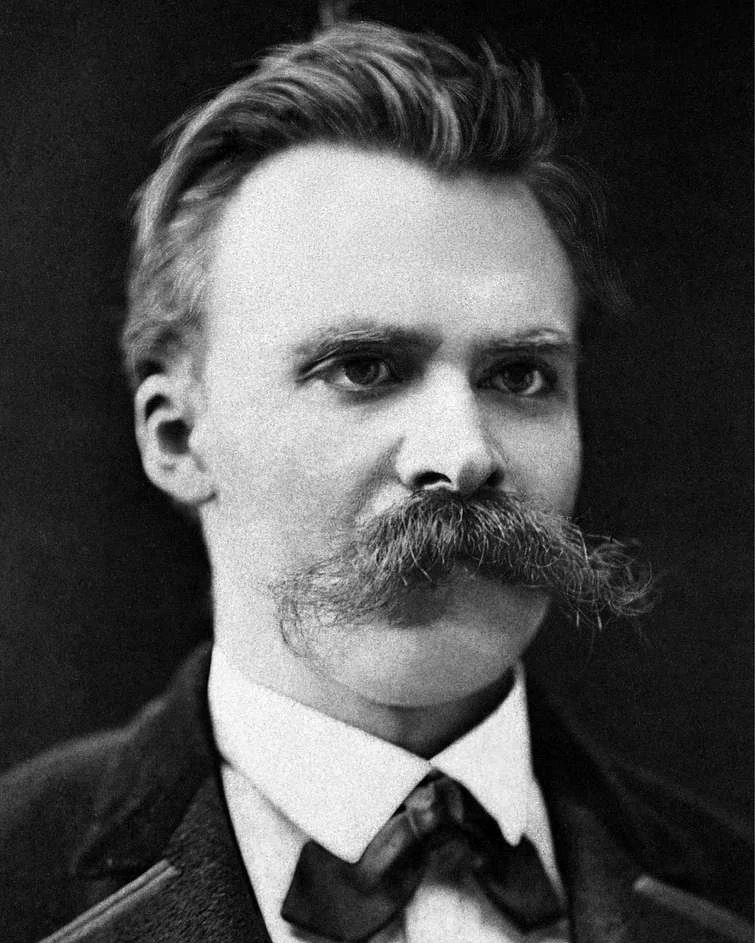
Friedrich Nietzsche
The philosopher who named the loss of values, whose eagle flies above the press’s flask, and whose question every title on the list keeps asking in its own tongue.
“One must still have chaos in one, to give birth to a dancing star.”
Thus Spake Zarathustra, Prologue, trans. Thomas Common
Why Nietzsche
Nietzsche stands here for the loss of values. He saw, earlier and more clearly than anyone, that the highest values of a civilization were emptying themselves out, and that what would follow was not freedom but nihilism, unless something could be willed in their place.
That loss is the ground the press builds on. Every title on the list begins, in one way or another, after the easy answers are gone, and asks what can still be chosen as good. Nietzsche named the catastrophe; the press’s books are its attempt to answer it.
- The Birth of Tragedy (1872)
- Untimely Meditations (1873–76)
- Human, All Too Human (1878)
- Daybreak (1881)
- The Gay Science (1882; expanded 1887)
- Thus Spake Zarathustra (1883–85)
- Beyond Good and Evil (1886)
- On the Genealogy of Morals (1887)
- Twilight of the Idols (1889)
- Ecce Homo (written 1888; published 1908)
The Life
A Pastor’s Son in Röcken
Friedrich Wilhelm Nietzsche was born on 15 October 1844 in Röcken, a village near Lützen in Prussian Saxony, and named for King Friedrich Wilhelm IV, on whose birthday he was born. His father, Carl Ludwig Nietzsche, was the Lutheran pastor of the village, as his father had been before him. In 1849 his father died of a brain ailment, and months later his younger brother died too.
The family moved to Naumburg, where the boy grew up among women, his mother Franziska, his sister Elisabeth, a grandmother and two aunts, and from 1858 to 1864 he studied at Schulpforta, the most rigorous classical school in Germany, where he learned the discipline of the ancient languages and began to write music and verse.
Philology, Schopenhauer, and Wagner
He began at Bonn in theology and classical philology, then followed his teacher Friedrich Ritschl to Leipzig, and abandoned theology for good. In 1865 he found Schopenhauer’s The World as Will and Representation in a Leipzig bookshop and read it as a revelation; in 1868 he met Richard Wagner, and a friendship began that would shape his early life.
In 1869, at only twenty-four and before he had completed his doctorate, he was appointed professor of classical philology at the University of Basel on Ritschl’s recommendation. He served as a medical orderly in the Franco-Prussian War of 1870, fell gravely ill, and returned to Basel and to the Wagners at Tribschen. His first book, The Birth of Tragedy (1872), read Greek tragedy as the marriage of two drives, the Apollonian and the Dionysian, and scandalized his fellow philologists.
The Break, and the Wandering Years
The first Bayreuth Festival of 1876 disillusioned him, and Human, All Too Human (1878) marked his break with Wagner and with his own romantic youth. Migraines, failing eyes, and stomach illness forced him to resign his chair in 1879, and he lived from then on on a modest pension, a wanderer without home or post.
For a decade he moved with the seasons: summers at Sils-Maria in the high Engadine, winters in Genoa, Nice, Rapallo, and at last Turin, writing in rented rooms. In 1882 he met Lou Salomé and hoped briefly for a companion of mind; the hope ended in grief. In those solitary years he wrote Daybreak (1881), The Gay Science (1882), and the book he considered his greatest gift to mankind, Thus Spake Zarathustra.
Zarathustra, and the Last Books
Thus Spake Zarathustra appeared in parts between 1883 and 1885, a prophetic book in the voice of a sage who comes down from his mountain to teach the overman. Beyond Good and Evil followed in 1886, and Nietzsche asked Jacob Burckhardt to read it, though it said the same things as his Zarathustra, only differently, very differently. On the Genealogy of Morals came in 1887.
In 1888, his last year of work, he wrote at astonishing speed: The Case of Wagner, Twilight of the Idols, The Antichrist, and his strange autobiography, Ecce Homo. He was beginning, at last, to be read.
Turin, and the Long Silence
On 3 January 1889 Nietzsche collapsed in Turin; the story told ever since is that he threw his arms around the neck of a horse being beaten in the street. In the days that followed he sent out letters signed “Dionysus” and “The Crucified,” and he was brought back to Germany, to asylums in Basel and Jena, and then into the care of his mother in Naumburg. He never recovered his mind.
After his mother’s death his sister Elisabeth took him to Weimar, where he died on 25 August 1900, and he was buried in the churchyard at Röcken beside his father. Elisabeth founded the Nietzsche Archive and assembled The Will to Power from his notebooks, bending his legacy toward the nationalism and antisemitism he himself had scorned, a distortion scholars would spend the next century undoing.
Zarathustra’s Eagle
At the close of the Prologue to Thus Spake Zarathustra, an eagle sweeps through the air in wide circles with a serpent coiled about its neck, not as prey but as a friend: Zarathustra’s two animals, the proudest and the wisest beneath the sun.
The press’s emblem carries that eagle above its flask, a mark of the vantage it tries to write from, and the crest that guides readers through the will toward the good is the eagle with its serpent. Pride of height, and the wisdom that stays close to the ground: the press would like to keep both.
The Thought
The core of Nietzsche’s philosophy, and where each idea lives in the press’s own books.
Not a boast but a diagnosis: the faith that had held a civilization’s values together had died, and the consequences had not yet arrived.
The condition in which the highest values devalue themselves, and nothing seems worth anything at all, unless new values are won.
The task left to the living: to test every inherited value, and to create values that can stand without borrowed authority.
The drive in all life to grow, to overcome, and to give form, deeper than the mere wish to survive or to be comfortable.
Zarathustra’s image of the human being who has overcome the old values and creates new ones: a goal set beyond the present man.
The heaviest thought: could you will this very life to return, again and again, without end? Only a life worth repeating is fully affirmed.
The spirit becomes a camel bearing inherited burdens, then a lion that says “I will” against “Thou shalt,” and at last a child: a new beginning, a sacred Yes.
The two drives of Greek tragedy: the Apollonian gift of form, measure, and clarity, and the Dionysian torrent of life, ecstasy, and dissolution.
Within the Press
Nietzsche in the Press’s Books
An History Beside Time speaks to Nietzsche’s reader directly: “If thou hast walked with Zarathustra through mountains of questioning, thou wilt not find thyself altogether in the unfamiliar; yet this work seeketh a different end than intoxication. It seeketh order.” The book borrows Zarathustra’s prophetic voice, its numbered, scriptural cadence, and turns it from the overthrow of old values to the building of an inner order that can hold.
The Wisdom of Catastrophe begins where Nietzsche leaves the modern reader: in the condition he named nihilism. Its reading of decadence is Nietzsche’s: a spirit that can no longer create values, still bowed beneath the old commands, and filling the silence with resentment and distraction. And its guiding idea is that nihilism, faced rather than fled, can become a passage rather than an ending: that meaning, once lost, can return.
The Sibling Masterworks
Nietzsche’s remark that Beyond Good and Evil said the same things as his Zarathustra, only differently, is the whole reasoning behind the Nietzsche Set: Zarathustra in Thomas Common’s translation, Beyond Good and Evil in that of Helen Zimmern, who had known Nietzsche at Sils-Maria, and a companion volume, On the Psychology of Friedrich Nietzsche’s Sibling Masterworks, reading the two side by side.
Toward the Horizon of the Good
The press’s phrase, the will toward the good, stands deliberately beside Nietzsche’s will to power, and takes his challenge seriously. He showed that once inherited values collapse, no good can simply be assumed; it must be willed, created, and tested. The press accepts that verdict. It does not ask for a return to the old “Thou shalt”; it asks what a free spirit, having said “I will,” should will.
Its answer passes through Nietzsche’s own hardest thought. The eternal return asks whether you could will this act, this life, again and again forever. The will toward the good asks the same: whether a choice can still be called good now, in a week, in a year, and forever. A good that could not bear eternal repetition was only a convenience.
And where Nietzsche’s lion clears the ground with its “I will,” the third metamorphosis is the child, a new beginning and a sacred Yes. The press reads the will toward the good as that Yes: not a return to what was lost, but a value created and chosen, strong enough to be willed forever, and wide enough to answer to the self, the family, the nation, and the world.