
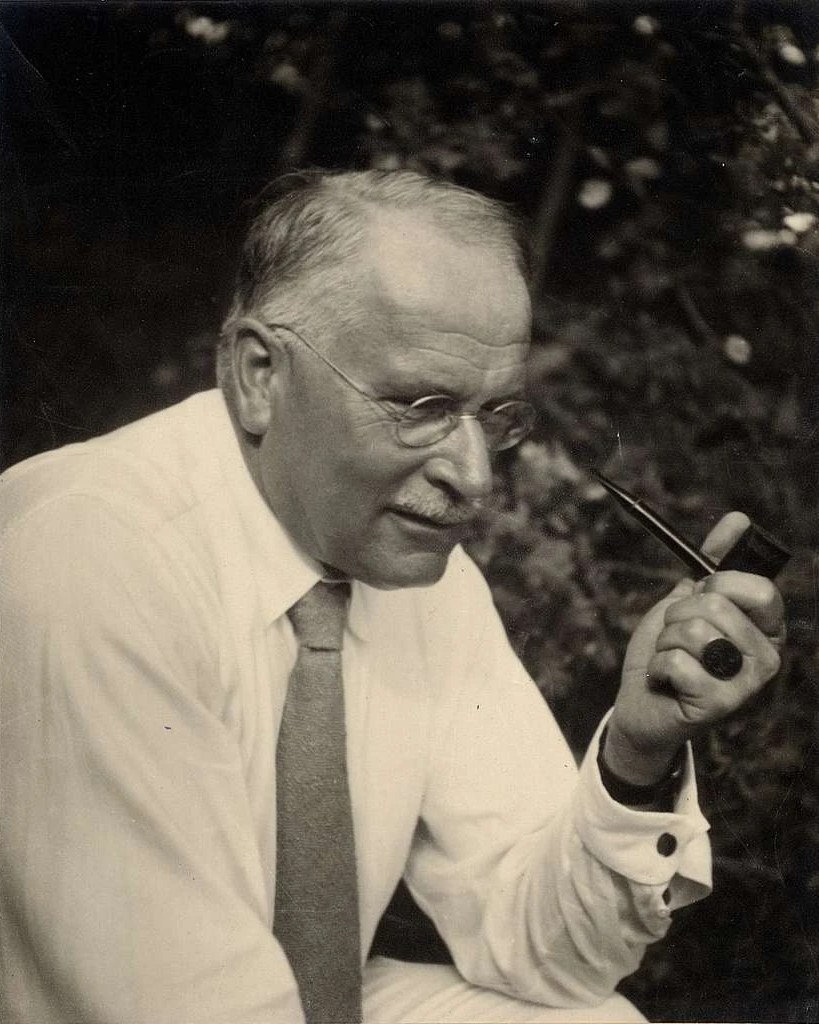
C. G. Jung
The Swiss psychiatrist whose discoveries the press holds to be simply true: the shadow, the archetype, and the long, unfinished work of becoming whole.
“One does not become enlightened by imagining figures of light, but by making the darkness conscious.”
C. G. Jung, Alchemical Studies
Why Jung
The press returns to Jung for one reason above all others: what he found was true. The shadow, the archetype, the collective unconscious, the long work of individuation were not theories laid over the psyche from outside, but structures he discovered in it, patiently, in his patients, in himself, and in the myths and dreams of every age. They have held.
That is why his language runs through this list more than anyone’s. Where the press speaks of the inner life, it is usually speaking Jung’s tongue, because it has found no truer one.
- Symbols of Transformation (1911–12)
- Psychological Types (1921)
- The Archetypes and the Collective Unconscious
- Psychology and Alchemy (1944)
- Aion (1951)
- Answer to Job (1952)
- Mysterium Coniunctionis (1955–56)
- Memories, Dreams, Reflections (1962)
- The Red Book (published 2009)
The Life
A Pastor’s Son on Lake Constance
Carl Gustav Jung was born on 26 July 1875 in Kesswil, a village on the Swiss shore of Lake Constance, the son of Paul Achilles Jung, a pastor of the Swiss Reformed Church, and Emilie Preiswerk, whose Basel family had long been drawn to the uncanny. The family soon moved to Laufen, by the Rhine Falls, and then to Klein-Hüningen near Basel, where Jung grew up a solitary child among the questions of a faith his father could no longer fully hold.
Late in life he described having felt, even as a boy, that he was two people: the schoolboy of his own time, and another, older and timeless, who belonged to the centuries. That second personality, and the sense of a deeper self standing behind the everyday one, became the subject of his life’s work.
Medicine, and the Burghölzli
Jung studied medicine at the University of Basel from 1895 and chose psychiatry, then a neglected field, because it was the one place where the study of nature and the study of the spirit met. His doctoral dissertation of 1902 examined the séances of a young medium in his own mother’s family, and asked what the psyche was doing when it spoke in voices not its own.
In 1900 he joined the Burghölzli, the psychiatric clinic of the University of Zurich, under Eugen Bleuler. There his word-association experiments showed that hesitations and slips clustered around charged, hidden themes, which he called feeling-toned complexes: fragments of the psyche that behave almost like independent beings. In 1903 he married Emma Rauschenbach, who would become an analyst and scholar in her own right.
Freud, and the Break
Jung’s findings confirmed much of what Sigmund Freud had been arguing in Vienna, and in 1907 the two men met for the first time and are said to have talked for thirteen hours without pause. For six years Jung was Freud’s closest ally and chosen heir; they lectured together in America in 1909, and in 1910 Jung became the first president of the International Psychoanalytical Association.
The break came with Wandlungen und Symbole der Libido (1911–12), later Symbols of Transformation, in which Jung read the psyche’s energy as something wider than sexuality, and myth as a living language of the soul rather than a disguise. By 1913 the friendship was over, and in 1914 Jung resigned the presidency.
The Confrontation with the Unconscious
What followed was the most dangerous period of his life. In the autumn of 1913 Jung was overwhelmed by visions of a flood of blood covering Europe, months before the war began, and he chose to go down into the images rather than away from them. Night after night he recorded his fantasies and conversations with inner figures, and gave them form in the calligraphed and painted pages of the Red Book, which he kept for some sixteen years and which was published only in 2009.
He later said that all his subsequent work grew out of those years. They were the proof, in his own person, of what he would teach: that the unconscious is not a cellar of refuse but a living realm, and that a person who meets it consciously, without being swallowed by it, comes back more whole.
The Tower, the Journeys, and the Alchemists
Psychological Types (1921) set out his distinction of introversion and extraversion and the four functions of thinking, feeling, sensation, and intuition. From 1923 he built, stone by stone, a tower at Bollingen on the upper shore of Lake Zurich, a retreat without electricity where he could live closer to the timeless personality he had known as a boy. He traveled to the Pueblo of Taos in New Mexico, to East Africa, and to India, looking for the psyche beneath the surfaces of other civilizations.
From the late 1920s he turned to alchemy, and found in its old treatises a record of the same transformation he had witnessed in his patients and himself. Psychology and Alchemy (1944), Aion (1951), Answer to Job (1952), and Mysterium Coniunctionis (1955–56) are the harvest of that search. He died at his home in Küsnacht on 6 June 1961, having dictated the memoir published the next year as Memories, Dreams, Reflections.
Jung and Nietzsche
Jung studied at Basel, the university where Nietzsche had taught a generation before, and read Thus Spake Zarathustra as a young man with fascination and unease. From 1934 to 1939 he gave a seminar in Zurich on the book, later published as Nietzsche’s Zarathustra, reading it as a document of a psyche under enormous pressure, a man seized by the archetype he was trying to describe.
That meeting of the two is the crossing where The Wisdom of Catastrophe stands: Jung’s map of the inner life laid over Nietzsche’s diagnosis of a world whose old values have given way.
The Thought
The core of Jung’s philosophy, and where each idea lives in the press’s own books.
The face worn for the world: a necessary adaptation to society, and a danger only when a person mistakes the mask for the face.
The center of consciousness, the “I” that narrates and steers, yet only one complex among many, and never the whole of the psyche.
All that a person refuses to recognize in themselves. Unintegrated, it is projected onto others; made conscious, it returns as strength.
The contrasexual figure within, the bridge between the conscious personality and the unconscious, and a chief carrier of projection.
The ordering center of the whole psyche, conscious and unconscious together, the totality toward which a life can grow.
The lifelong process of becoming the whole person one already is in potential, as the oak is already present in the acorn.
A deeper layer shared by all people, whose archetypes surface again and again in myth, religion, and dream, in every age.
The tendency of anything driven to an extreme to turn into its opposite, because the opposite was never absent, only denied.
Within the Press
Beside Time: Jung in An History Beside Time
An History Beside Time is built on Jung’s architecture, and says so in its closing appendix, which translates its own symbolic names into the terms of analytical psychology. The Mask is the persona; the Student is the ego, dangerous when it identifies with its best-developed function; the Institution, “the judge that speaketh without anger,” is the Self; the Witness is consciousness and the bridging function that holds opposites; and the Work, sealed with the command “Be whole,” is individuation.
Its first law is Jung’s enantiodromia, which the book names outright and calls not superstition but architecture: opposites do not merely war, they beget. Its seasons of the soul are the alchemical colors Jung recovered, the blackening, the whitening, and the reddening: “The first color of the work is black.” And its central claim is Jung’s own, spoken in the book’s cadence: “For the cosmos did not split that thou mightest remain divided. It split that the Whole might become conscious of itself in thee.”
The Shadow and the Catastrophe
The Wisdom of Catastrophe takes up Jung’s map of the psyche not as dogma but as orientation, a means of finding one’s way through the inner dark. Its central movements are Jungian: that what the ego refuses does not vanish but becomes autonomous; that the rejected shadow is projected onto an enemy or a scapegoat; and that catastrophe tears away the comfortable accounts the ego gives of itself, until the shadow must be faced.
In that light, nihilism is not only a loss but the failure of inherited meanings, through which the Self presses toward a more truthful life. To befriend the devil, in the treatise’s sense, is not to agree with him but to end one’s innocence of him: to know one’s own capacity for destruction well enough that it can no longer rule unseen.
Alchemy, Dreams, and the Translations
Jung’s reading of alchemy as an inner art is the lens through which the press presents The Magical World of the Heroes, Cesare della Riviera’s treatise addressed to the inward “Heroe,” whose furnace and vessel are figures for the transformation of the self.
His conviction that the dream speaks in images with an intelligence of its own is why the press restores Karl Albert Scherner’s image-making Soul to English. And his account of the complex as a splinter of the psyche that can seize the personality is the bridge by which a modern reader can enter the exorcists’ manuals of Series C, Menghi and Canale, the latter of which carries an appendix reading its text through analytical psychology.
Toward the Horizon of the Good
Jung is often mistaken for a thinker beyond good and evil. He was the opposite. He held that the integration of the shadow is a moral achievement, perhaps the hardest there is, and that a goodness which refuses to know its own darkness does not remain good: it projects its evil onto others and calls its hatred virtue.
That is the root of the will toward the good’s inward hand. Charity offered by someone who has not faced their own shadow is unsteady at its root; compassion without shadow-work curdles into performance. Individuation, rightly understood, is not a private luxury either, for Jung insisted that it deepens a person’s bond with others rather than severing it, and that answers to the good’s outward reach: to self, family, friends, nation, and world.
In An History Beside Time the Self becomes the Institution, and the will toward the Good becomes the axis around which the whole house turns: “For the Good is not a list of behaviors. It is the orientation of the whole house. It is the Whole seeking to be Whole in thee.” That sentence is Jung’s psychology arriving at its horizon.