
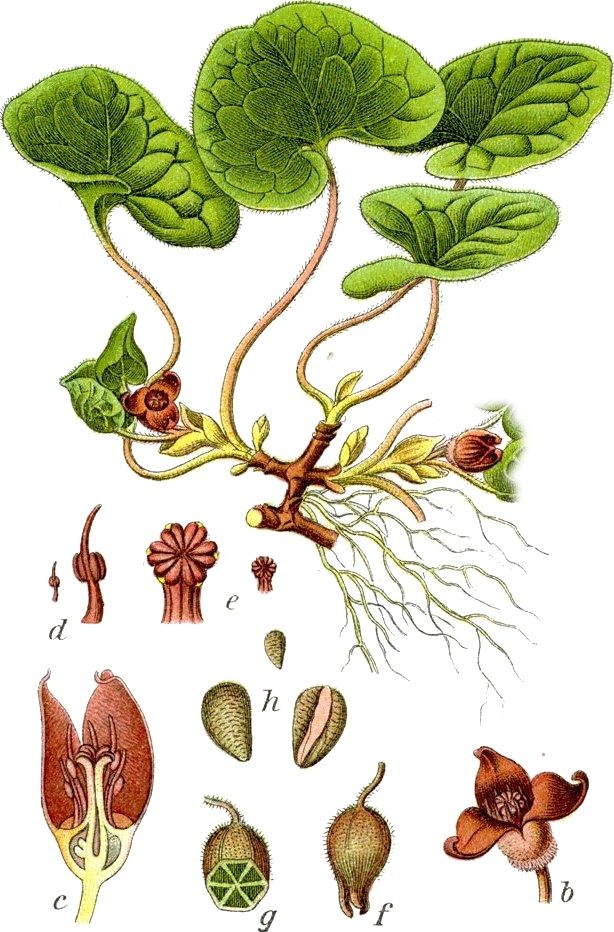
Asarabacca
Asaro
- Known today as
- Asarum europaeum, wild ginger of European woods.
- Kind
- Plant, in 2 older authorities
- Constituents
- asarone, aristolochic acid I, methyleugenol
- Poisoning
- Aristolochic acid nephropathy
- Earliest authority here
- Pliny (AD 23/24–79)
- In other databases
- Plants of the World Online search · GBIF search · Wikidata search
- In the Canale glossary
- On the Manner of Discerning and Healing the Bewitched, Appendix A: Part Three, Chapter 5: Vomitory Medicines
Revised October 1, 2026: An older authority added from a text read in full. Version 1, first published September 25, 2026.
Caution. Hazardous in some form or dose; see the modern assessment below.
Asarabacca: what did Canale use it for?
Leaves and root, steeped, as a moderately strong vomit (ch. 5).
Asarabacca: what does modern science say?
A genuine emetic. Like other members of its family it contains compounds related to aristolochic acid, which causes kidney failure and cancer, and regulators treat the genus with caution.
Asarabacca: is it poisonous?
Yes, in some form or dose. Its poisoning is aristolochic acid nephropathy: Months to years of exposure; the kidney damage is cumulative and silent. Historical description, not medical advice; in a poisoning, call a poison centre.
Pharmacognosy & Toxicology
- Constituents
- asarone ChEMBLalpha- and beta-, in the oil
- aristolochic acid I ChEMBLin the root, at low levels
- methyleugenol ChEMBL
- Mechanism
- The oil irritates the stomach and the vagal reflex empties it, which is the vomit Canale used; the sneezing powder works by the same irritation on the nose. Aristolochic acid, present in the European species, is the agent of a kidney scarring and urinary cancers, and asarone and methyleugenol are carcinogens in rodents.
- Toxic dose
- A few grams of the root vomit; the kidney and cancer risks are cumulative and have no safe dose.
- Syndrome
- Aristolochic acid nephropathy
- Standing
- Withdrawn from the German snuffs that carried it; the FDA lists Asarum among the aristolochic-acid plants to be avoided; no approved use.
- FDA (2001). Letter to industry on aristolochic acid, listing Asarum species. Standard reference work
- Schaneberg, B. T., and Khan, I. A. (2004). “Analysis of products suspected of containing Aristolochia or Asarum species.” Journal of Ethnopharmacology 94. Verified against its record · doi:10.1016/j.jep.2004.06.010
The abstract of each source, beneath its citation. For Club members. About the Club or sign in.
Constituent names open the compound’s record at PubChem, and “ChEMBL” beside a name opens its record at ChEMBL, the European Bioinformatics Institute’s database of bioactive molecules. Where a mechanism line was checked against ChEMBL (ChEMBL 37, read 1 October 2026), the check is shown with the measured value and its source paper, or says plainly that nothing has been measured. Doses are as the references give them, for description only; this is not medical advice. Each source carries the result of its check against Crossref, PubMed, or the authority’s page: see Verification.
Asarabacca: what lore surrounds it?
Its chief fame after antiquity was as a purgative snuff: dried and powdered, it was a standard ingredient of sneezing powders and headache snuffs into the eighteenth century, valued, and later restricted, for how violently it cleared the head.
Used in These Compounds
Asarabacca is an ingredient of 1 compound medicine in the database. For Club members. Create a free account or sign in.
Asarabacca: what did the older authorities say?
- Pliny
- Says asarum “has the properties of nard, and, indeed, by some persons is known as wild nard,” with a leaf like ivy but rounder and softer, a purple flower, and a seed like a grape, best from Pontus; it is good for the liver, an ounce in honied wine and water, “purges the bowels like hellebore,” and serves for dropsy and jaundice; mixed with must it makes a strongly diuretic wine; it is taken up as the leaves appear and dried in the shade, “apt however to turn mouldy.”
- Culpeper
- Puts it under Mars, “and therefore inimical to nature”: drunk, it provokes vomiting and purges downwards and by urine; the common use is the juice of five or seven leaves in a little drink to cause vomiting, the finer powder provoking vomits and the coarser purging downwards; and the roots, “very effectual against the biting of serpents,” go into mithridate and Venice treacle.
Sources
- [41] European Medicines Agency, Committee on Herbal Medicinal Products (HMPC). Herbal monographs, assessment reports and public statements, ema.europa.eu, cited under the herb concerned: aniseed (summary, EMA/305345/2016); Aristolochia (public statement, EMEA/HMPC/138381/2005); asarone (public statement, EMEA/HMPC/139215/2005); caraway (EMA/HMPC/715092/2013); centaury (EMA/HMPC/277493/2015); chicory root (assessment report, EMA/HMPC/113041/2010); cinnamon (EMA/HMPC/246774/2009); clove (assessment report, EMA/HMPC/534946/2010); ethanol in herbal products (reflection paper, EMA/HMPC/85114/2008); fennel (EMEA/HMPC/372839/2016, Rev. 1, 2024); fumitory (draft assessment report, EMA/HMPC/367013/2021); greater celandine (public statement, EMA/HMPC/743927/2010); hops (EMA/HMPC/682384/2013); horehound (EMA/HMPC/604271/2012); mallow (assessment report, EMA/HMPC/749518/2016); marshmallow root (Althaeae radix); melissa (summary, EMA/HMPC/310761/2013); myrrh (assessment report and monograph, EMA/HMPC/96910/2010 and 96911/2010); peppermint oil (assessment report, EMEA/HMPC/349465/2006); pyrrolizidine alkaloids (public statement, EMA/HMPC/893108/2011); rhubarb (EMA/HMPC/113700/2019); sage (Salviae officinalis folium); wormwood (EMA/HMPC/751490/2016). Read in full · the text read
- [43] Felter, H. W., & Lloyd, J. U. (1898). King’s American Dispensatory. Monographs as transcribed at Henriette’s Herbal Homepage, henriettes-herb.com, cited under the drug concerned. Read in full · the text read
- [87] Michl, J., Bello, O., Kite, G. C., Simmonds, M. S. J., & Heinrich, M. (2017). Medicinally used Asarum species: high-resolution LC-MS analysis of aristolochic acid analogs and in vitro toxicity screening in HK-2 cells. Frontiers in Pharmacology 8: 215. doi:10.3389/fphar.2017.00215 Verified against its record · PMID 28588481
- Grieve, M. (1931). A Modern Herbal, “Asarabacca.” Book, not indexed
- Pliny the Elder, Natural History 12.27, 21.78, trans. J. Bostock & H. T. Riley (1855), Perseus Digital Library. Primary text
- Culpeper, N. (1653). The Complete Herbal, “Asarabacca.” Project Gutenberg #49513. Primary text
Verification
- Checked
- October 1, 2026
- Passes
- Every sentence read against its sources, in the pass over the remaining 343 entries
- The Standing line checked against the authority it names (EMA, WHO, FDA, CITES, Commission E)
- Every dated or regulatory claim checked by category across the database
- Each quotation from the older authorities checked word for word against the text, read in full
- Sources
- 8 cited: 2 read in full, 2 verified against its record, 2 primary text, 1 standard reference work, 1 book, not indexed. 2 with the abstract on file.
- Corrections
- None were needed.
What was checked, how, and what was found is set out on the Verification page. A checked source is one whose record was found; it does not make the entry medical advice.
Cite This Entry
Version 1 · first published September 25, 2026 · last revised October 1, 2026
- Chicago
“Asarabacca.” In Materia Medica, edited by B. C. P. Statema. Version 1. The Thinking Press, 2026–. Last modified October 1, 2026. https://thethinkingpress.org/materia-medica/asarabacca.
- MLA
“Asarabacca.” Materia Medica, edited by B. C. P. Statema, version 1, The Thinking Press, 1 Oct. 2026, thethinkingpress.org/materia-medica/asarabacca. Accessed 8 Oct. 2026.
- APA
Asarabacca. (2026, October 1). In B. C. P. Statema (Ed.), Materia medica (Version 1). The Thinking Press. Retrieved October 8, 2026, from https://thethinkingpress.org/materia-medica/asarabacca
Club members keep entries on a shelf with private notes, print the plates as cards, and receive an entry by email each week. Create a free account before January 1, 2027 and all of it is yours for good. About the Club
See Also
Poisoned alike: aristolochic acid nephropathy
Also in Pliny the Elder
Balm of Gilead in Pliny the Elder · Arthritica in Pliny the Elder · Barley water in Pliny the Elder · Armenian stone, pills of in Pliny the Elder · everything Pliny the Elder names →
Also in Nicholas Culpeper
Bistort in Nicholas Culpeper · The amulet herbs in Nicholas Culpeper · Blackthorn in Nicholas Culpeper · Alkanet in Nicholas Culpeper · everything Nicholas Culpeper names →
Drawing on the same sources: Grieve, Culpeper
Nearby in the alphabet
The aspergillum (or perforated ball on a handle, with which holy water is sprinkled) · Asafoetida (“devil’s dung) · Aster (Aster amellus) · Aurum potabile (Gold dissolved or suspended in liquid for drinking) · Armenian bole (colored by iron oxide)
Historical description, not medical advice.