
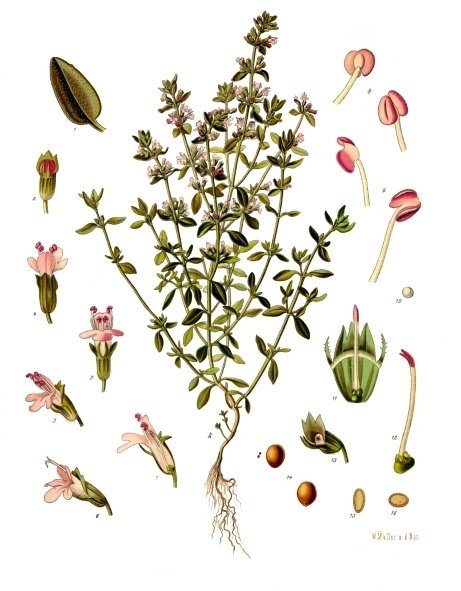
Thyme
Thymum; Greek thymon
- Known today as
- Thymus vulgaris and wild thyme, T. serpyllum.
- Kind
- Plant, in 1 older authority
- Constituents
- thymol, carvacrol
- Earliest authority here
- Pliny (AD 23/24–79)
- Qualities
- Hot and dry (Galenic tradition). What the degrees mean
- In other databases
- Plants of the World Online search · GBIF search · Wikidata search
Thyme: what was it used for?
Warming and drying: for coughs, the stomach, and worms; burnt to cleanse the air of rooms.
Thyme: how is it taken as a tea?
An ounce of the dried herb to a pint of boiling water, sweetened with sugar or honey, a tablespoonful or more several times a day for whooping cough, catarrh, and sore throat; thyme tea, Grieve says, arrests gastric fermentation.
All the herbal teas of the database. Historical directions, not medical advice.
Thyme: what does modern science say?
Thymol, from its oil, is a true antiseptic and is still used in mouthwashes.
Pharmacognosy & Toxicology
- Constituents
- Mechanism
- Thymol disrupts bacterial and fungal membranes; it was the antiseptic of Lister’s successors and is in mouthwashes still.
- Toxic dose
- The oil irritates; the herb is a food.
- Standing
- Thyme is in the European monographs for coughs; thymol in the mouthwash Listerine since 1879.
- European Medicines Agency (2013). Community herbal monograph on Thymus vulgaris. Book, seen in reviews
Constituent names open the compound’s record at PubChem, and “ChEMBL” beside a name opens its record at ChEMBL, the European Bioinformatics Institute’s database of bioactive molecules. Where a mechanism line was checked against ChEMBL (ChEMBL 37, read 1 October 2026), the check is shown with the measured value and its source paper, or says plainly that nothing has been measured. Doses are as the references give them, for description only; this is not medical advice. Each source carries the result of its check against Crossref, PubMed, or the authority’s page: see Verification.
Thyme: what lore surrounds it?
Medieval ladies are said to have embroidered a sprig of thyme onto a chosen knight’s scarf or tunic to lend him courage, echoing a Greek custom of adding thyme to the bath before battle; braided into the hair it was thought to give boldness in love. Banks of thyme were held to be where the fairies danced, the belief behind Oberon’s line in A Midsummer Night’s Dream: “I know a bank where the wild thyme blows.”
Thyme: what did the older authorities say?
- Pliny
- Says that thyme, burned, drives away every venomous creature.
Sources
- Pliny, Natural History XXI. Primary text
- Dioscorides, De materia medica. Read in part · the text read
- Icy Sedgwick, on thyme folklore. Book, not indexed
- Grieve, M. A Modern Herbal, “Thyme, Garden.” As published on botanical.com.
Verification
- Checked
- October 1, 2026
- Passes
- Every sentence read against its sources, in the pass over the remaining 343 entries
- The Standing line checked against the authority it names (EMA, WHO, FDA, CITES, Commission E)
- Every dated or regulatory claim checked by category across the database
- Sources
- 5 cited: 1 read in part, 1 primary text, 1 book, seen in reviews, 1 book, not indexed, 1 not yet checked.
- Corrections
- None were needed.
What was checked, how, and what was found is set out on the Verification page. A checked source is one whose record was found; it does not make the entry medical advice.
Cite This Entry
Version 1 · first published September 25, 2026
- Chicago
“Thyme.” In Materia Medica, edited by B. C. P. Statema. Version 1. The Thinking Press, 2026–. Last modified September 25, 2026. https://thethinkingpress.org/materia-medica/thyme.
- MLA
“Thyme.” Materia Medica, edited by B. C. P. Statema, version 1, The Thinking Press, 25 Sept. 2026, thethinkingpress.org/materia-medica/thyme. Accessed 8 Oct. 2026.
- APA
Thyme. (2026, September 25). In B. C. P. Statema (Ed.), Materia medica (Version 1). The Thinking Press. Retrieved October 8, 2026, from https://thethinkingpress.org/materia-medica/thyme
Club members keep entries on a shelf with private notes, print the plates as cards, and receive an entry by email each week. Create a free account before January 1, 2027 and all of it is yours for good. About the Club
See Also
Sharing thymol, carvacrol
Nepeta cataria · Origanum vulgare · Diatrion piperion · Origanum dictamnus
Also in Pliny the Elder
Toad in Pliny the Elder · Teasel in Pliny the Elder · Tongue stones in Pliny the Elder · Sweet flag in Pliny the Elder · everything Pliny the Elder names →
Drawing on the same sources: Pliny, Dioscorides, Icy Sedgwick, Grieve
Silphium · Walnut, middle bark of · Valerian · Southernwood · Verdigris · Aconite · Saffron · the bibliography →
Of the same qualities: hot and dry
Wormwood, oil of · Theriac · Aniseed · Sulfur · Asafoetida · St. John’s wort · what the degrees mean →
Nearby in the alphabet
Tinder fungus (A hoof-shaped bracket of birch and beech) · The thurible · Thorn apple (of the nightshade family) · Toadflax (Linaria vulgaris) · Toadstone (Lepidotes, believed to come from a toad’s head) · Tetragrammaton (not pronounced in Jewish practice)

Historical description, not medical advice.