
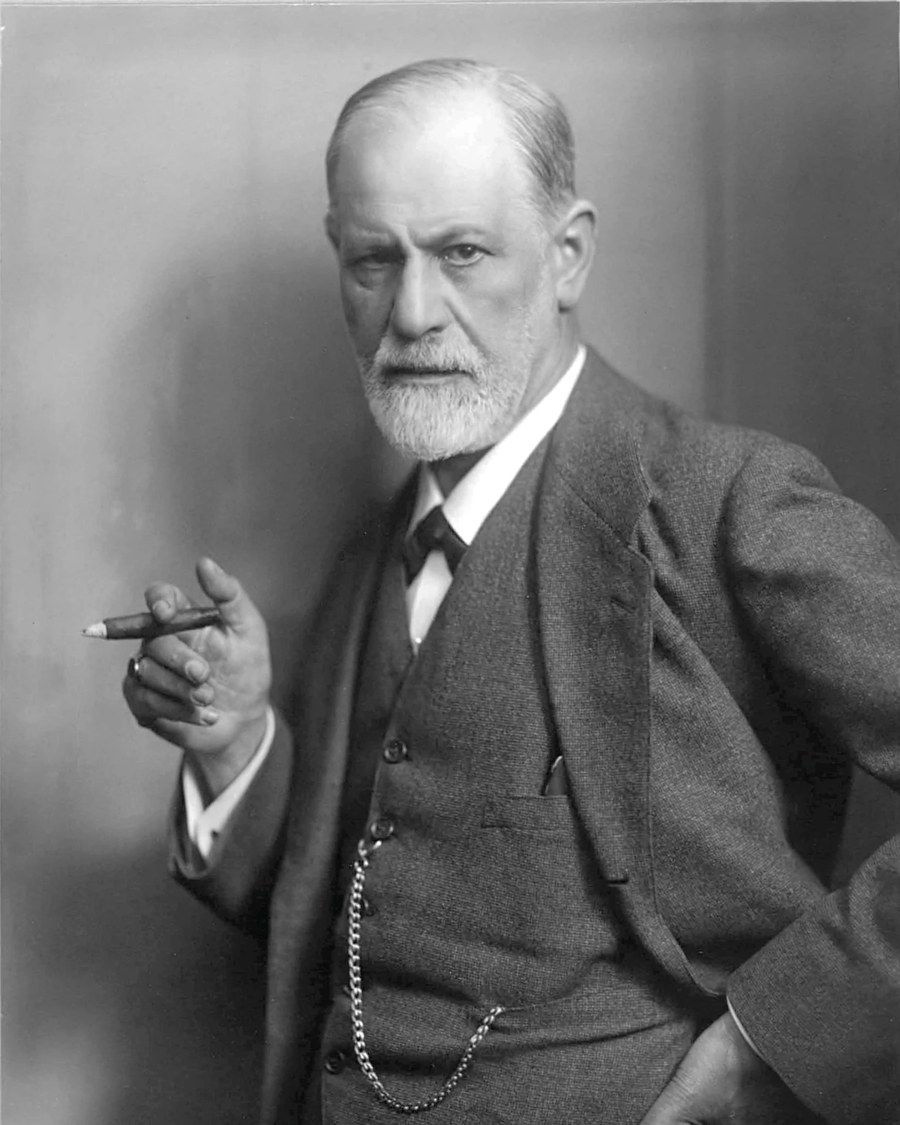
Sigmund Freud
The Viennese physician who looked without flinching at the harshest truths of the mind, and who named Karl Albert Scherner among those who had gone into the dream before him.
“The interpretation of dreams is the royal road to a knowledge of the unconscious activities of the mind.”
Sigmund Freud, The Interpretation of Dreams
Why Freud
Freud stands here for a kindred reason, held more loosely. Not every theory he built has stood as Jung’s discoveries have, and the press does not follow him everywhere; but no one before him looked so steadily at what a respectable age most wanted hidden.
What the press honors in Freud is that steadiness: a readiness to accept harsh and uncomfortable realities, about the mind and about civilization itself, without flinching and without consolation. It is the same courage the will toward the good asks of anyone who would face their own shadow.
- Studies on Hysteria (1895, with Josef Breuer)
- The Interpretation of Dreams (1899, dated 1900)
- The Psychopathology of Everyday Life (1901)
- Three Essays on the Theory of Sexuality (1905)
- Totem and Taboo (1913)
- Beyond the Pleasure Principle (1920)
- The Ego and the Id (1923)
- The Future of an Illusion (1927)
- Civilization and Its Discontents (1930)
- Moses and Monotheism (1939)
The Life
From Freiberg to Vienna
Sigmund Freud was born on 6 May 1856 in Freiberg, a small town in Moravia, now Příbor in the Czech Republic, the first child of Jakob Freud, a Jewish wool merchant, and his young third wife, Amalia. When trade failed, the family moved, first to Leipzig and then, in 1860, to Vienna, the city that would be Freud’s home for nearly eighty years.
He was first in his class at the gymnasium and entered the University of Vienna in 1873, where he trained in the physiological laboratory of Ernst Brücke, studying the nervous systems of fish and the structure of nerve cells. He took his medical degree in 1881, turned to clinical neurology to earn a living, and in 1886 married Martha Bernays, with whom he had six children, the youngest of them Anna, who would carry his work forward.
Paris, Hysteria, and the Talking Cure
In 1885–86 Freud studied in Paris under Jean-Martin Charcot at the Salpêtrière, whose demonstrations convinced him that ideas, not only damaged nerves, could make the body ill. Back in Vienna, his older colleague Josef Breuer told him of a patient, later known as Anna O., whose symptoms eased when she spoke of the memories behind them, a treatment she herself named the talking cure.
Their joint Studies on Hysteria (1895) opened the way. Freud soon set hypnosis aside for free association, asking his patients to say whatever came to mind, and from his consulting room at Berggasse 19, where he practiced from 1891, the method and the theory of psychoanalysis took shape.
The Self-Analysis and the Book of Dreams
The death of his father in October 1896 set Freud upon the most original experiment of his life: a systematic analysis of himself, carried on through his own dreams and set down in letters to his friend Wilhelm Fliess. From it came The Interpretation of Dreams, published in November 1899 with the date 1900 on its title page. Its first printing of six hundred copies took eight years to sell.
The book argued that every dream has a meaning, that it fulfills a wish in disguise, and that its strange images obey a grammar of condensation, displacement, and symbol. Before making that argument, Freud surveyed those who had gone before him, and gave careful attention to Karl Albert Scherner, whose Das Leben des Traumes of 1861 had read the dreaming body as a house and the dream as the work of an image-making Soul. In later editions Freud went further, crediting Scherner with the discovery of symbolism in dreams.
The Movement, and Its Quarrels
The Psychopathology of Everyday Life (1901) found the unconscious at work in slips and forgettings; Three Essays on the Theory of Sexuality (1905) scandalized Vienna by tracing adult life back to the drives of childhood. From 1902 a circle of followers met in his apartment on Wednesday evenings, and in 1909 he lectured at Clark University in Massachusetts with Jung beside him.
The movement grew, and so did its ruptures: with Alfred Adler in 1911, and in 1913 with Jung, over Jung’s refusal to read the psyche’s energy as sexual alone. Freud answered with Totem and Taboo (1913), carrying psychoanalysis into anthropology and religion.
War, and the Darker Drives
The First World War, and the soldiers who returned compelled to relive their terrors, drove Freud to a harsher view of the mind. In Beyond the Pleasure Principle (1920) he proposed, beside the drive toward life and union, a drive toward repetition and death; in The Ego and the Id (1923) he redrew the mind as three contending powers.
In 1923 he was diagnosed with cancer of the jaw, and for the sixteen years that remained he endured more than thirty operations, working on through constant pain. The Future of an Illusion (1927) and Civilization and Its Discontents (1930) turned his unsparing gaze upon religion and upon civilization itself, whose order, he concluded, is bought by a renunciation paid within each of its members.
Exile, and the End
In 1933 his books were burned in Berlin. When Germany annexed Austria in March 1938, the Gestapo searched his apartment and detained his daughter Anna, and only with the intervention of friends, among them Princess Marie Bonaparte and Ernest Jones, was Freud allowed to leave. He reached London in June 1938 and settled at 20 Maresfield Gardens in Hampstead. Four of his sisters, left behind, were later murdered in the camps.
He finished Moses and Monotheism in exile, and died in London on 23 September 1939, three weeks after the Second World War began, his physician easing his last suffering at his request.
A Demonological Neurosis
In 1923 Freud published a study of a seventeenth-century Bavarian painter, Christoph Haizmann, who believed he had signed a pact with the Devil and sought deliverance by exorcism at the shrine of Mariazell. Freud read the old record as a case history: the demons of the seventeenth century, he suggested, were the neuroses of his own, clothed in the language of their age.
It is exactly the terrain of the press’s Series C. Girolamo Menghi’s Cudgel of Demons and Floriano Canale’s On the Manner of Discerning and Healing the Bewitched are the manuals such a painter’s exorcists would have known, and Canale’s care to tell genuine affliction from its false causes reads, three centuries early, like the first page of a diagnosis.
The Thought
The core of Freud’s philosophy, and where each idea lives in the press’s own books.
Most of mental life happens out of sight, and what is hidden there still acts, shaping choices, symptoms, slips, and dreams.
The mind’s refusal to admit what it cannot bear. What is repressed does not disappear; it returns, disguised, in symptoms and in projection.
Dreams disguise their meaning by condensation, displacement, and symbol; interpreted, they become the royal road to the unconscious.
The drives, the reality-bound self that mediates, and the internalized conscience that judges: three powers contending within one person.
In his late work, a drive toward life and union set against a drive toward repetition, dissolution, and death.
The redirecting of raw drive into work, art, and culture, so that energy is neither denied nor let run wild, but given a higher end.
The defense by which what one cannot admit in oneself is seen, instead, in someone else.
His motto for the analytic cure: where the unconscious was, there the conscious self shall come to be.
Within the Press
Freud in the Press’s Books
In An History Beside Time the psyche begins with two primal names: “The first name he found was hunger. And hunger said: ‘I.’ The second name he found was fear. And fear said: ‘Not-I.’” Its appendix calls them the instinctual ground of the psyche, energies that, disowned, return as autonomous powers ruling from below. That is Freud’s discovery, set in the book’s own cadence: the drives are not abolished by being denied.
Where the book departs from him is instructive. Its inner judge, the Institution, is “the judge that speaketh without anger, and therefore cannot be bribed,” not the punishing superego Freud described, which torments with guilt. The press keeps Freud’s honesty about the drives and his map of their conflict, while holding that the highest law within is calm rather than cruel.
The Wisdom of Catastrophe likewise builds on Freud’s mechanisms, repression and projection above all: that what is refused in oneself is seen in the enemy, and that catastrophe is the moment the repressed can no longer be kept below.
Freud and Jung
The press stands in debt to both sides of their quarrel. Freud’s patient reading of the dream as a meaningful text shapes how it approaches Scherner; Jung’s myth and archetype shape An History Beside Time. Between them runs the question the whole list keeps asking: what the darker parts of the mind are, and what we owe to them.
Freud and Nietzsche
Freud said he had long avoided reading Nietzsche, precisely because Nietzsche’s guesses and intuitions so often agreed, in the most astonishing way, with the laborious findings of psychoanalysis. The philosopher reached by insight what the physician reached by method, and The Wisdom of Catastrophe inherits both: Nietzsche’s diagnosis of a culture losing its values, and Freud’s sense that the price of civilization is paid within each of its members.
Toward the Horizon of the Good
Freud did not preach the good; he cleared the ground on which it could honestly stand. His refusal of comforting illusions is the first discipline of the will toward the good, which cannot rest on what merely feels good now, but must hold in a week, in a year, and forever. A good built on self-deception will not survive the test of time.
His idea of sublimation points further still. The drives are not to be denied, which only drives them underground, nor indulged, which lets them rule; they are to be given a higher task. An History Beside Time says it in its own law of offices: “Every power within thee shall have a task, and no power shall have a throne.” And his motto for the cure, that where the unconscious was, the conscious self shall come to be, is the beginning of every good that knows what it is doing.