
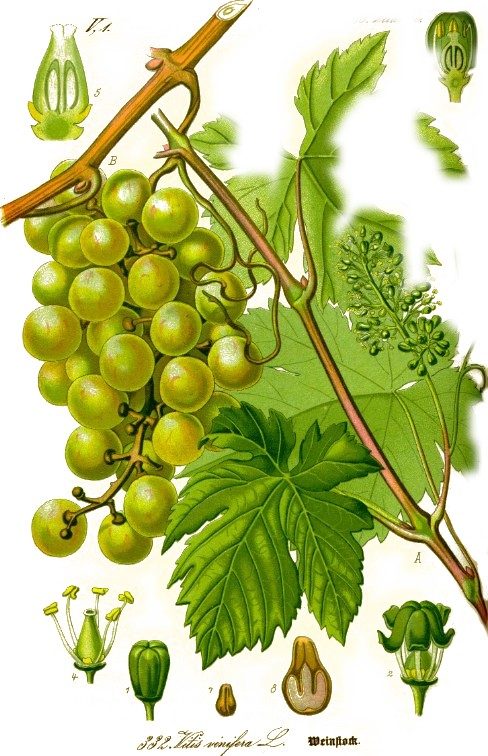
Vine ash
Cenere di vite
- Known today as
- Ash of burnt vine wood.
- Kind
- Mineral, in 2 older authorities
- Constituents
- potassium carbonate, calcium carbonate, phosphates
- Earliest authority quoted here
- Pliny the Elder (AD 23/24–79)
- In other databases
- Wikidata search
- In the Canale glossary
- On the Manner of Discerning and Healing the Bewitched, Appendix A: Part Three, Chapter 9: Anointings
Revised October 17, 2026: Tradition, lore, modern assessment, and sources extended. Checked against its sources, each read in full, in part, or in its abstract. Version 1, first published September 25, 2026.
Vine ash: what did Canale use it for?
In the oil for hexes (ch. 9).
Vine ash: what does modern science say?
Alkaline ash. Wood ash is rich in calcium and potassium, which form carbonates in the air, and is strongly alkaline, often above pH 12.
Vine ash: what did the older authorities say?
- Dioscoridesc. AD 40–90
- Gives the ashes of the vine’s branches, with vinegar, for venereal warts and glandular swellings, and with rose oil, rue and vinegar for dislocations and viper bites; the liquid that sweats from a burning green branch removes hair and takes off warts.
- The dyers and soap-boilers
- Wood ashes went into soap: Pliny has the Gauls make it of tallow and ashes, the best of beech and yoke-elm. Pomet’s dyers used the ash of calcined wine lees.
Vine ash: what lore surrounds it?
The chemists called what remained in the retort after distillation the caput mortuum, and drew a salt out of it by water and fire.
Pharmacognosy
- Constituents
- Mechanism
- Like other wood ash it is strongly alkaline, rich in calcium and potassium. Canale distils it with new wax, turpentine and dragon’s blood into an oil, of which the patient takes a quarter-ounce every morning for a month.
- Canale, F. (1614; translated from the Brescia edition of 1674). Discerning and Healing the Bewitched, ch. 9.
Constituent names open the compound’s record at PubChem, and “ChEMBL” beside a name opens its record at ChEMBL, the European Bioinformatics Institute’s database of bioactive molecules. Where a mechanism line was checked against ChEMBL (ChEMBL 37, read 1 October 2026), the check is shown with the measured value and its source paper, or says plainly that nothing has been measured. Doses are as the references give them, for description only; this is not medical advice. Each source carries the result of its check against Crossref, PubMed, or the authority’s page: see Verification.
Sources
- Dioscorides, De materia medica V. Read in part · the text read
- Eichermüller, J., Scheu, J., Sekerci, F., Kappler, A., and Thorwarth, H. (2026). Effect of short carbonation on element mobility in wood ash. ACS Omega 11: 54950–54964. Read in full · the text read
- Pliny the Elder, Natural History 28.51, trans. J. Bostock & H. T. Riley (1855), Perseus Digital Library. Read in part · the text read
- Pomet, P. (1712). A Compleat History of Druggs, with additions from Lemery and Tournefort. London: R. Bonwicke et al. Read in part · the text read
Verification
- Checked
- October 1, 2026, October 17, 2026
- Passes
- Read against its sources in the fifty-entry sample
- Every dated or regulatory claim checked by category across the database
- Every source read, in full, in part, or in its abstract, and every sentence checked against what was read (October 17, 2026)
- Sources
- 5 cited: 1 read in full, 3 read in part, 1 not yet checked.
- Corrections
- None recorded.
What was checked, how, and what was found is set out on the Verification page. A checked source is one whose record was found; it does not make the entry medical advice.
Club members can point at a technical term in this entry, such as a constituent, an action, or a word of Jung’s, to read its definition from the source. The Club.
Cite This Entry
Version 1 · first published September 25, 2026 · last revised October 17, 2026
- Chicago
“Vine ash.” In Materia Medica, edited by B. C. P. Statema. Version 1. The Thinking Press, 2026–. Last modified October 17, 2026. https://thethinkingpress.org/materia-medica/vine-ash.
- MLA
“Vine ash.” Materia Medica, edited by B. C. P. Statema, version 1, The Thinking Press, 17 Oct. 2026, thethinkingpress.org/materia-medica/vine-ash. Accessed 22 Nov. 2026.
- APA
Vine ash. (2026, October 17). In B. C. P. Statema (Ed.), Materia medica (Version 1). The Thinking Press. Retrieved November 22, 2026, from https://thethinkingpress.org/materia-medica/vine-ash
See Also
Sharing potassium carbonate, calcium carbonate
Olive-wood ash lye · Woodlouse · Pearls, prepared · Corallium rubrum · Cuttlefish bone
Also in Dioscorides
Walnut, middle bark of in Dioscorides · Verdigris in Dioscorides · Wormwood, oil of in Dioscorides · Valerian in Dioscorides · everything Dioscorides names →
Drawing on the same sources: Dioscorides, Pomet, Canale
Aster · Vitriol · Turmeric · The amulet herbs · Sweet almond, oil of · the bibliography →
Nearby in the alphabet
Vinegar (Soured wine) · The vernicle (leaving his image) · Vinegar of the four thieves (Vinegar steeped with herbs and garlic) · Violet, lettuce, sow-thistle (garden lettuce (Lactuca sativa), sow-thistle (Sonchus oleraceus)) · Verbena (Verbena officinalis) · Viper (Vipera species, dried into troches)
Historical description, not medical advice.
