
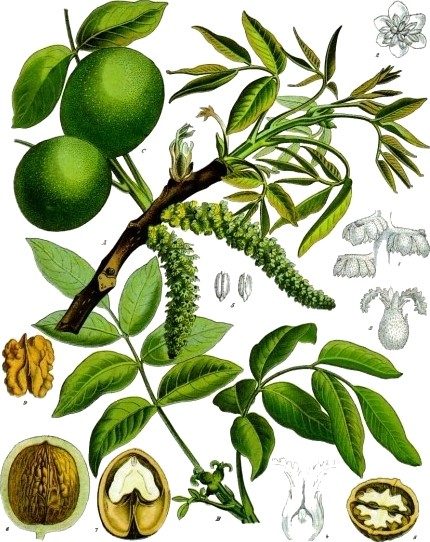
Walnut, middle bark of
Scorza mezzana della noce
- Known today as
- The inner bark of Juglans regia.
- Kind
- Plant, in 2 older authorities
- Constituents
- juglone, tannins, ellagic acid
- Earliest authority here
- Dioscorides (c. AD 40–90)
- In other databases
- Plants of the World Online search · GBIF search · Wikidata search
- In the Canale glossary
- On the Manner of Discerning and Healing the Bewitched, Appendix A: Part Three, Chapter 5: Vomitory Medicines
Revised October 1, 2026: Tradition, lore, modern assessment, and sources extended. Version 1, first published September 25, 2026.
Walnut, middle bark of: what did Canale use it for?
Powdered, a dram at a time, as a vomit (ch. 5).
Walnut, middle bark of: what does modern science say?
Walnut bark is purgative, with a bitter, astringent taste. Juglone, the quinone that stains the hands and kills the plants beneath the tree, is a strong irritant and purgative; a dram of the bark powder would act as Canale says, and would not be given now.
Pharmacognosy & Toxicology
- Constituents
- juglone ChEMBL5-hydroxy-1,4-naphthoquinone, in the green husk, leaf, and inner bark
- tannins
- ellagic acid ChEMBL
- Mechanism
- Juglone is a reactive quinone that irritates the gut, which is Canale’s vomit at a dram of the bark, and is antifungal and allelopathic, poisoning the plants under a walnut tree. The leaf’s tannins are the astringent of the leaf tea.
- Toxic dose
- The bark at Canale’s dram nauseates; the leaf tea is safe; juglone stains the skin and sensitises.
- Standing
- Walnut leaf has an EMA monograph (2014) for minor skin inflammation and sweating of the hands and feet; the bark has none.
- EMA/HMPC (2014). Community herbal monograph on Juglans regia L., folium (EMA/HMPC/346737/2011). Verified against its record
- Strugstad, M. P., and Despotovski, S. (2012). “A summary of extraction, synthesis, properties, and potential uses of juglone.” Journal of Ecosystems and Management 13. Verified against its record · doi:10.22230/jem.2012v13n3a119
The abstract of each source, beneath its citation. For Club members. About the Club or sign in.
Constituent names open the compound’s record at PubChem, and “ChEMBL” beside a name opens its record at ChEMBL, the European Bioinformatics Institute’s database of bioactive molecules. Where a mechanism line was checked against ChEMBL (ChEMBL 37, read 1 October 2026), the check is shown with the measured value and its source paper, or says plainly that nothing has been measured. Doses are as the references give them, for description only; this is not medical advice. Each source carries the result of its check against Crossref, PubMed, or the authority’s page: see Verification.
Walnut, middle bark of: what lore surrounds it?
The walnut tree, Juglans, is Jove’s nut; the witches of Benevento were said to gather under a great walnut, and the tree’s poisonous shade is an old Italian belief that modern botany explains by the juglone its roots exude.
Walnut, middle bark of: what did the older authorities say?
- Dioscorides
- Gives the green rind and the leaves of the walnut as astringent, and the Latin herbals the inner bark, boiled, as a purge and a vomit, “the middle bark” being that between the outer rind and the wood.
- Pliny
- Says the walnut was brought from Persia by the kings, and that its shade and its smell are heavy and hurt the head, whence its ill name among the old.
Sources
- [54] Grieve, M. (1931). A Modern Herbal. Online edition, botanical.com, cited under the plant concerned. Read in part · the text read
- Pliny, Natural History XV–XVII. Primary text
- Dioscorides, De materia medica I. Primary text
Verification
- Checked
- October 1, 2026
- Passes
- Every sentence read against its sources, in the pass over the remaining 343 entries
- The Standing line checked against the authority it names (EMA, WHO, FDA, CITES, Commission E)
- Every dated or regulatory claim checked by category across the database
- Sources
- 5 cited: 1 read in part, 2 verified against its record, 2 primary text. 1 with the abstract on file.
- Corrections
- None were needed.
What was checked, how, and what was found is set out on the Verification page. A checked source is one whose record was found; it does not make the entry medical advice.
Cite This Entry
Version 1 · first published September 25, 2026 · last revised October 1, 2026
- Chicago
“Walnut, middle bark of.” In Materia Medica, edited by B. C. P. Statema. Version 1. The Thinking Press, 2026–. Last modified October 1, 2026. https://thethinkingpress.org/materia-medica/walnut-middle-bark-of.
- MLA
“Walnut, middle bark of.” Materia Medica, edited by B. C. P. Statema, version 1, The Thinking Press, 1 Oct. 2026, thethinkingpress.org/materia-medica/walnut-middle-bark-of. Accessed 8 Oct. 2026.
- APA
Walnut, middle bark of. (2026, October 1). In B. C. P. Statema (Ed.), Materia medica (Version 1). The Thinking Press. Retrieved October 8, 2026, from https://thethinkingpress.org/materia-medica/walnut-middle-bark-of
Club members keep entries on a shelf with private notes, print the plates as cards, and receive an entry by email each week. Create a free account before January 1, 2027 and all of it is yours for good. About the Club
See Also
Sharing juglone, tannins, ellagic acid
Juglans nigra · Rumex crispus · Galium odoratum · Betonica officinalis · Veronica chamaedrys · Bezoar stone · Punica granatum · Bistorta officinalis
Also in Dioscorides
Wormwood, oil of in Dioscorides · Vine ash in Dioscorides · Calamine in Dioscorides · Verdigris in Dioscorides · everything Dioscorides names →
Also in Pliny the Elder
Water germander in Pliny the Elder · Violet, lettuce, sow-thistle in Pliny the Elder · Wax in Pliny the Elder · Verbena in Pliny the Elder · everything Pliny the Elder names →
Drawing on the same sources: Pliny, Dioscorides
White lead · Toad · Yarrow · Bitter aloes · the bibliography →
Nearby in the alphabet
Vitriol (blue vitriol (copper sulfate), and white vitriol (zinc sulfate)) · Viper (Vipera species, dried into troches) · Wax ex-votos · Weapon-salve · Vinegar of the four thieves (Vinegar steeped with herbs and garlic)
Historical description, not medical advice.