
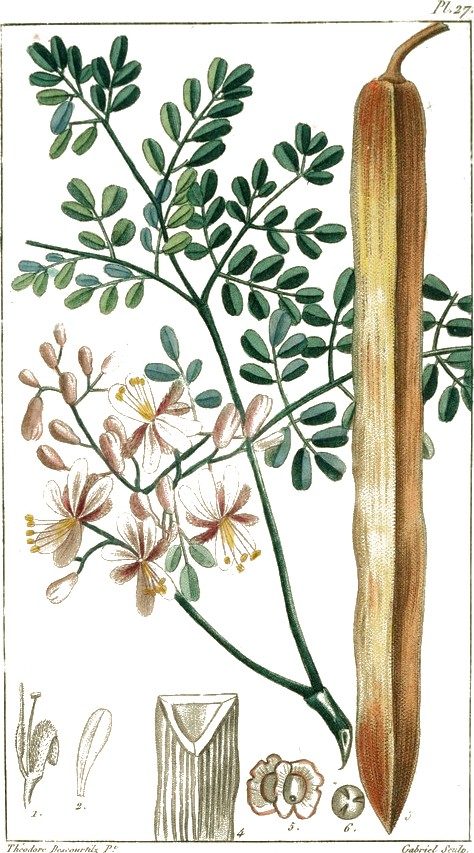
Ben-nut
Balano mirepsica
- Known today as
- Probably the seed of the horseradish tree, Moringa oleifera (or M. peregrina).
- Kind
- Plant, in 1 older authority
- Constituents
- oleic acid, behenic acid, glucomoringin, and 1 more
- Earliest authority here
- Pliny (AD 23/24–79)
- In other databases
- Plants of the World Online search · GBIF search · Wikidata search
- In the Canale glossary
- On the Manner of Discerning and Healing the Bewitched, Appendix A: Part Three, Chapter 5: Vomitory Medicines
Revised October 1, 2026: An older authority added from a text read in full. Version 1, first published September 25, 2026.
Ben-nut: what did Canale use it for?
Roasted, powdered, or baked in dough, as a vomit (ch. 5; note XXXV).
Ben-nut: what does modern science say?
The pressed oil, “oil of ben,” was prized by perfumers because it does not go rancid.
Pharmacognosy & Toxicology
- Constituents
- oleic acid ChEMBL70 per cent of the oil
- behenic acid ChEMBLwhich named the oil
- glucomoringina glucosinolate that releases a mustard-oil isothiocyanate
- moringine ChEMBLbenzylamine
- Mechanism
- The seed of Moringa oleifera: its isothiocyanates irritate the gut, which is the vomit of Canale, and are antibacterial; the seed proteins flocculate dirty water, which is the seed’s real modern use; the oil is a stable emollient.
- Toxic dose
- A few seeds purge and vomit; the leaf is eaten as a vegetable without harm.
- Standing
- The seed is a WHO-noted water clarifier; the leaf powder is sold as a supplement with small trials for blood sugar and lipids; no monograph.
- Anwar, F., et al. (2007). “Moringa oleifera: a food plant with multiple medicinal uses.” Phytotherapy Research 21. Verified against its record · doi:10.1002/ptr.2023
- Ndabigengesere, A., et al. (1995). “Active agents and mechanism of coagulation of turbid waters using Moringa oleifera.” Water Research 29. Verified against its record · doi:10.1016/0043-1354(94)00161-y
The abstract of each source, beneath its citation. For Club members. About the Club or sign in.
Constituent names open the compound’s record at PubChem, and “ChEMBL” beside a name opens its record at ChEMBL, the European Bioinformatics Institute’s database of bioactive molecules. Where a mechanism line was checked against ChEMBL (ChEMBL 37, read 1 October 2026), the check is shown with the measured value and its source paper, or says plainly that nothing has been measured. Doses are as the references give them, for description only; this is not medical advice. Each source carries the result of its check against Crossref, PubMed, or the authority’s page: see Verification.
Ben-nut: what did the older authorities say?
- Pliny
- Says the myrobalanum, found in the Thebais and the parts of Arabia between Judaea and Egypt, “is provided by Nature for unguents, as from its very name would appear,” being the nut of a tree with a leaf like the heliotropium and a fruit the size of a filbert, the Arabian kind white; it sold at two denarii the pound, and the unguent of bryon and oil of balanus was, he thinks, “the very first that was ever made.”
Sources
- [38] Encyclopaedia Britannica, online edition, britannica.com. Articles: Ambergris; Aristolochiaceae; Asafetida; Azurite; Castor-oil plant; Civet; Dragon’s blood; Garden cress; Jet; Kermes; Laudanum; Lye; Monemvasía; Musk; Precious coral; Saltpetre; Sulfur dioxide; Tartar emetic; Tropaeolum. Book, seen in reviews
- [42] Feedipedia (animal feed resources information system). Moringa (Moringa oleifera). feedipedia.org. Book, not indexed
- [52] Gopalakrishnan, L., Doriya, K., & Kumar, D. S. (2016). Moringa oleifera: a review on nutritive importance and its medicinal application. Food Science and Human Wellness 5(2): 49–56. doi:10.1016/j.fshw.2016.04.001 Verified against its record · doi:10.1016/j.fshw.2016.04.001
- Pliny the Elder, Natural History 12.46–47, 13.2, trans. J. Bostock & H. T. Riley (1855), Perseus Digital Library. Primary text
Verification
- Checked
- October 1, 2026
- Passes
- Every sentence read against its sources, in the pass over the remaining 343 entries
- The Standing line checked against the authority it names (EMA, WHO, FDA, CITES, Commission E)
- Every dated or regulatory claim checked by category across the database
- Each quotation from the older authorities checked word for word against the text, read in full
- Sources
- 6 cited: 3 verified against its record, 1 primary text, 1 book, seen in reviews, 1 book, not indexed. 1 with the abstract on file.
- Corrections
- None were needed.
What was checked, how, and what was found is set out on the Verification page. A checked source is one whose record was found; it does not make the entry medical advice.
Cite This Entry
Version 1 · first published September 25, 2026 · last revised October 1, 2026
- Chicago
“Ben-nut.” In Materia Medica, edited by B. C. P. Statema. Version 1. The Thinking Press, 2026–. Last modified October 1, 2026. https://thethinkingpress.org/materia-medica/ben-nut.
- MLA
“Ben-nut.” Materia Medica, edited by B. C. P. Statema, version 1, The Thinking Press, 1 Oct. 2026, thethinkingpress.org/materia-medica/ben-nut. Accessed 8 Oct. 2026.
- APA
Ben-nut. (2026, October 1). In B. C. P. Statema (Ed.), Materia medica (Version 1). The Thinking Press. Retrieved October 8, 2026, from https://thethinkingpress.org/materia-medica/ben-nut
Club members keep entries on a shelf with private notes, print the plates as cards, and receive an entry by email each week. Create a free account before January 1, 2027 and all of it is yours for good. About the Club
See Also
Sharing oleic acid
Blessed oil · Sweet almond, oil of · Chrism · Olive oil and holy water
Also in Pliny the Elder
Bitter aloes in Pliny the Elder · Barley water in Pliny the Elder · Black pepper in Pliny the Elder · Balm of Gilead in Pliny the Elder · everything Pliny the Elder names →
Nearby in the alphabet
Benzoin (the resin of Styrax benzoin of Sumatra) · Bells (and wrongly, called their “baptism) · Betony (Betonica officinalis) · Basil (Ocimum basilicum) · Bezoar stone (A concretion formed in the stomach of goats and other animals) · Birch polypore (A white bracket of dead birch) · Balsam of Peru (vanilla-scented balsam from Myroxylon balsamum var)
Historical description, not medical advice.