
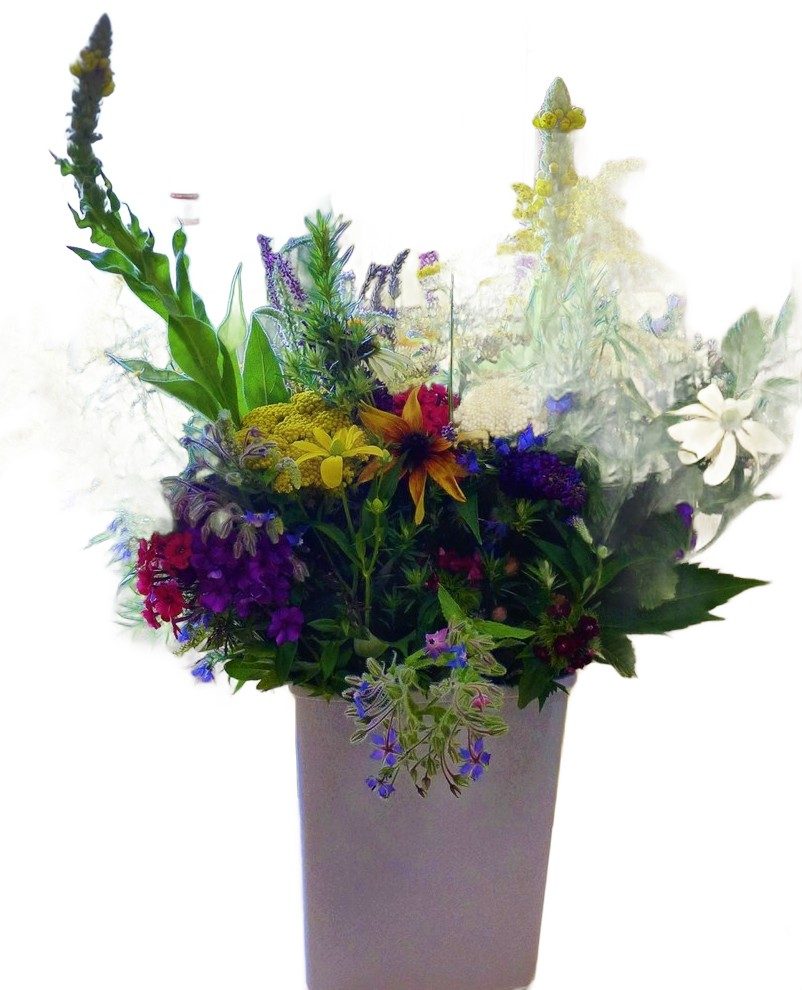
Blessed herbs
Erbe benedette
- Known today as
- Herbs blessed by the Church, especially on the feast of the Assumption (15 August).
- Kind
- Sacramental
- Constituents
- hypericin, thujone, carvone
- In the Canale glossary
- On the Manner of Discerning and Healing the Bewitched, Appendix A: Treatise Two: Blessed Objects and Materials
Revised October 17, 2026: Checked against its sources, each read in full, in part, or in its abstract. Version 1, first published September 25, 2026.
Blessed herbs: what did Canale use it for?
Allowed in gathering and use “if we use, along with the herbs, the divine Symbol or the Lord’s Prayer” (Treatise Two; note LXXIV).
Blessed herbs: what does modern science say?
The Assumption blessing of herbs (Kräuterweihe) is still practised in Bavaria and Austria: for 2026 the Archdiocese of Munich and Freising announced festal Masses and blessings of herbs for the day, by epd’s report, and the Diocese of Linz calls the custom a thousand years old.
The toxic dose and the poisoning
- Toxic dose
- See the several herbs.
The references for these lines are listed under Pharmacognosy, in Science. Doses are as the references give them, for description only; this is not medical advice. In a poisoning, call a poison centre.
In Their Own Words
The Catholic Encyclopedia's article on blessings says that herbs and grasses, with the other fruits of the earth, may be sanctified by the word of God and prayer.
“The fruits of the earth, such as grapes, corn, and the garnered harvest, seeds that are put into the earth, wine and the vintage, herbs and grasses may all in a fitting and appropriate language be "sanctified by the word of God and prayer".”
Patrick Morrisroe, The Catholic Encyclopedia, “Blessing”, “Blessing”, (b) articles of food. Vol. 2. New York: Robert Appleton Company, 1907 (New Advent transcription). The text, read in full
Each passage is quoted from the text named, which the press fetched and read, and was checked word for word against a fresh copy of it; the link opens that copy. Passages are given as printed, without the editors’ footnote numbers, and with words broken across lines joined.
Pharmacognosy
- Constituents
- Mechanism
- The blessing is a form of words over herbs that have their own entries; the pharmacology is theirs and is unchanged by the words, which is what the Church itself holds in distinguishing sacramentals from medicines.
- Standing
- A rite, not a drug; the clinical reading on amulets and placebo takes up what the blessing adds.
- Canale, F. (1614; translated from the Brescia edition of 1674). Discerning and Healing the Bewitched, Treatise Two.
Constituent names open the compound’s record at PubChem, and “ChEMBL” beside a name opens its record at ChEMBL, the European Bioinformatics Institute’s database of bioactive molecules. Where a mechanism line was checked against ChEMBL (ChEMBL 37, read 1 October 2026), the check is shown with the measured value and its source paper, or says plainly that nothing has been measured. Doses are as the references give them, for description only; this is not medical advice. Each source carries the result of its check against Crossref, PubMed, or the authority’s page: see Verification.
Sources
- [39] Erzbistum München und Freising (2026). Gottesdienste und Kräutersegnungen zu Mariä Himmelfahrt (press release), 7 August 2026. Read in full · the text read
- [120] Weller, P. T. (trans.) (1964). The Roman Ritual, Part XI: Blessings and Other Sacramentals. EWTN Library, ewtn.com. Read in part · the text read
- Diözese Linz (2026). “15. August: Maria Himmelfahrt – Kräutersegnungen.” Press release, 3 August 2026. Read in full · the text read
Verification
- Checked
- October 1, 2026, October 17, 2026
- Passes
- Read against its sources in the pass over the remaining 343 entries
- Every dated or regulatory claim checked by category across the database
- Every source read, in full, in part, or in its abstract, and every sentence checked against what was read (October 17, 2026)
- Sources
- 4 cited: 2 read in full, 1 read in part, 1 not yet checked.
- Corrections
- None recorded.
What was checked, how, and what was found is set out on the Verification page. A checked source is one whose record was found; it does not make the entry medical advice.
Club members can point at a technical term in this entry, such as a constituent, an action, or a word of Jung’s, to read its definition from the source. The Club.
Cite This Entry
Version 1 · first published September 25, 2026 · last revised October 17, 2026
- Chicago
“Blessed herbs.” In Materia Medica, edited by B. C. P. Statema. Version 1. The Thinking Press, 2026–. Last modified October 17, 2026. https://thethinkingpress.org/materia-medica/blessed-herbs.
- MLA
“Blessed herbs.” Materia Medica, edited by B. C. P. Statema, version 1, The Thinking Press, 17 Oct. 2026, thethinkingpress.org/materia-medica/blessed-herbs. Accessed 22 Nov. 2026.
- APA
Blessed herbs. (2026, October 17). In B. C. P. Statema (Ed.), Materia medica (Version 1). The Thinking Press. Retrieved November 22, 2026, from https://thethinkingpress.org/materia-medica/blessed-herbs
See Also
Sharing hypericin, thujone, carvone
Hypericum perforatum · Salvia fruticosa · Artemisia absinthium · Salvia officinalis · Tanacetum vulgare · Carum carvi · Mint, oil of · Anethum graveolens
Drawing on the same sources: Canale
Nearby in the alphabet
Blessed oil · Blessed candles (and the Paschal candle) · Blessed paper (Paper blessed so that what is written on it may take effect) · Blessed bread (distinct from the Eucharist) · Bloodroot (the first flower of the spring woods from Canada to the South) · Blessed ashes (blessed on Ash Wednesday) · Bloodstone (iron oxide, which streaks blood-red) · Bladderwrack (a brown seaweed of rocky shores, buoyed by paired air bladders)

Historical description, not medical advice.
