
Chance and the Goblin Tricks of the Unconscious
Web edition, version 1.0, 9 October 2026
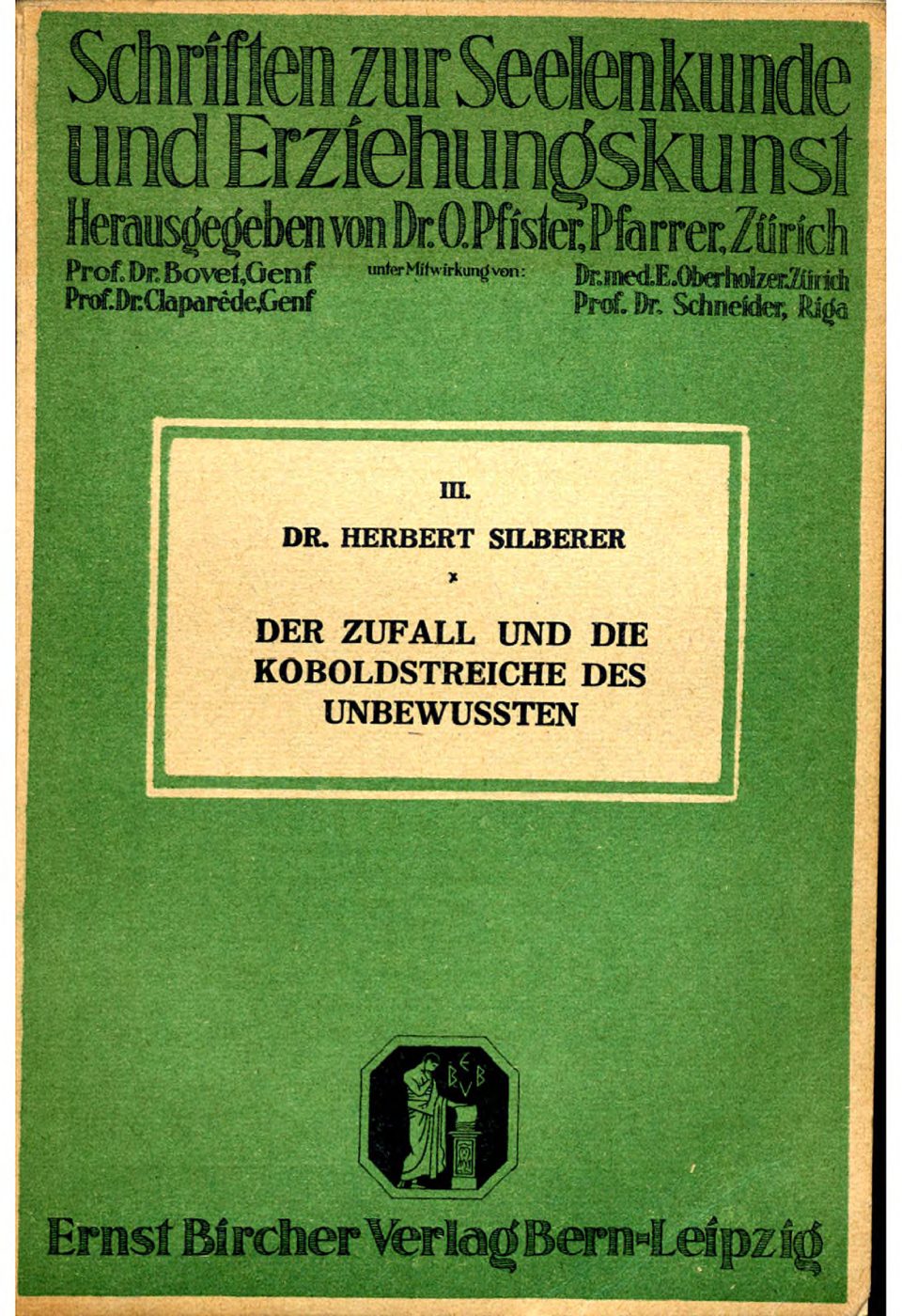
Title Page, Translator's Note, Contents, Foreword, and I. What Do We Call Chance? are free to read. The rest is for Club members: create a free account before January 1, 2027 and confirm your email, and you are a Charter Member, with every part, for good. Join the Club.
Herbert Silberer (1882 to 1923), who for some years belonged to the circle around Freud, wrote this little book for Oskar Pfister’s popular series in Zurich. It gathers seventy-five cases, his own and those of Freud, Jung, Adler, Stekel, Kammerer and Strindberg, in which chance turns out to have a hand in it: ours. This is its first English translation, as far as the press has been able to find.
- The edition
- Herbert Silberer, Der Zufall und die Koboldstreiche des Unbewussten. Schriften zur Seelenkunde und Erziehungskunst, Heft III. Bern and Leipzig: Ernst Bircher Verlag, 1921.
- The text
- Translated from the page images of the International Psychoanalytic University Berlin’s copy, scanned for the Internet Archive; the scan’s text layer was read against every page image and corrected. No other printing has been found. See the scanned book.
- Rights
- Silberer’s German text is in the public domain; the Internet Archive marks the scan with the Public Domain Mark 1.0. The publisher’s device and cover are reproduced from the same copy.
- Copyright
- Translation © 2026 B. C. P. Statema. The Thinking Press, Kenosha, Wisconsin. All rights reserved.
Translator’s Note
Herbert Silberer (1882 to 1923), a Viennese writer on dreams, symbolism and the occult who belonged for some years to the circle around Freud, published this little book in 1921 as the third number of the Schriften zur Seelenkunde und Erziehungskunst, a popular series edited in Zurich by the pastor and analyst Oskar Pfister. It gathers seventy-five examples, from Silberer's own life, from friends, and from Freud, Jung, Adler, Stekel, Rank, Kammerer and Strindberg, of chances that are not chance: the ring lost on the way to a broken engagement, the name that will not come, the misread headline, the stone that turns into a beast when the scientist goes home. Silberer died by his own hand in January 1923 (English and German Wikipedia, "Herbert Silberer").
This translation is made from the page images of the Bern and Leipzig printing of 1921 (Ernst Bircher Verlag), the copy of the International Psychoanalytic University Berlin, scanned for the Internet Archive. The scan's text layer was used only as a first draft of the German; every page was read against its image and corrected. No other printing has been found. The publisher's advertisement printed after the list of literature is not part of Silberer's text and is left out.
The English keeps the book's parts in their order: the list of the series, the half-title, the series title, the title page, the contents, Pfister's foreword, and Silberer's four chapters and list of literature. Every heading is given in English and then in Silberer's German. His examples are numbered as he numbers them, 1 to 75, with 46a. Where a case turns on a German word, a pun, a slip, a misreading, a rhyme, the German is kept beside the English, because the argument runs on its letters; the translator's glosses are in parentheses. Where Silberer spaced out a word for emphasis, the English sets it in italics, as it does the names he spaced out. His dashes are given as commas, colons or parentheses. He quotes Freud, Jung, Kammerer, Schopenhauer and Strindberg in German; the English translates his German. The page numbers of the 1921 edition are not reproduced; the contents link to the parts of this edition, and the page references inside the examples are Silberer's own, to the books he cites.
The text is translated without modern commentary. A few notes, marked with a dagger and a roman numeral and gathered at the end, explain a pun, place a name or a quotation, or say what the original prints; each says where its information comes from.
Read before you join
Passages from the parts that are for members, free to read:
- The husband who kissed her hand From the examples: a goodbye at the front door, a gauntlet thrown down.
- The goblin in the headlines From the war years: the misreadings of a mind that had stopped reading more than the bold type.
- Strindberg and the maggot From the Strindberg examples: a vision told at dinner, and what was on the plate.
- Names that are fates From the last chapter: Herr Sicher who was never sure, and Herr Frisch who was always tired.
Contents
- Title PageFree to readTitelblatt1 min
- Translator's NoteFree to read2 min
- ContentsFree to readInhalt1 min
- ForewordFree to readVorwort2 min
- I. What Do We Call Chance?Free to readI. Was nennen wir Zufall?6 min
- II. Chance Influenced: (a) The Order Is Worked InMembersII. Der beeinflusste Zufall: a) Die Ordnung wird hineingewirkt.34 min
- (b) The Order Is Seen InMembersb) Die Ordnung wird hineingeschaut.21 min
- III. The Valuation of ChanceMembersIII. Wertung des Zufalls.14 min
- IV. FateMembersIV. Schicksal.11 min
- LiteratureMembersLiteratur.2 min
- NotesMembers3 min
Your bookmarks and highlights
Sign in with your Club account to highlight passages and keep bookmarks. They are kept with your account, on every device.
Sources for this page
What this page and the Translator’s Note say about the author and the book, beyond the book itself, comes from these, read for it:
Revisions
- 1.0, 9 October 2026. First publication: the whole book, with the series list, title pages, Pfister’s foreword, the four chapters and the list of literature.
