
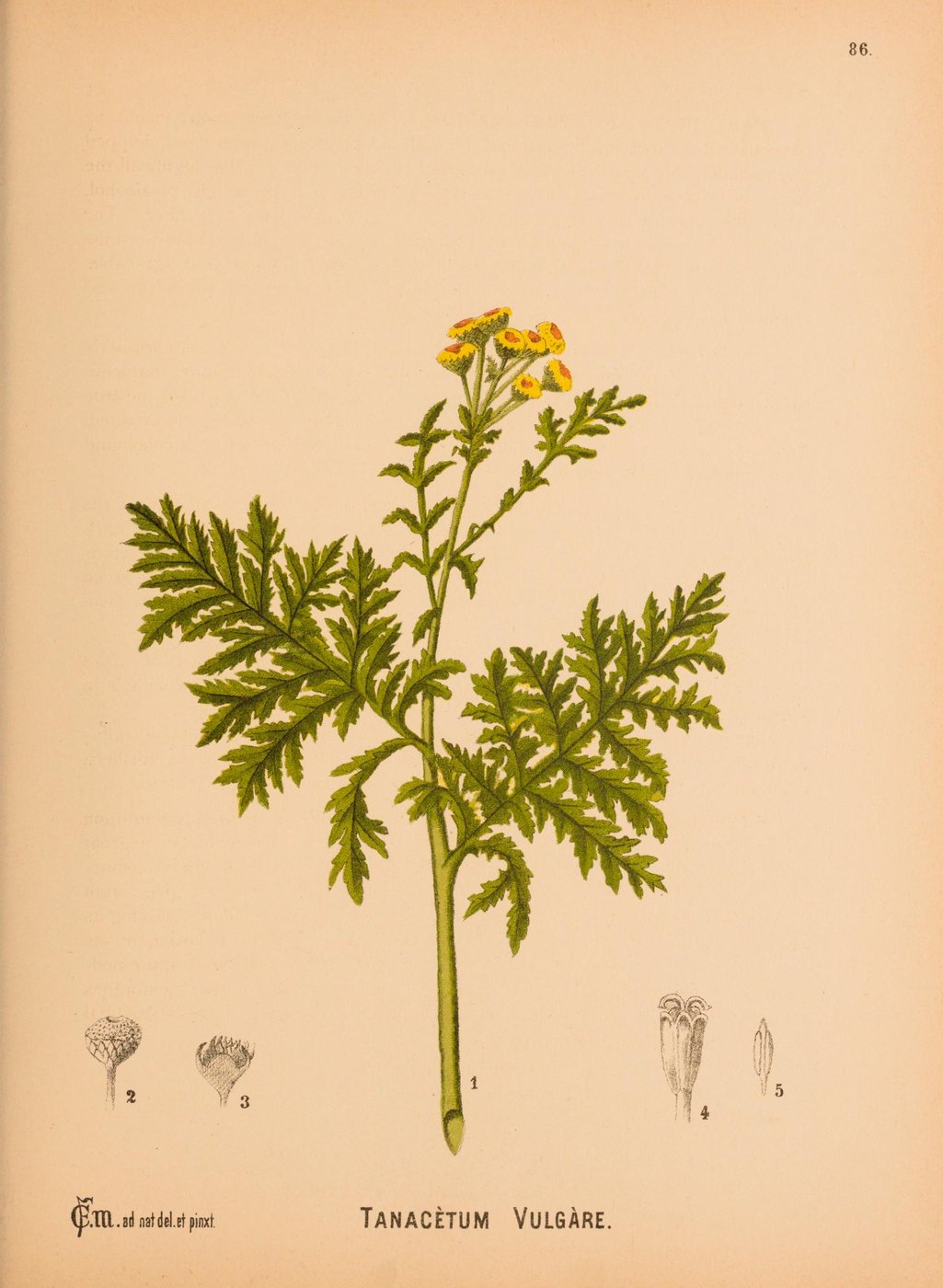
Tansy
Tanacetum
- Known today as
- Tanacetum vulgare.
- Kind
- Plant, in 3 older authorities
- Constituents
- thujone, camphor, parthenolide
- Poisoning
- Convulsant terpenes
- Earliest authority quoted here
- Charlemagne (c. 747–814)
- In other databases
- Plants of the World Online · GBIF · Wikidata
Revised October 19, 2026: Tradition, lore, modern assessment, and sources extended. Checked against its sources, each read in full, in part, or in its abstract. Corrected after an audit of each claim against the text its source gives. Version 1, first published September 25, 2026.
Caution. Poisonous in quantity.
Tansy: what was it used for?
Against worms and to provoke the menses; eaten at Easter in the “tansy” pudding.
Tansy: what does modern science say?
Its volatile oil is mainly thujone; in large doses, Grieve warns, tansy “becomes a violent irritant,” and “excessive doses have produced seizures.” Thujone, the toxic agent of absinthe, is also reported to be insecticidal, which bears out the old use against flies.
Tansy: how is it taken as a tea?
An ounce to a pint of boiling water, a teacupful night and morning fasting, to expel worms in children; in Scotland a half to one teaspoonful of the dried flowers and seeds for gout; an old country tea for fever.
All the herbal teas of the database. Historical directions, not medical advice.
Tansy: foraging it in the Midwest
- Part
- Flowers
- When
- Late summer
The Flambeau Ojibwe had no name of their own for it, saying it came from the south and was good for fevers; the yellow flowers went into the odorous hunting mixture smoked to attract deer. A roadside escape.
After Smith. All the foragables of the Midwest. Historical record, not a field guide: identify before you gather, and read the whole entry.
Tansy: is it poisonous?
Yes, in some form or dose. Poisonous in quantity. Its poisoning is convulsant terpenes: Minutes to an hour from the oils. Historical description, not medical advice; in a poisoning, call a poison centre.
The toxic dose and the poisoning
- Toxic dose
- Excessive doses have produced seizures (Grieve).
- Syndrome
- Convulsant terpenes
The references for these lines are listed under Pharmacognosy, in Science. Doses are as the references give them, for description only; this is not medical advice. In a poisoning, call a poison centre.
Tansy: what did the older authorities say?
- Charlemagnec. 747–814
- The Capitulare de villis names tansy, tanazitam, among the herbs the gardens of his estates are to have.
- The tansy of Easter
- Tansy cakes of the young leaves and eggs, Grieve writes, came to be eaten on Easter Day “as a remembrance of the bitter herbs eaten by the Jews at the Passover,” and Coles (1656) held that tansy “is very wholesome after the salt fish consumed during Lent.”
- Culpeper1616–1654
- Gives it for the womb, to help conception and prevent miscarriage, and bruised and laid on the navel against worms.
Tansy: what lore surrounds it?
The name, Grieve writes, “is probably derived from the Greek Athanaton (immortal), either, says Dodoens, because it lasts so long in flower or, as Ambrosius thought, because it is capital for preserving dead bodies from corruption. It was said to have been given to Ganymede to make him immortal.”
Pharmacognosy
- Constituents
- Mechanism
- Thujone blocks the GABA-A receptor and provokes convulsions.
- Checked against ChEMBL
- thujone: No measurement in ChEMBL for “blocks the GABA-A receptor” (15 activities recorded, none against the target named); the line rests on its references.
- Höld, K. M., et al. (2000). PNAS 97. Abstract read · the text read
The abstract of each source, beneath its citation. For Club members. About the Club or sign in.
Constituent names open the compound’s record at PubChem, and “ChEMBL” beside a name opens its record at ChEMBL, the European Bioinformatics Institute’s database of bioactive molecules. Where a mechanism line was checked against ChEMBL (ChEMBL 37, read 1 October 2026), the check is shown with the measured value and its source paper, or says plainly that nothing has been measured. Doses are as the references give them, for description only; this is not medical advice. Each source carries the result of its check against Crossref, PubMed, or the authority’s page: see Verification.
Sources
- Capitulare de villis (c. 800). Read in full · the text read
- Grieve, M. (1931). A Modern Herbal, “Tansy.” Read in full · the text read
Verification
- Checked
- October 1, 2026, October 17, 2026
- Passes
- Read against its sources in the fifty-entry sample
- Every dated or regulatory claim checked by category across the database
- The mechanism read against ChEMBL (ChEMBL 37): curated mechanisms and measured activity
- Every source read, in full, in part, or in its abstract, and every sentence checked against what was read (October 17, 2026)
- Sources
- 3 cited: 2 read in full, 1 abstract read. 1 with the abstract on file.
- Corrections
- A bare citation of Grieve's A Modern Herbal is removed; the entry already cites the article read.
What was checked, how, and what was found is set out on the Verification page. A checked source is one whose record was found; it does not make the entry medical advice.
Club members can point at a technical term in this entry, such as a constituent, an action, or a word of Jung’s, to read its definition from the source. The Club.
Cite This Entry
Version 1 · first published September 25, 2026 · last revised October 19, 2026
- Chicago
“Tansy.” In Materia Medica, edited by B. C. P. Statema. Version 1. The Thinking Press, 2026–. Last modified October 19, 2026. https://thethinkingpress.org/materia-medica/tansy.
- MLA
“Tansy.” Materia Medica, edited by B. C. P. Statema, version 1, The Thinking Press, 19 Oct. 2026, thethinkingpress.org/materia-medica/tansy. Accessed 22 Nov. 2026.
- APA
Tansy. (2026, October 19). In B. C. P. Statema (Ed.), Materia medica (Version 1). The Thinking Press. Retrieved November 22, 2026, from https://thethinkingpress.org/materia-medica/tansy
See Also
Poisoned alike: convulsant terpenes
Wormwood, oil of · Sage · Camphor · Rosemary · Eucalyptus · Mugwort · Hungary water · Mint, oil of · the syndrome, with all of them →
Sharing thujone, camphor, parthenolide
Artemisia abrotanum · Blessed herbs · Vinegar of the four thieves · Tanacetum parthenium
Also in Charlemagne
Houseleek in Charlemagne · Lovage in Charlemagne · everything Charlemagne names →
Also in Nicholas Culpeper
Toadflax in Nicholas Culpeper · Sundew in Nicholas Culpeper · Tormentil in Nicholas Culpeper · Strawberry in Nicholas Culpeper · everything Nicholas Culpeper names →
Drawing on the same sources: Grieve
Nearby in the alphabet
Tamarind (The pod pulp of Tamarindus indica) · Tea tree oil · Sweet flag (Acorus calamus) · Teonanácatl (Small mushrooms that turn blue where they are bruised) · Sweet almond, oil of (Oil pressed from sweet almonds)
Historical description, not medical advice.
