
The Symbolism of Dreams
Web edition, version 1.0, 10 October 2026
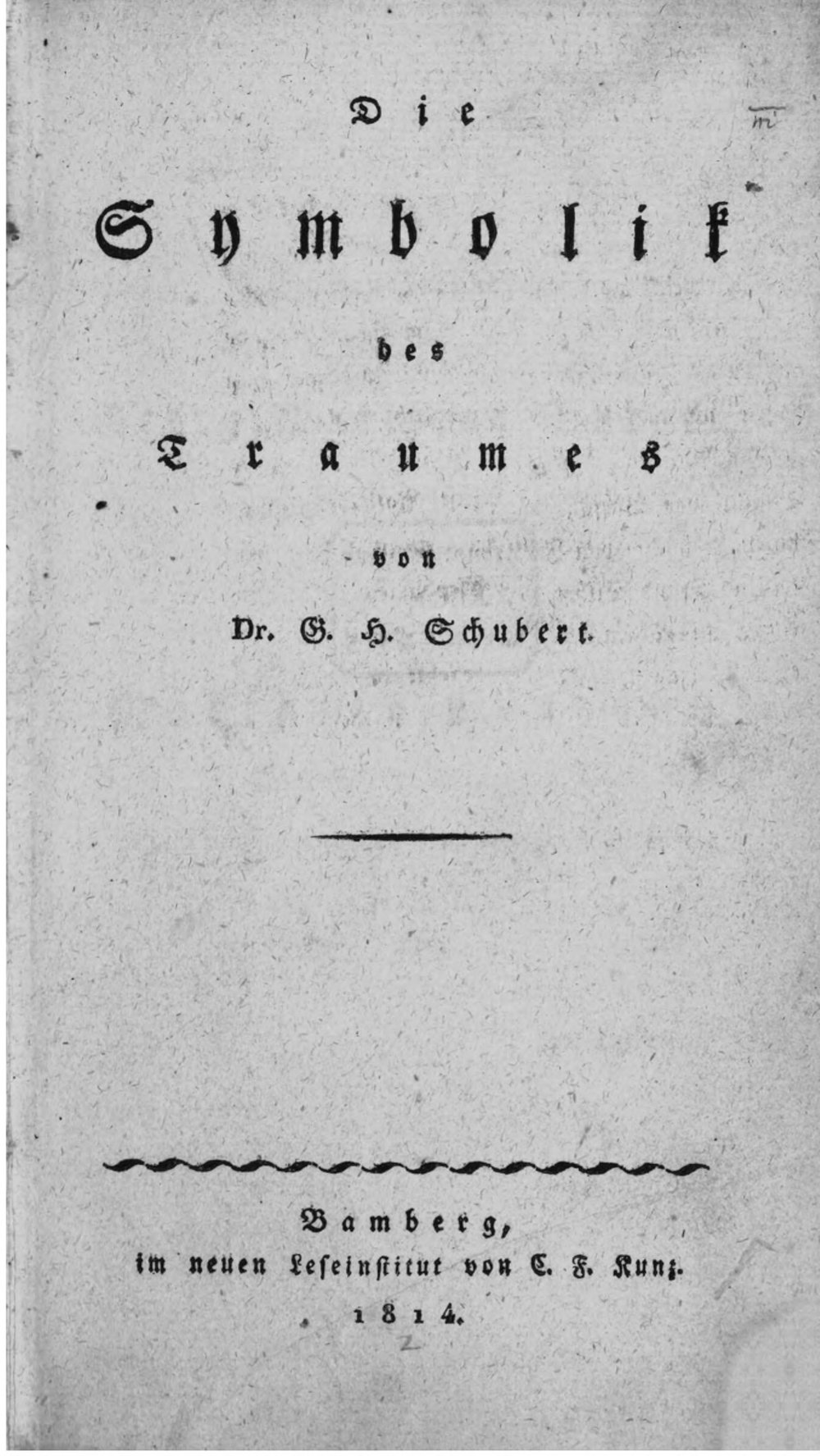
Title Page, Translator's Note, Preface, and 1. The Language of Dreams are free to read. The rest is for Club members: create a free account before January 1, 2027 and confirm your email, and you are a Charter Member, with every part, for good. Join the Club.
Gotthilf Heinrich Schubert (1780 to 1860), physician and naturalist, dated the preface of this book at Nuremberg on 17 April 1814. It was one of the most famous books of its time, and its influence reached E. T. A. Hoffmann and later Freud and Jung. It reads the dream as a language of images, the same language that poetry, prophecy and nature speak, and follows it into conscience, madness and somnambulism. This is its first English translation, as far as the press has been able to find.
- The edition
- G. H. Schubert, Die Symbolik des Traumes. Bamberg: im neuen Leseinstitut von C. F. Kunz, 1814. With a leaf of corrections.
- The text
- Translated from the page images of the Bayerische Staatsbibliothek’s copy (Ph.sp. 766), by way of the Internet Archive, with a Google scan of another copy of the 1814 printing as a check on hard readings. Schubert’s own list of corrections is carried into the text. The later editions (1821 and after) have not been compared. See the scanned book.
- Rights
- Schubert’s German text is in the public domain. The title page is reproduced from the Bayerische Staatsbibliothek’s copy, by way of the Internet Archive.
- Copyright
- Translation © 2026 B. C. P. Statema. The Thinking Press, Kenosha, Wisconsin. All rights reserved.
Translator’s Note
Gotthilf Heinrich Schubert (1780 to 1860), physician and naturalist, wrote this book while he was head of the Realschule at Nuremberg; his preface is dated there on 17 April 1814, and the book was printed that year at Bamberg by C. F. Kunz. It runs to 204 pages, with a leaf of corrections at the end.
This translation is made from the page images of the Bayerische Staatsbibliothek’s copy (shelfmark Ph.sp. 766), scanned by the library’s digitization centre and mirrored on the Internet Archive. The German was read from the images; the scan’s machine-read text was used only to find places, and a second scan of the 1814 printing, made by Google from a copy whose library is not named, was used as a check where a word was hard to read. Someone has entered a few of the printed corrections in pencil in the Munich copy; the translation follows the printed list, not the pencil. Every correction in Schubert’s own list, headed “Verbesserungen”, has been carried into the text, and the list itself is translated at the end, where alone the page and line numbers of 1814 are kept, since without them it would point nowhere.
The English keeps Schubert’s seven numbered sections and his paragraphs as he printed them. Each heading is given in English and then as Schubert printed it. His own footnotes stay beside the paragraph that carries them, with the marks he gave them (*, **, *a) and so on). Words he set in spaced type are in italics, and his dashes are given as commas, colons or parentheses. His Greek is kept in Greek letters. Once he sends the reader back to a page of his own book; the reference is given here as a link to the passage. The page numbers of 1814 are not reproduced.
The text is translated without modern commentary. A few notes, marked with a dagger and a roman numeral and gathered at the end, place a name or a book the reader could not otherwise place, and each says where its information comes from.
Read before you join
Passages from the parts that are for members, free to read:
- Death and the wedding From the symbolism of nature: the nightingale that sings of the rose over graves, and the insect that marries on the day it dies.
- The warning daemon From the hidden poet: the inner voice that stops a man on the path before the rock falls, and sends another out at midnight.
- The spirits of Mars From the confusion of languages: Swedenborg’s spirits who learned to speak without feeling, so that no one could understand them.
- The girl with two souls From the sixth section: a girl who lived two lives on alternate days, and a patient who woke each time as a French émigrée.
Contents
- Title PageFree to readTitelblatt1 min
- Translator's NoteFree to read2 min
- PrefaceFree to readVorrede.2 min
- 1. The Language of DreamsFree to read1. Die Sprache des Traumes.13 min
- 2. The Language of Poetry and of RevelationMembers2. Die Sprache der Poesie und der Offenbarung.12 min
- 3. The Symbolism of NatureMembers3. Die Symbolik der Natur.34 min
- 4. The Hidden PoetMembers4. Der versteckte Poet.16 min
- 5. Of a Babylonian Confusion of LanguagesMembers5. Von einer babylonischen Sprachenverwirrung.30 min
- 6. EchoMembers6. Die Echo.1 hr 7 min
- 7. The Deus ex MachinaMembers7. Der Deus ex Machina.42 min
- CorrectionsMembersVerbesserungen.2 min
- NotesMembers3 min
Your bookmarks and highlights
Sign in with your Club account to highlight passages and keep bookmarks. They are kept with your account, on every device.
Sources for this page
What this page and the Translator’s Note say about the author and the book, beyond the book itself, comes from these, read for it:
- English Wikipedia, “Gotthilf Heinrich von Schubert” (read in full)
- German Wikipedia, “Gotthilf Heinrich von Schubert” (read)
- English Wikipedia, “Battle of Paris (1814)” (read in full)
- Internet Archive, the title pages of Schubert’s Ahndungen (1806, 1807, and the second part’s second volume)
- English Wikipedia, “Louis Claude de Saint-Martin” (read)
- German Wikipedia, “Johann Arnold Kanne” (read in full)
- English Wikipedia, “Georg Friedrich Creuzer” (read)
- German Wikipedia, “Carl Alexander Ferdinand Kluge” (read)
- English Wikipedia, “Johann Christian Reil” (read)
- English Wikipedia, “Johann Heinrich Jung” (read)
- German Wikipedia, “Johann Henrich Reitz” (read in full)
- English Wikipedia, “Joseph Mason Cox” (read)
- Swedenborg, Earths in Our Solar System, Project Gutenberg eBook 16044 (the sections on Mars, read in full)
- Internet Archive, the scanned copy and its record
Revisions
- 1.0, 10 October 2026. First publication: the whole book, with the dedication, preface, seven sections and Schubert’s list of corrections.
