
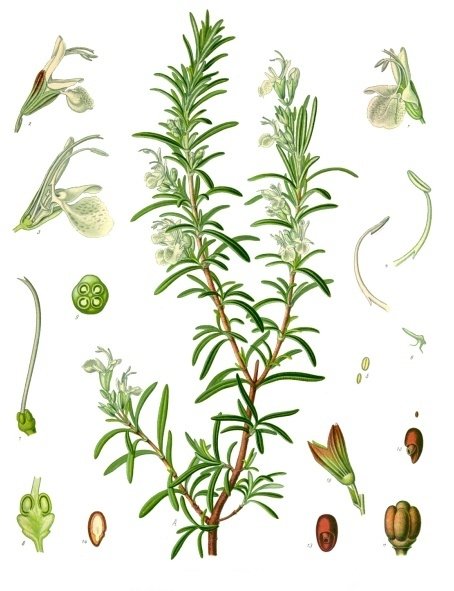
Rosemary
Ros marinus, “dew of the sea”
- Known today as
- Salvia rosmarinus (formerly Rosmarinus officinalis).
- Kind
- Plant, in 3 older authorities
- Constituents
- 1,8-cineole, camphor, rosmarinic acid, and 1 more
- Earliest authority here
- Dioscorides (c. AD 40–90)
- Qualities
- Hot and dry in the second degree (Galenic tradition). What the degrees mean
- In other databases
- Plants of the World Online search · GBIF search · Wikidata search
Revised October 1, 2026: Tradition, lore, modern assessment, and sources extended. Version 1, first published September 25, 2026.
Rosemary: what was it used for?
For the head and the memory, the palsy, and the weak stomach; burnt in sickrooms and churches as a cheap incense; the chief herb of Hungary water.
Rosemary: how is it taken as a tea?
The young tops, leaves, and flowers infused and taken warm, with care to keep the steam in, for headache, colic, colds, and nervous complaints.
All the herbal teas of the database. Historical directions, not medical advice.
Rosemary: what does modern science say?
Its carnosic acid and oil are antioxidant and antimicrobial in the laboratory; claims for memory rest on small studies. Its scent, breathed, improved speed on memory tasks in small studies at Northumbria University, and under a gram of the dried herb improved memory scores in one small trial of the elderly, while six grams impaired them; the oil in quantity can provoke seizures. Rosemary extract is now an approved antioxidant in foods.
Pharmacognosy & Toxicology
- Constituents
- 1,8-cineole ChEMBL
- camphor ChEMBL
- rosmarinic acid ChEMBL
- carnosic acid and carnosolthe antioxidant diterpenes
- Mechanism
- The oil on the skin is a rubefacient and counter-irritant, the Hungary water use; cineole in the breath raised alertness and memory scores in small trials of inhaled rosemary (Moss, 2003), which gives Ophelia’s remembrance a laboratory footnote; carnosic acid is a food antioxidant (E392). The oil in quantity is a convulsant by its camphor.
- Toxic dose
- The herb is safe; the oil swallowed at a few millilitres has caused seizures; not for epileptics.
- Syndrome
- Convulsant terpenes (thujone, pinocamphone, camphor)
- Standing
- EMA monographs (2011) for the leaf for dyspepsia and the oil for minor muscular pain and circulatory complaints, on tradition.
- EMA/HMPC (2011). Community herbal monograph on Rosmarinus officinalis L., folium (EMA/HMPC/457257/2010). Verified against its record
- Moss, M., et al. (2003). “Aromas of rosemary and lavender essential oils differentially affect cognition and mood in healthy adults.” International Journal of Neuroscience 113. Verified against its record · doi:10.1080/00207450390161903
The abstract of each source, beneath its citation. For Club members. About the Club or sign in.
Constituent names open the compound’s record at PubChem, and “ChEMBL” beside a name opens its record at ChEMBL, the European Bioinformatics Institute’s database of bioactive molecules. Where a mechanism line was checked against ChEMBL (ChEMBL 37, read 1 October 2026), the check is shown with the measured value and its source paper, or says plainly that nothing has been measured. Doses are as the references give them, for description only; this is not medical advice. Each source carries the result of its check against Crossref, PubMed, or the authority’s page: see Verification.
Rosemary: what lore surrounds it?
“There’s rosemary, that’s for remembrance,” says Ophelia. Carried at weddings and laid on coffins, it stood for fidelity and for memory of the dead. See Hungary water.
Sir Thomas More let it run over his garden walls “because it is the herb sacred to remembrance, and therefore to friendship.” Sprigs are worn on Anzac Day in Australia, since rosemary grows wild on the Gallipoli peninsula.
Used in These Compounds
Rosemary is an ingredient of 3 compound medicines in the database. For Club members. Create a free account or sign in.
Rosemary: what did the older authorities say?
- Dioscorides
- Gives libanotis, the rosemary, as warming, for the jaundice and before exercise, and the Romans burned it in rites where incense was too dear.
- Charlemagne
- Ordered it grown on the imperial farms in the Capitulare de villis of about 800, and the monasteries kept it; it reached England before the Conquest, and Queen Philippa’s mother sent her cuttings from Antwerp in 1338 with a treatise on its virtues.
- The Greek students
- Wore garlands of it at their examinations to strengthen the memory, a custom still invoked by its sellers.
Sources
- Gerard, J. (1597). The Herball. Verified against its record · doi:10.5962/bhl.title.99400
- Shakespeare, Hamlet IV.5. Book, not indexed
- Grieve, M. A Modern Herbal, “Rosemary.” As published on botanical.com. Standard reference work
- Moss, M., et al. (2003). “Aromas of rosemary and lavender essential oils differentially affect cognition and mood.” International Journal of Neuroscience 113. Verified against its record · doi:10.1080/00207450390161903
- Capitulare de villis (c. 800). Book, seen in reviews
Verification
- Checked
- October 1, 2026
- Passes
- Every sentence read against its sources, in the fifty-entry sample
- The Standing line checked against the authority it names (EMA, WHO, FDA, CITES, Commission E)
- Every dated or regulatory claim checked by category across the database
- Sources
- 7 cited: 4 verified against its record, 1 standard reference work, 1 book, seen in reviews, 1 book, not indexed. 2 with the abstract on file.
- Corrections
- the elderly memory trial used 750 mg, not "a teaspoon," and 6 g impaired.
What was checked, how, and what was found is set out on the Verification page. A checked source is one whose record was found; it does not make the entry medical advice.
Cite This Entry
Version 1 · first published September 25, 2026 · last revised October 1, 2026
- Chicago
“Rosemary.” In Materia Medica, edited by B. C. P. Statema. Version 1. The Thinking Press, 2026–. Last modified October 1, 2026. https://thethinkingpress.org/materia-medica/rosemary.
- MLA
“Rosemary.” Materia Medica, edited by B. C. P. Statema, version 1, The Thinking Press, 1 Oct. 2026, thethinkingpress.org/materia-medica/rosemary. Accessed 8 Oct. 2026.
- APA
Rosemary. (2026, October 1). In B. C. P. Statema (Ed.), Materia medica (Version 1). The Thinking Press. Retrieved October 8, 2026, from https://thethinkingpress.org/materia-medica/rosemary
Club members keep entries on a shelf with private notes, print the plates as cards, and receive an entry by email each week. Create a free account before January 1, 2027 and all of it is yours for good. About the Club
See Also
Poisoned alike: convulsant terpenes (thujone, pinocamphone, camphor)
Sage · Mugwort · Tansy · Mint, oil of · Wormwood, oil of · Hyssop · Camphor · Hungary water · the syndrome, with all of them →
Sharing 1,8-cineole, camphor, rosmarinic acid
Artemisia abrotanum · Elettaria cardamomum · Laurus nobilis · Paregoric
Also in Dioscorides
Rue in Dioscorides · Rose in Dioscorides · Saffron in Dioscorides · Rocket in Dioscorides · everything Dioscorides names →
Drawing on the same sources: Gerard, Shakespeare, Grieve
Purslane · Self-heal · Toad · Marigold · Toadstone · Rosemary rice water · Radish · the bibliography →
Of the same qualities: hot and dry
Parsley · Onion · St. John’s wort · Myrrh · what the degrees mean →
Nearby in the alphabet
Round birthwort (Aristolochia rotunda) · Rosary (Strings of prayer beads) · Rowan (Sorbus aucuparia) · Roquefort mould (The blue mould of blue cheeses) · The Roman Ritual (issued by Pope Paul V in 1614, the year of Canale’s treatise)

Historical description, not medical advice.