
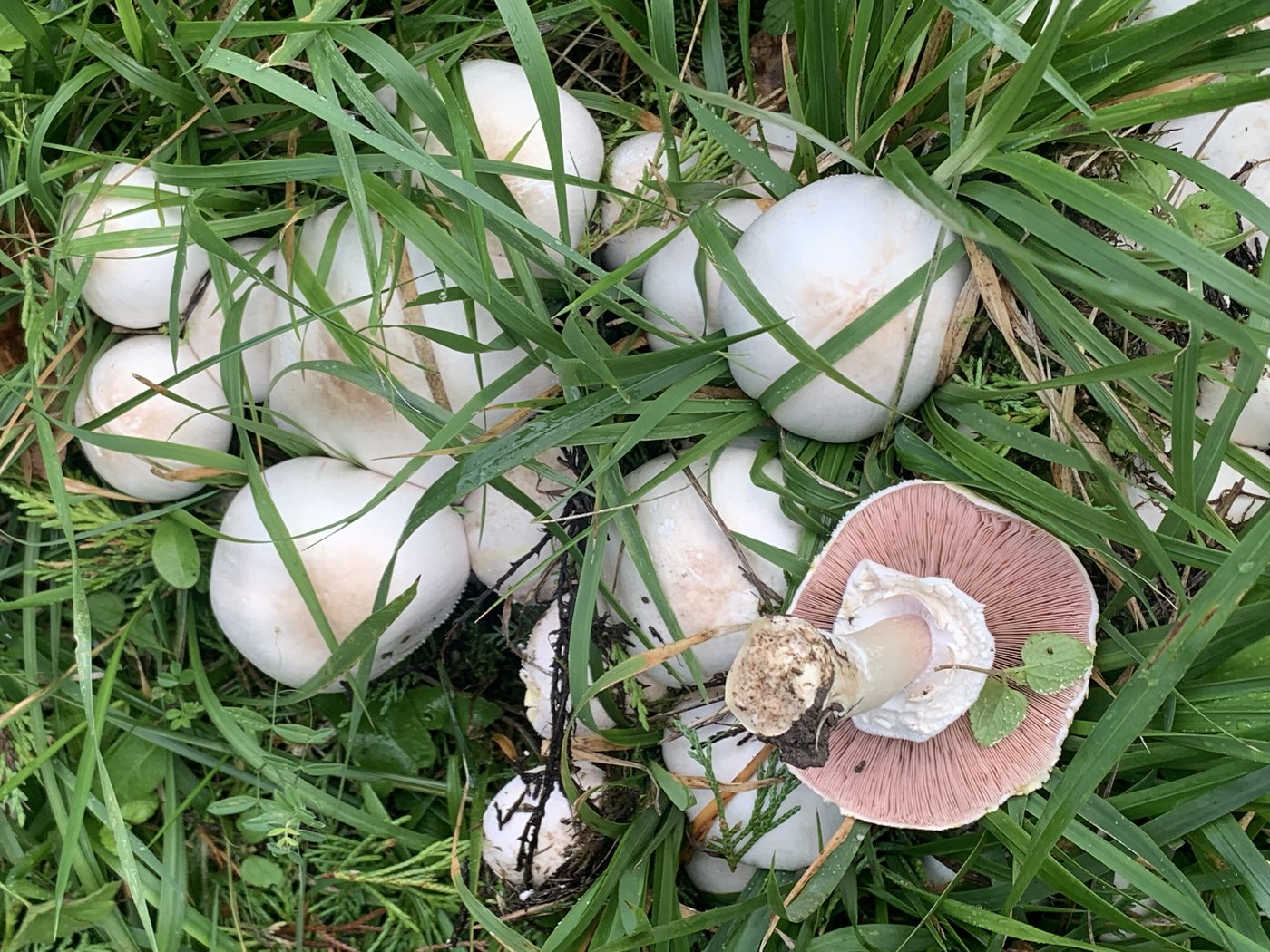
Yellow stainer
Agaricus xanthodermus
- Known today as
- A white Agaricus whose cap and stem base stain vivid yellow when bruised, and whose crushed stem base smells of phenol.
- Kind
- Fungus
- Constituents
- phenol, 4,4'-dihydroxyazobenzene
- Poisoning
- Gastrointestinal irritants
- In other databases
- GBIF search · Wikidata search
Revised October 17, 2026: Checked against its sources, each read in full, in part, or in its abstract. Version 1, first published September 25, 2026.
Caution. Poisonous.
Yellow stainer: what was it used for?
None.
Yellow stainer: what does modern science say?
In ten years of poisonings in South Sardinia it caused abdominal pain and cramps, diarrhoea, nausea and vomiting, beginning on average two hours after the meal.
Yellow stainer: is it poisonous?
Yes, in some form or dose. Poisonous. Its poisoning is gastrointestinal irritants: Thirty minutes to three hours: the short latency is reassuring, since the deadly syndromes come later. Historical description, not medical advice; in a poisoning, call a poison centre.
The toxic dose and the poisoning
- Toxic dose
- A meal; in the Sardinian series symptoms began on average two hours later.
- Syndrome
- Gastrointestinal irritants
The references for these lines are listed under Pharmacognosy, in Science. Doses are as the references give them, for description only; this is not medical advice. In a poisoning, call a poison centre.
Yellow stainer: what lore surrounds it?
Kin to the cultivated button mushroom, and one of the toxic species most often behind mushroom poisonings in South Sardinia.
In Their Own Words
George Massee describes Agaricus xanthodermus as having a skin that yellows when touched and white flesh that turns yellow when broken, with deep yellow flesh at the base of the stem.
“…cuticle becoming yellowish when touched, and the white flesh changing to yellow when broken; g. free, sinuate, pale rose then grey, finally purple-brown; s. cylindrical, stuffed, ring thin, flesh deep yellow at base, rest white”
George Massee, F.L.S., European Fungus Flora: Agaricaceae, Psalliota, Ag. xanthodermus. London: Duckworth & Co., 3 Henrietta Street, W.C., 1902 (Project Gutenberg eBook #33013). The text, read in part
Each passage is quoted from the text named, which the press fetched and read, and was checked word for word against a fresh copy of it; the link opens that copy. Passages are given as printed, without the editors’ footnote numbers, and with words broken across lines joined.
Pharmacognosy
- Constituents
- phenol ChEMBLthe phenolic smell, and enough of it to account for the toxicity
- 4,4'-dihydroxyazobenzenethe first azo compound known to arise endogenously in nature
- Mechanism
- Phenol is present in the fruit bodies in high enough concentration to account for the toxicity. The species is named among the gastrointestinal irritants that cause a self-limited gastroenteritis of rapid onset.
- Standing
- None.
- Gill, M., and Strauch, R. J. (1984). “Constituents of Agaricus xanthodermus: the first naturally endogenous azo compound.” Zeitschrift für Naturforschung C 39. Abstract read · the text read
The abstract of each source, beneath its citation. For Club members. About the Club or sign in.
Constituent names open the compound’s record at PubChem, and “ChEMBL” beside a name opens its record at ChEMBL, the European Bioinformatics Institute’s database of bioactive molecules. Where a mechanism line was checked against ChEMBL (ChEMBL 37, read 1 October 2026), the check is shown with the measured value and its source paper, or says plainly that nothing has been measured. Doses are as the references give them, for description only; this is not medical advice. Each source carries the result of its check against Crossref, PubMed, or the authority’s page: see Verification.
Sources
- Qi, Z., et al. (2026). Integrative taxonomy of Agaricus subgen. Pseudochitonia in arid northwestern China. Journal of Fungi 12: 512. Read in full · the text read
- La Rosa, L., Corrias, S., Pintor, I., & Cosentino, S. (2024). Epidemiology and clinical aspect of mushroom poisonings in South Sardinia: a 10-year retrospective analysis (2011–2021). Food Science & Nutrition 12: 430–438. Read in full · the text read
- Oprita, B., et al. (2025). Wild/woodland mushroom poisoning: the experience of Bucharest Emergency Hospital. Journal of Fungi 11: 578. Read in full · the text read
Verification
- Checked
- October 1, 2026, October 17, 2026
- Passes
- Read against its sources in the pass over the remaining 343 entries
- Every dated or regulatory claim checked by category across the database
- Every source read, in full, in part, or in its abstract, and every sentence checked against what was read (October 17, 2026)
- Sources
- 4 cited: 3 read in full, 1 abstract read. 1 with the abstract on file.
- Corrections
- None recorded.
What was checked, how, and what was found is set out on the Verification page. A checked source is one whose record was found; it does not make the entry medical advice.
Club members can point at a technical term in this entry, such as a constituent, an action, or a word of Jung’s, to read its definition from the source. The Club.
Cite This Entry
Version 1 · first published September 25, 2026 · last revised October 17, 2026
- Chicago
“Yellow stainer.” In Materia Medica, edited by B. C. P. Statema. Version 1. The Thinking Press, 2026–. Last modified October 17, 2026. https://thethinkingpress.org/materia-medica/yellow-stainer.
- MLA
“Yellow stainer.” Materia Medica, edited by B. C. P. Statema, version 1, The Thinking Press, 17 Oct. 2026, thethinkingpress.org/materia-medica/yellow-stainer. Accessed 22 Nov. 2026.
- APA
Yellow stainer. (2026, October 17). In B. C. P. Statema (Ed.), Materia medica (Version 1). The Thinking Press. Retrieved November 22, 2026, from https://thethinkingpress.org/materia-medica/yellow-stainer
See Also
Poisoned alike: gastrointestinal irritants
Bryony · The sickener · Caper spurge · Scammony · Castor-oil plant, seeds of · Pokeweed · Colocynth · Morel · the syndrome, with all of them →
Nearby in the alphabet
Yerba mate · Yellow dock (Rumex crispus) · Yew (Taxus baccata) · Yarrow (Achillea millefolium) · Zedoary (of the ginger family, a bitter, camphor-scented root from India) · Wormwood, oil of (Artemisia absinthium) · Abracadabra (one letter shorter each time, into a narrowing triangle) · Woody nightshade
Historical description, not medical advice.

