
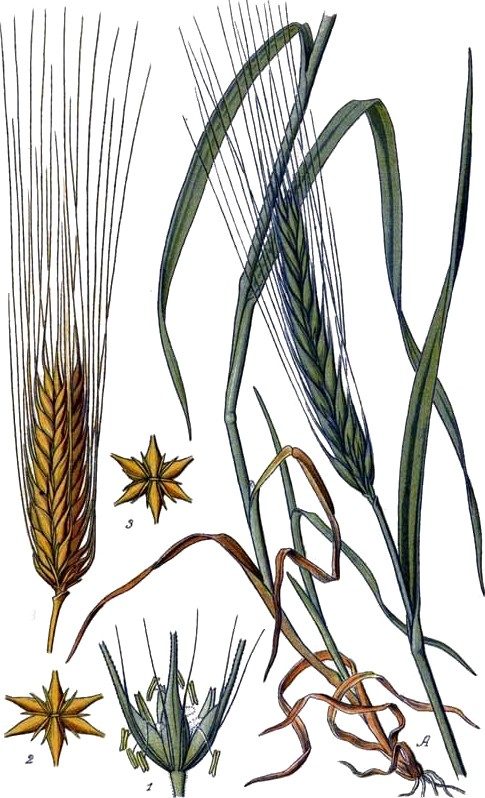
Barley water
Acqua d’orzo
- Known today as
- A thin decoction of barley.
- Kind
- Food & Drink, in 1 older authority
- Constituents
- beta-glucan, starch, B vitamins
- Earliest authority here
- Pliny (AD 23/24–79)
- In the Canale glossary
- On the Manner of Discerning and Healing the Bewitched, Appendix A: Part Three, Chapter 5: Vomitory Medicines
Revised October 3, 2026: An older authority added from a text read in full. Checked against its sources, each read in full, in part, or in its abstract. Version 1, first published September 25, 2026.
Barley water: what did Canale use it for?
The base of the mildest vomits, or rich meat broth in its place (ch. 5).
Barley water: what does modern science say?
A soothing, demulcent drink, the vehicle here for the other ingredients.
Pharmacognosy & Toxicology
- Constituents
- beta-glucana soluble fibre
- starch ChEMBLabout 80 per cent of pearl barley
- B vitaminsniacin and thiamine
- Mechanism
- A bland, demulcent, nourishing drink, given in fevers and catarrhs and to dilute cow’s milk for infants; barley beta-glucan, at 3 g a day, lowers blood cholesterol, the claim authorised for barley in the European Union.
- Toxic dose
- A food.
- Standing
- A food; the European Food Safety Authority concluded in 2011 that barley beta-glucans lower LDL cholesterol, and the claim was authorised in 2012.
Constituent names open the compound’s record at PubChem, and “ChEMBL” beside a name opens its record at ChEMBL, the European Bioinformatics Institute’s database of bioactive molecules. Where a mechanism line was checked against ChEMBL (ChEMBL 37, read 1 October 2026), the check is shown with the measured value and its source paper, or says plainly that nothing has been measured. Doses are as the references give them, for description only; this is not medical advice. Each source carries the result of its check against Crossref, PubMed, or the authority’s page: see Verification.
What Medicine Makes of It
- Ergot and the Witch TrialsThe 1976 hypothesis, and why most historians reject it.
- Fasting, Vigil, and VisionWhat hunger and sleeplessness do to the senses.
Barley water: what lore surrounds it?
Strained barley water, ptisane, was one of the great remedies of Hippocratic medicine. Hippocrates wanted the barley “well boiled,” since in the boiling it swells as much as it can and so does not swell in the bowels; according to the food historian of Pass the Flamingo, Galen repeated the warning centuries later and named flavourings for it, olive oil, salt, cumin, honeyed wine, and vinegar, though he preferred dill and leeks. The same writer notes that water boiled with grain would have been safer to drink than fresh water.
Barley water: what did the older authorities say?
- Pliny
- Of ptisan, the barley gruel of the Greeks, he says they “have written in such high terms of the praises of ptisan” that the Roman alica cannot be old; he gives nettle taken with a ptisan to ease expectoration, bulbs of asphodel boiled with a ptisan for consumption, and the smooth acanthus “boiled with the food, a ptisan more particularly,” for ruptures and spasms.
Sources
- [16] The British Pharmaceutical Codex (1911). London: Pharmaceutical Society of Great Britain. Monographs as transcribed at Henriette’s Herbal Homepage, henriettes-herb.com. Read in full · the text read
- Pass the Flamingo, on ancient barley water. Read in full · the text read
- Pliny the Elder, Natural History 22.61, 22.15, 22.32, 22.34, trans. J. Bostock & H. T. Riley (1855), Perseus Digital Library. Read in part · the text read
- Hippocrates. On Regimen in Acute Diseases, trans. F. Adams (1849). Wikisource. Read in full · the text read
- European Commission (2012). Commission Regulation (EU) No 1048/2012 of 8 November 2012 on the authorisation of a health claim made on foods and referring to the reduction of disease risk. Official Journal of the European Union L 310: 38–40. Read in full · the text read
- “Beta-glucan.” Wikipedia (read 2 October 2026). Read in full · the text read
- Canale, F. (1622). Del modo di conoscer et sanare i maleficiati. Brescia. Read in part · the text read
Verification
- Checked
- October 1, 2026, and October 3, 2026
- Passes
- Every sentence read against its sources, in the pass over the remaining 343 entries
- The Standing line checked against the authority it names (EMA, WHO, FDA, CITES, Commission E)
- Every dated or regulatory claim checked by category across the database
- Each quotation from the older authorities checked word for word against the text, read in full
- Every source read, in full, in part, or in its abstract, and every sentence checked against what was read (October 3, 2026)
- Sources
- 7 cited: 5 read in full, 2 read in part.
- Corrections
- None were needed.
What was checked, how, and what was found is set out on the Verification page. A checked source is one whose record was found; it does not make the entry medical advice.
Cite This Entry
Version 1 · first published September 25, 2026 · last revised October 3, 2026
- Chicago
“Barley water.” In Materia Medica, edited by B. C. P. Statema. Version 1. The Thinking Press, 2026–. Last modified October 3, 2026. https://thethinkingpress.org/materia-medica/barley-water.
- MLA
“Barley water.” Materia Medica, edited by B. C. P. Statema, version 1, The Thinking Press, 3 Oct. 2026, thethinkingpress.org/materia-medica/barley-water. Accessed 8 Oct. 2026.
- APA
Barley water. (2026, October 3). In B. C. P. Statema (Ed.), Materia medica (Version 1). The Thinking Press. Retrieved October 8, 2026, from https://thethinkingpress.org/materia-medica/barley-water
Club members keep entries on a shelf with private notes, print the plates as cards, and receive an entry by email each week. Create a free account before January 1, 2027 and all of it is yours for good. About the Club
See Also
Sharing beta-glucan, starch, B vitamins
Saccharomyces cerevisiae · Ganoderma lingzhi · Malva sylvestris · Curcuma zedoaria
Also in Pliny the Elder
Ben-nut in Pliny the Elder · Balm of Gilead in Pliny the Elder · Bitter aloes in Pliny the Elder · Asarabacca in Pliny the Elder · everything Pliny the Elder names →
Drawing on the same sources: Canale
Blessed herbs · The amulet herbs · Damascus prunes · the bibliography →
Nearby in the alphabet
Basil (Ocimum basilicum) · Balsam of Peru (vanilla-scented balsam from Myroxylon balsamum var) · Bells (and wrongly, called their “baptism) · Balm (Melissa officinalis) · Benzoin (the resin of Styrax benzoin of Sumatra) · Aurum potabile (Gold dissolved or suspended in liquid for drinking)
Historical description, not medical advice.