
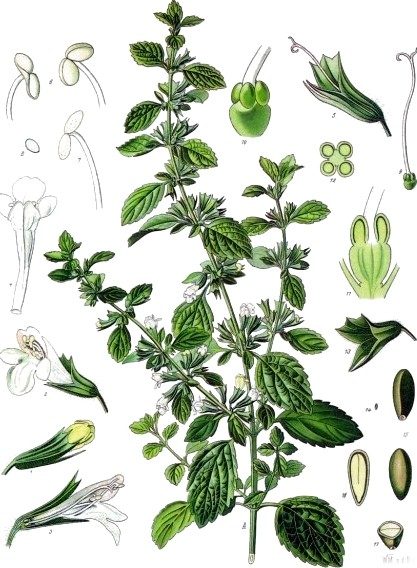
Balm
Melissa
- Known today as
- Lemon balm, Melissa officinalis.
- Kind
- Plant, in 1 older authority
- Constituents
- citral, rosmarinic acid, citronellal
- Earliest authority here
- Paris, 1611
- Qualities
- Hot and dry in the second degree (Galenic tradition). What the degrees mean
- In other databases
- Plants of the World Online search · GBIF search · Wikidata search
- In the Canale glossary
- On the Manner of Discerning and Healing the Bewitched, Appendix A: Treatise One, Part Three, Chapters 2–3: Purgative and Preparative Medicines
Balm: what did Canale use it for?
Its distilled water in the melancholic preparative (ch. 3).
Balm: how is it taken as a tea?
An ounce of the herb to a pint of boiling water: a pleasant, cooling tea for feverish colds and influenza, Grieve says, and the fresh leaves make a better tea than the dry.
All the herbal teas of the database. Historical directions, not medical advice.
Balm: what does modern science say?
Lemon balm has mild calming effects supported by small modern trials. It was an early modern remedy for low spirits.
Pharmacognosy & Toxicology
- Constituents
- citral ChEMBLgeranial and neral, the lemon scent
- rosmarinic acid ChEMBLup to 6 per cent of the leaf
- citronellal ChEMBL
- Mechanism
- Rosmarinic acid inhibits GABA transaminase, which raises GABA in the brain and accounts for the measured calming; the extract also binds muscarinic and nicotinic receptors, and lemon balm cream shortens cold sores by its tannin-polyphenol action on the herpes virus.
- Checked against ChEMBL
- rosmarinic acid: No measurement in ChEMBL for “inhibits GABA transaminase” (369 activities recorded, none against the target named); the line rests on its references.
- Toxic dose
- Safe at tea and extract doses; 600 mg of extract calmed laboratory-induced stress in a placebo-controlled trial (Kennedy, 2004).
- Standing
- EMA monograph (2013) for mild stress and sleep; a 2021 meta-analysis of trials found reductions in anxiety and depression scores, with the usual caveats about trial quality.
- EMA/HMPC (2013). Community herbal monograph on Melissa officinalis L., folium (EMA/HMPC/196745/2012). Verified against its record
- Kennedy, D. O., et al. (2004). “Attenuation of laboratory-induced stress in humans after acute administration of Melissa officinalis.” Psychosomatic Medicine 66. Abstract read · the text read
- Ghazizadeh, J., et al. (2021). “The effects of lemon balm on depression and anxiety in clinical trials: a systematic review and meta-analysis.” Phytotherapy Research 35. Verified against its record · doi:10.1002/ptr.7252
The abstract of each source, beneath its citation. For Club members. About the Club or sign in.
Constituent names open the compound’s record at PubChem, and “ChEMBL” beside a name opens its record at ChEMBL, the European Bioinformatics Institute’s database of bioactive molecules. Where a mechanism line was checked against ChEMBL (ChEMBL 37, read 1 October 2026), the check is shown with the measured value and its source paper, or says plainly that nothing has been measured. Doses are as the references give them, for description only; this is not medical advice. Each source carries the result of its check against Crossref, PubMed, or the authority’s page: see Verification.
What Medicine Makes of It
- Melancholy and the DemonThe black bile, the devil’s bath, and depression.
Balm: what lore surrounds it?
Melissa is the Greek for honeybee: the plant was grown for the hives.
Balm: what did the older authorities say?
- Paris, 1611
- The Carmelites of the rue de Vaugirard began distilling their eau de mélisse, Carmelite water, sold for centuries against faintness and melancholy.
Sources
- [28] Culpeper, N. (1653). Pharmacopœia Londinensis, or, The London Dispensatory [the Royal College of Physicians’ pharmacopoeia in English, with Culpeper’s commentary]. London: Peter Cole. Text Creation Partnership edition A35381. Read in part · the text read
- [41] European Medicines Agency, Committee on Herbal Medicinal Products (HMPC). Herbal monographs, assessment reports and public statements, ema.europa.eu, cited under the herb concerned: aniseed (summary, EMA/305345/2016); Aristolochia (public statement, EMEA/HMPC/138381/2005); asarone (public statement, EMEA/HMPC/139215/2005); caraway (EMA/HMPC/715092/2013); centaury (EMA/HMPC/277493/2015); chicory root (assessment report, EMA/HMPC/113041/2010); cinnamon (EMA/HMPC/246774/2009); clove (assessment report, EMA/HMPC/534946/2010); ethanol in herbal products (reflection paper, EMA/HMPC/85114/2008); fennel (EMEA/HMPC/372839/2016, Rev. 1, 2024); fumitory (draft assessment report, EMA/HMPC/367013/2021); greater celandine (public statement, EMA/HMPC/743927/2010); hops (EMA/HMPC/682384/2013); horehound (EMA/HMPC/604271/2012); mallow (assessment report, EMA/HMPC/749518/2016); marshmallow root (Althaeae radix); melissa (summary, EMA/HMPC/310761/2013); myrrh (assessment report and monograph, EMA/HMPC/96910/2010 and 96911/2010); peppermint oil (assessment report, EMEA/HMPC/349465/2006); pyrrolizidine alkaloids (public statement, EMA/HMPC/893108/2011); rhubarb (EMA/HMPC/113700/2019); sage (Salviae officinalis folium); wormwood (EMA/HMPC/751490/2016). Read in full · the text read
- [51] Ghazizadeh, J., Sadigh-Eteghad, S., Marx, W., et al. (2021). The effects of lemon balm (Melissa officinalis L.) on depression and anxiety in clinical trials: a systematic review and meta-analysis. Phytotherapy Research 35(12): 6690–6705. doi:10.1002/ptr.7252 Verified against its record · doi:10.1002/ptr.7252
- Grieve, M. A Modern Herbal, “Balm.” As published on botanical.com.
Verification
- Checked
- October 1, 2026
- Passes
- Every sentence read against its sources, in the fifty-entry sample
- The Standing line checked against the authority it names (EMA, WHO, FDA, CITES, Commission E)
- Every dated or regulatory claim checked by category across the database
- The mechanism read against ChEMBL (ChEMBL 37): curated mechanisms and measured activity
- Sources
- 7 cited: 1 read in full, 1 read in part, 1 abstract read, 3 verified against its record, 1 not yet checked. 2 with the abstract on file.
- Corrections
- None were needed.
What was checked, how, and what was found is set out on the Verification page. A checked source is one whose record was found; it does not make the entry medical advice.
Cite This Entry
Version 1 · first published September 25, 2026
- Chicago
“Balm.” In Materia Medica, edited by B. C. P. Statema. Version 1. The Thinking Press, 2026–. Last modified September 25, 2026. https://thethinkingpress.org/materia-medica/balm.
- MLA
“Balm.” Materia Medica, edited by B. C. P. Statema, version 1, The Thinking Press, 25 Sept. 2026, thethinkingpress.org/materia-medica/balm. Accessed 8 Oct. 2026.
- APA
Balm. (2026, September 25). In B. C. P. Statema (Ed.), Materia medica (Version 1). The Thinking Press. Retrieved October 8, 2026, from https://thethinkingpress.org/materia-medica/balm
Club members keep entries on a shelf with private notes, print the plates as cards, and receive an entry by email each week. Create a free account before January 1, 2027 and all of it is yours for good. About the Club
See Also
Sharing citral, rosmarinic acid
Citrus medica · Verbena officinalis · Origanum vulgare · Ocimum basilicum · Prunella vulgaris · Symphytum officinale · Salvia officinalis
Drawing on the same sources: Grieve, Kennedy
Betony · Asarabacca · Bladderwrack · Carmelite water · the bibliography →
Of the same qualities: hot and dry
Asafoetida · Bitter aloes · Aniseed · Black hellebore · Wormwood, oil of · what the degrees mean →
Nearby in the alphabet
Balm of Gilead (The resin of Commiphora gileadensis) · Aurum potabile (Gold dissolved or suspended in liquid for drinking) · Balsam of Peru (vanilla-scented balsam from Myroxylon balsamum var) · Aster (Aster amellus) · Barley water (A thin decoction of barley) · The aspergillum (or perforated ball on a handle, with which holy water is sprinkled)
Historical description, not medical advice.