
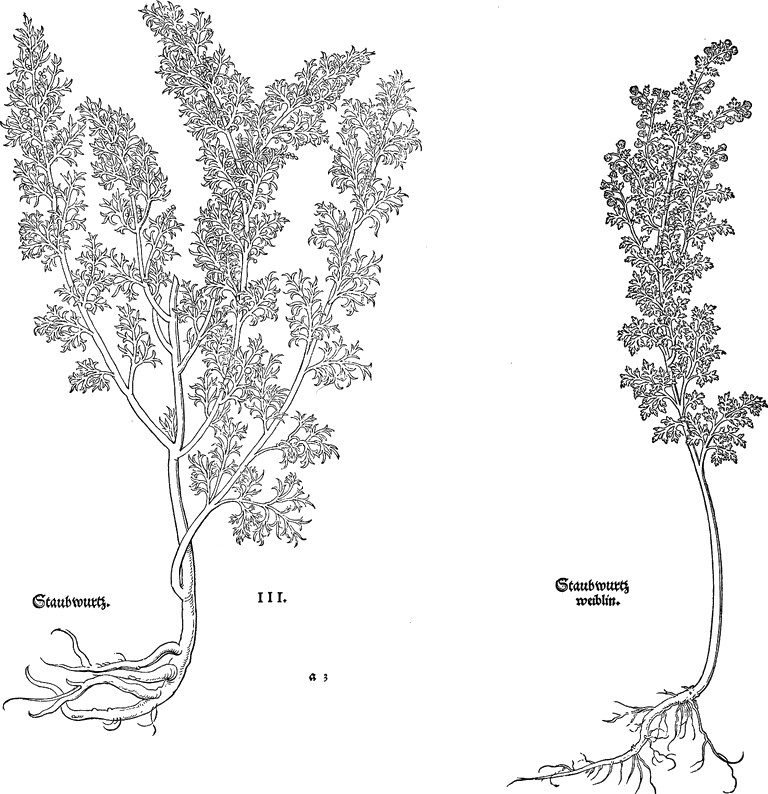
Southernwood
Abrotano
- Known today as
- Artemisia abrotanum, “lad’s love.”
- Kind
- Plant, in 2 older authorities
- Constituents
- 1,8-cineole, davanone, thujone, and 2 more
- Earliest authority here
- Dioscorides (c. AD 40–90)
- In other databases
- Plants of the World Online search · GBIF search · Wikidata search
- In the Canale glossary
- On the Manner of Discerning and Healing the Bewitched, Appendix A: Part Three, Chapter 10: Amulets
Revised October 1, 2026: Tradition, lore, modern assessment, and sources extended. Version 1, first published September 25, 2026.
Southernwood: what did Canale use it for?
Hung about the neck, and for fumigations and decoctions (ch. 10).
Southernwood: what does modern science say?
Aromatic and moth-repellent. Its oil is rich in thujone and other terpenes that repel insects in the laboratory; there is no evidence for hair or for serpents.
Pharmacognosy & Toxicology
- Constituents
- 1,8-cineole ChEMBL
- davanone
- thujone ChEMBLvariable, low
- abrotaninean alkaloid
- coumarins
- Mechanism
- An artemisia with a bitter and an oil that is antimicrobial and insect-repellent, the lad’s-love of the linen chest; worn at the neck it is a scent. A nasal spray of southernwood extract was tested for allergic rhinitis in a small open study (Remberg, 2004) and no more.
- Toxic dose
- Safe at tea doses; the oil in quantity, like other artemisias, is a convulsant.
- Standing
- No monograph.
- Remberg, P., et al. (2004). “Characteristics, clinical effect profile and tolerability of a nasal spray preparation of Artemisia abrotanum L. for allergic rhinitis.” Phytomedicine 11. Verified against its record · doi:10.1078/0944-7113-00350
The abstract of each source, beneath its citation. For Club members. About the Club or sign in.
Constituent names open the compound’s record at PubChem, and “ChEMBL” beside a name opens its record at ChEMBL, the European Bioinformatics Institute’s database of bioactive molecules. Where a mechanism line was checked against ChEMBL (ChEMBL 37, read 1 October 2026), the check is shown with the measured value and its source paper, or says plainly that nothing has been measured. Doses are as the references give them, for description only; this is not medical advice. Each source carries the result of its check against Crossref, PubMed, or the authority’s page: see Verification.
Southernwood: what lore surrounds it?
Boys carried a sprig to court girls, whence lad’s love; it was laid among clothes against the moth, as its French name garde-robe says, and carried to church with the Bible to be smelled against drowsiness in the sermon.
Southernwood: what did the older authorities say?
- Dioscorides
- Gives abrotonon, boiled in wine, against poisons and the bite of serpents, and the smoke of it to drive serpents from the house.
- Culpeper
- Says the ashes mixed with oil make the hair grow on a bald head or a beardless chin, which gave it the names lad’s love and old man.
Sources
- [94] North Carolina State Extension. Artemisia abrotanum. North Carolina Extension Gardener Plant Toolbox. plants.ces.ncsu.edu. Book, not indexed
- Dioscorides, De materia medica III. Read in part · the text read
- Grieve, M. (1931). A Modern Herbal, “Southernwood.” Book, seen in reviews
Verification
- Checked
- October 1, 2026
- Passes
- Every sentence read against its sources, in the pass over the remaining 343 entries
- The Standing line checked against the authority it names (EMA, WHO, FDA, CITES, Commission E)
- Every dated or regulatory claim checked by category across the database
- Sources
- 4 cited: 1 read in part, 1 verified against its record, 1 book, seen in reviews, 1 book, not indexed. 1 with the abstract on file.
- Corrections
- None were needed.
What was checked, how, and what was found is set out on the Verification page. A checked source is one whose record was found; it does not make the entry medical advice.
Cite This Entry
Version 1 · first published September 25, 2026 · last revised October 1, 2026
- Chicago
“Southernwood.” In Materia Medica, edited by B. C. P. Statema. Version 1. The Thinking Press, 2026–. Last modified October 1, 2026. https://thethinkingpress.org/materia-medica/southernwood.
- MLA
“Southernwood.” Materia Medica, edited by B. C. P. Statema, version 1, The Thinking Press, 1 Oct. 2026, thethinkingpress.org/materia-medica/southernwood. Accessed 8 Oct. 2026.
- APA
Southernwood. (2026, October 1). In B. C. P. Statema (Ed.), Materia medica (Version 1). The Thinking Press. Retrieved October 8, 2026, from https://thethinkingpress.org/materia-medica/southernwood
Club members keep entries on a shelf with private notes, print the plates as cards, and receive an entry by email each week. Create a free account before January 1, 2027 and all of it is yours for good. About the Club
See Also
Sharing 1,8-cineole, thujone, coumarins
Elettaria cardamomum · Salvia rosmarinus · Alpinia officinarum · Mint, oil of · Tanacetum vulgare · Salvia officinalis · Artemisia absinthium · Artemisia vulgaris
Also in Dioscorides
Squill in Dioscorides · Sorrel, syrup of in Dioscorides · St. John’s wort in Dioscorides · Saffron in Dioscorides · everything Dioscorides names →
Also in Nicholas Culpeper
Solomon’s seal in Nicholas Culpeper · Toadflax in Nicholas Culpeper · Shepherd’s purse in Nicholas Culpeper · everything Nicholas Culpeper names →
Drawing on the same sources: Dioscorides, Grieve
Thyme · Valerian · Snapdragon · Sumac · the bibliography →
Nearby in the alphabet
Species Pleris Archonticon · Speedwell (Veronica chamaedrys and its relatives) · Spermaceti (A white wax from the head of the sperm whale) · Spikenard (a Himalayan valerian) · Snail (shelled and boiled, distilled, or eaten)
Historical description, not medical advice.