
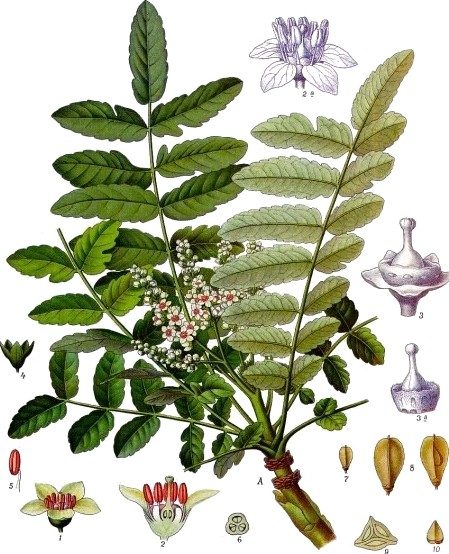
Frankincense
Incenso; thus
- Known today as
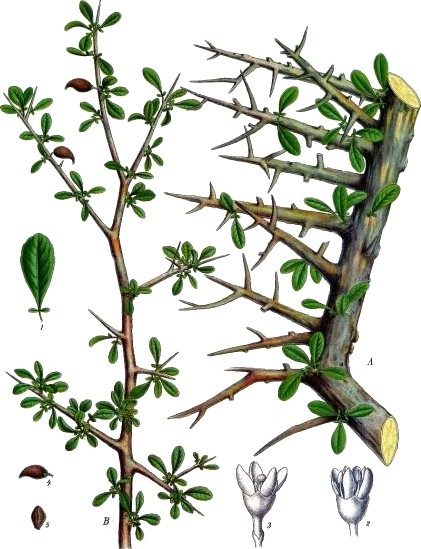
- The resin of Boswellia sacra and related trees.
- Kind
- Resin & Wood, in 3 older authorities
- Constituents
- boswellic acid, 3-O-acetyl-11-keto-beta-boswellic acid, incensole acetate
- Earliest authority here
- Dioscorides (c. AD 40–90)
- Qualities
- Hot in the second degree, dry in the first (Galenic tradition). What the degrees mean
- In other databases
- Plants of the World Online search · GBIF search · Wikidata search
- In the Canale glossary
- On the Manner of Discerning and Healing the Bewitched, Appendix A: Part Three, Chapters 7–8: The Bath and Fumigations
Frankincense: what did Canale use it for?
In fumigations and in the oil; blessed at Epiphany with gold and myrrh; placed on coals in the blessing of the house (chs. 8–9; Treatise Two).
Frankincense: what does modern science say?
The incense of the Temple and the Church. Burnt, it is aromatic; its boswellic acids have some anti-inflammatory action taken by mouth.
Pharmacognosy & Toxicology
- Constituents
- Mechanism
- The boswellic acids inhibit 5-lipoxygenase and the leukotrienes of inflammation; incensole acetate, in mice, acts on the TRPV3 channel and lowers anxiety, which has been offered as the pharmacology of incense.
- Checked against ChEMBL
- 3-O-acetyl-11-keto-beta-boswellic acid: Measured, as the entry says (“inhibit 5-lipoxygenase”): Polyunsaturated fatty acid 5-lipoxygenase (human), IC50 2.7 µM, CHEMBL1155562; Polyunsaturated fatty acid lipoxygenase ALOX15B (human), IC50 >40 µM, CHEMBL4414666.
- incensole acetate: Measured, as the entry says (“acts on the TRPV3 channel”): Transient receptor potential cation channel subfamily V member 3 (mouse), EC50 16 µM, CHEMBL3861968.
- Toxic dose
- No toxicity; the extracts can upset the stomach.
- Standing
- Extracts have eased osteoarthritis of the knee in several small trials; no approval.
- Moussaieff, A., et al. (2008). “Incensole acetate, an incense component, elicits psychoactivity by activating TRPV3 channels in the brain.” FASEB Journal 22. Verified against its record · doi:10.1096/fj.07-101865
- Yu, G., et al. (2020). “Effectiveness of Boswellia and Boswellia extract for osteoarthritis patients: a systematic review and meta-analysis.” BMC Complementary Medicine and Therapies 20. Verified against its record · doi:10.1186/s12906-020-02985-6
The abstract of each source, beneath its citation. For Club members. About the Club or sign in.
Constituent names open the compound’s record at PubChem, and “ChEMBL” beside a name opens its record at ChEMBL, the European Bioinformatics Institute’s database of bioactive molecules. Where a mechanism line was checked against ChEMBL (ChEMBL 37, read 1 October 2026), the check is shown with the measured value and its source paper, or says plainly that nothing has been measured. Doses are as the references give them, for description only; this is not medical advice. Each source carries the result of its check against Crossref, PubMed, or the authority’s page: see Verification.
What Medicine Makes of It
- The Purge, the Vomit, and the BathWhat the regimen did to the body.
Frankincense: what lore surrounds it?
The incense of the altar, and so the first of the sweet fumigations in the exorcist’s art.
Used in These Compounds
Frankincense is an ingredient of 1 compound medicine in the database. For Club members. Create a free account or sign in.
Frankincense: what did the older authorities say?
- Dioscorides
- Describes libanos for wounds, ulcers, and complaints of the eyes.
- Herodotus
- Recounts that the Arabians gathered it from trees guarded by small winged serpents, driven off with the smoke of storax.
- Matthew 2:11
- One of the gifts of the Magi.
Sources
- [58] Hamidpour, R., Hamidpour, S., Hamidpour, M., & Shahlari, M. (2013). Frankincense (Rǔ Xiāng; Boswellia species): from the selection of traditional applications to the novel phytotherapy for the prevention and treatment of serious diseases. Journal of Traditional and Complementary Medicine 3(4): 221–226. doi:10.4103/2225-4110.119723 Verified against its record · doi:10.4103/2225-4110.119723
- [91] National Center for Complementary and Integrative Health, NIH. Usefulness and Safety pages: Boswellia (April 2025); Chamomile (November 2024); St. John’s Wort (May 2025). nccih.nih.gov. Book, not indexed
Verification
- Checked
- October 1, 2026
- Passes
- Every sentence read against its sources, in the fifty-entry sample
- The Standing line checked against the authority it names (EMA, WHO, FDA, CITES, Commission E)
- Every dated or regulatory claim checked by category across the database
- The mechanism read against ChEMBL (ChEMBL 37): curated mechanisms and measured activity
- Sources
- 4 cited: 3 verified against its record, 1 book, not indexed. 2 with the abstract on file.
- Corrections
- None were needed.
What was checked, how, and what was found is set out on the Verification page. A checked source is one whose record was found; it does not make the entry medical advice.
Cite This Entry
Version 1 · first published September 25, 2026
- Chicago
“Frankincense.” In Materia Medica, edited by B. C. P. Statema. Version 1. The Thinking Press, 2026–. Last modified September 25, 2026. https://thethinkingpress.org/materia-medica/frankincense.
- MLA
“Frankincense.” Materia Medica, edited by B. C. P. Statema, version 1, The Thinking Press, 25 Sept. 2026, thethinkingpress.org/materia-medica/frankincense. Accessed 8 Oct. 2026.
- APA
Frankincense. (2026, September 25). In B. C. P. Statema (Ed.), Materia medica (Version 1). The Thinking Press. Retrieved October 8, 2026, from https://thethinkingpress.org/materia-medica/frankincense
Club members keep entries on a shelf with private notes, print the plates as cards, and receive an entry by email each week. Create a free account before January 1, 2027 and all of it is yours for good. About the Club
See Also
Also in Dioscorides
Ginger in Dioscorides · Feverfew in Dioscorides · Hemp in Dioscorides · Cuttlefish bone in Dioscorides · everything Dioscorides names →
Also in Herodotus
Garlic in Herodotus · Cinnamon in Herodotus · Castor-oil plant, seeds of in Herodotus · everything Herodotus names →
Also in Scripture
Galbanum in Scripture · Dill in Scripture · Hyssop in Scripture · Cumin in Scripture · everything Scripture names →
Of the same qualities: hot and dry
Galangal · Elecampane · Honey · Coffee · what the degrees mean →
Nearby in the alphabet
Friar’s balsam (storax, balsam of tolu, and aloes, in spirit) · Fox’s heart (The dried heart of a fox) · Fu ling (the sclerotium of a fungus that grows on pines) · Foxglove (Digitalis purpurea) · Funeral bell (A small brown mushroom of rotting wood) · Fool’s webcap (A tawny webcap of European woods) · Foetid pills
Historical description, not medical advice.