
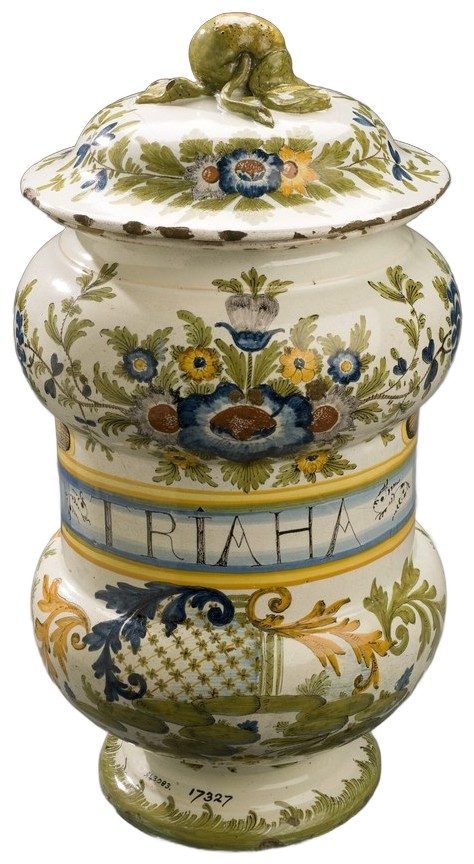
Theriac
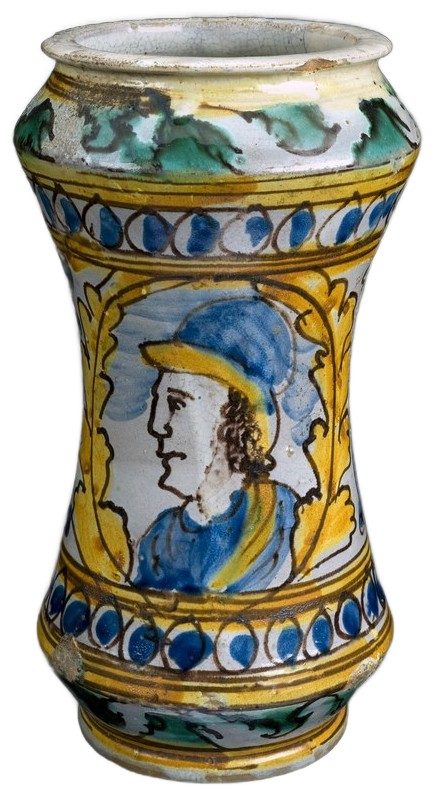
Teriaca
- Known today as
- The great compound antidote of antiquity, with about sixty ingredients in Galen’s formulation, including viper flesh and opium; Venice was a celebrated center of its manufacture.
- Kind
- Compound, in 3 older authorities
- Constituents
- morphine, viper flesh, scillaren, and 2 more
- Poisoning
- Opioid poisoning
- Earliest authority here
- Andromachus (fl. AD 60)
- Qualities
- Counted hot, like the mithridate, of which Culpeper warns that two drams may be dangerous “because of its heat”; he gives the treacle for coldness of the stomach, wind, and the colic. What the degrees mean
- In the Canale glossary
- On the Manner of Discerning and Healing the Bewitched, Appendix A: Part Three, Chapter 6: Remedies Given by Mouth After the Purge
Revised October 3, 2026: Checked against its sources, each read in full, in part, or in its abstract. Version 1, first published September 25, 2026.
Theriac: what did Canale use it for?
Praised at a dram at a time, continued over a course; in a distilled water and in the cockerel (ch. 6; note XLI).
Theriac: what does modern science say?
Its reputation as a universal antidote does not survive; it remained in continental pharmacopoeias well into the nineteenth century.
Pharmacognosy & Toxicology
- Constituents
- morphine ChEMBLfrom the opium: twenty-four drachms of Theban opium in the London recipe of 1653, more than in the mithridate
- viper fleshmade into troches with bread
- scillaren ChEMBLfrom the squill
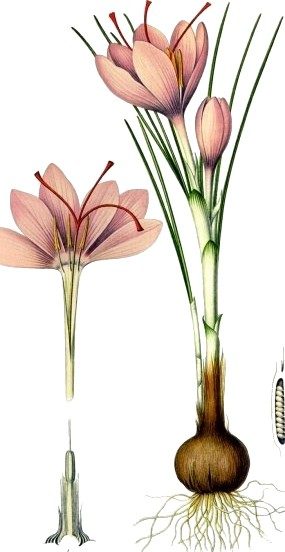
- myrrh, saffron, cinnamon, cassia, pepper, and some fifty aromatics
- honey ChEMBL
- Mechanism
- Fifty-five ingredients in Galen’s account and sixty-one in the London Pharmacopoeia of 1746, kept for years before use: the opium is what acted, and Heberden judged these compounds to be given chiefly as opiates and aromatics, counteracting no poison further than plain opium would. Its public compounding in Venice, Bologna, and other cities, with the ingredients inspected, Griffin takes for the beginning of medicines regulation.
- Checked against ChEMBL
- morphine: ChEMBL’s curated mechanism: agonist Mu-type opioid receptor.
- Toxic dose
- Culpeper allows half a dram to go about one’s business, a dram or more to sweat; Heberden warned that the opium in a dose lay at the mercy of the mixer, and that fermentation in the mass was said to make it three or four times stronger.
- Syndrome
- Opioid poisoning
- Standing
- The 1746 London Pharmacopoeia was the last to contain it, but it was still in the German Pharmacopoeia of 1872 and the French of 1884; in England it was called Venetian treacle, and by the twentieth century ‘theriac’ in advertisements seemed to mean syrupy treacle.
- Griffin, J. P. (2004). “Venetian treacle and the foundation of medicines regulation.” British Journal of Clinical Pharmacology 58. Read in full · the text read
The abstract of each source, beneath its citation. For Club members. About the Club or sign in.
Constituent names open the compound’s record at PubChem, and “ChEMBL” beside a name opens its record at ChEMBL, the European Bioinformatics Institute’s database of bioactive molecules. Where a mechanism line was checked against ChEMBL (ChEMBL 37, read 1 October 2026), the check is shown with the measured value and its source paper, or says plainly that nothing has been measured. Doses are as the references give them, for description only; this is not medical advice. Each source carries the result of its check against Crossref, PubMed, or the authority’s page: see Verification.
What Medicine Makes of It
- The PlagueThe pomander and the vinegar, the flea and the bacillus.
- The Universal AntidoteBezoar, unicorn, and theriac against every poison, and what replaced them.
The Recipe
The recipe: 10 ingredients, each linked to its entry. For Club members. Create a free account or sign in.
Theriac: what did the older authorities say?
- Andromachus
- Nero’s physician refined the antidote of Mithridates and added the flesh of vipers, making the theriac (from thēr, a wild beast) of later medicine.
- Galen
- Physician to the emperor Marcus Aurelius, gave its recipe and making in his books on antidotes, held that it should be kept twelve years before use, and records that the emperor took it within two months of its compounding without ill effect.
- Venice
- Made and exported theriac from the twelfth century; its public compounding, with the ingredients displayed for officials to check and the product stamped under supervision, made Venetian treacle famous across Europe.
Sources
- [28] Culpeper, N. (1653). Pharmacopœia Londinensis, or, The London Dispensatory [the Royal College of Physicians’ pharmacopoeia in English, with Culpeper’s commentary]. London: Peter Cole. Text Creation Partnership edition A35381. Read in part · the text read
- [62] Hudson, B. (2017). Theriac: an ancient brand? Wellcome Collection, 18 October 2017. wellcomecollection.org. Read in full · the text read
- Manganyi, M. C., et al. (2021). Bulbous plants Drimia: “a thin line between poisonous and healing compounds” with biological activities. Pharmaceutics 13: 1385. Read in full · the text read
Verification
- Checked
- October 1, 2026, and October 3, 2026
- Passes
- Every sentence read against its sources, in the pass over the remaining 343 entries
- The Standing line checked against the authority it names (EMA, WHO, FDA, CITES, Commission E)
- Every dated or regulatory claim checked by category across the database
- The mechanism read against ChEMBL (ChEMBL 37): curated mechanisms and measured activity
- Every source read, in full, in part, or in its abstract, and every sentence checked against what was read (October 3, 2026)
- Sources
- 4 cited: 3 read in full, 1 read in part. 1 with the abstract on file.
- Corrections
- None were needed.
What was checked, how, and what was found is set out on the Verification page. A checked source is one whose record was found; it does not make the entry medical advice.
Cite This Entry
Version 1 · first published September 25, 2026 · last revised October 3, 2026
- Chicago
“Theriac.” In Materia Medica, edited by B. C. P. Statema. Version 1. The Thinking Press, 2026–. Last modified October 3, 2026. https://thethinkingpress.org/materia-medica/theriac.
- MLA
“Theriac.” Materia Medica, edited by B. C. P. Statema, version 1, The Thinking Press, 3 Oct. 2026, thethinkingpress.org/materia-medica/theriac. Accessed 8 Oct. 2026.
- APA
Theriac. (2026, October 3). In B. C. P. Statema (Ed.), Materia medica (Version 1). The Thinking Press. Retrieved October 8, 2026, from https://thethinkingpress.org/materia-medica/theriac
Club members keep entries on a shelf with private notes, print the plates as cards, and receive an entry by email each week. Create a free account before January 1, 2027 and all of it is yours for good. About the Club
See Also
Poisoned alike: opioid poisoning
Diascordium · Paregoric · Dover’s powder · Opium poppy · Laudanum · Nepenthe · Mithridate · the syndrome, with all of them →
Sharing morphine, honey
Also in Andromachus the Elder
Viper in Andromachus the Elder · everything Andromachus the Elder names →
Also in Galen
Armenian bole in Galen · Terra sigillata in Galen · Caterpillar fungus in Galen · Purslane in Galen · everything Galen names →
Drawing on the same sources: Manganyi
Of the same qualities: hot and dry
Thyme · Sulfur · Wormwood, oil of · St. John’s wort · Aniseed · Saffron · what the degrees mean →
Nearby in the alphabet
Thorn apple (of the nightshade family) · Tetragrammaton (not pronounced in Jewish practice) · The thurible · Teonanácatl (Small brown mushrooms that stain blue when bruised) · Tinder fungus (A hoof-shaped bracket of birch and beech) · Teasel (Dipsacus fullonum)
Historical description, not medical advice.