
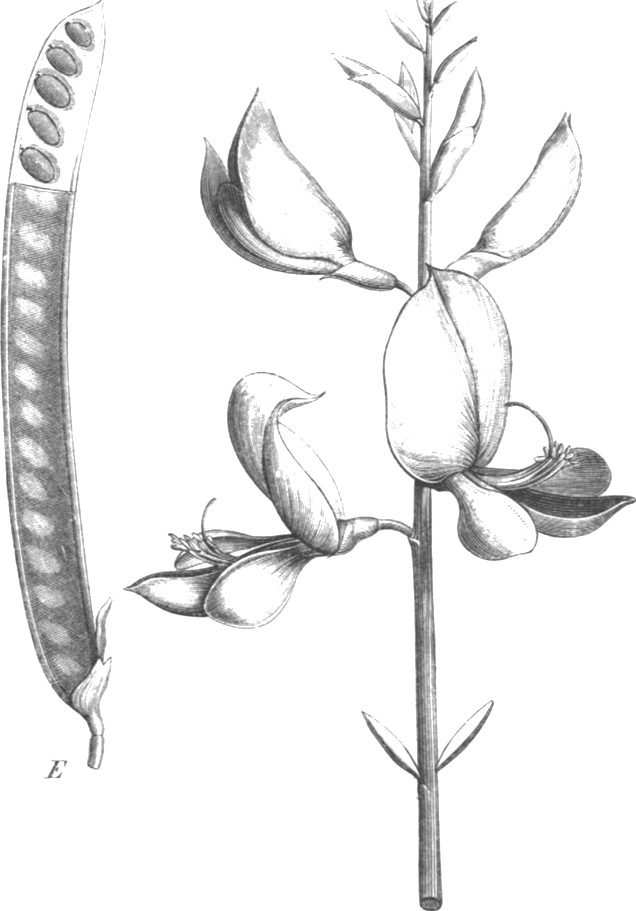
Broom
Ginestra
- Known today as
- Spanish broom, Spartium junceum, or common broom, Cytisus scoparius.
- Kind
- Plant, in 2 older authorities
- Constituents
- sparteine, scoparin
- Earliest authority here
- Pliny (AD 23/24–79)
- In other databases
- Plants of the World Online search · GBIF search · Wikidata search
- In the Canale glossary
- On the Manner of Discerning and Healing the Bewitched, Appendix A: Part Three, Chapter 5: Vomitory Medicines
Revised October 1, 2026: An older authority added from a text read in full. Version 1, first published September 25, 2026.
Broom: what did Canale use it for?
“Much used for the bewitched”: flowers, seeds, and juice as vomits, the flowers even as a salad; its flowers in the oil for the bewitched (chs. 5, 9).
Broom: what does modern science say?
Broom’s alkaloid sparteine acts on the heart, and in large doses causes vomiting and purging; Spanish broom has caused poisoning when substituted for true broom.
Pharmacognosy & Toxicology
- Constituents
- Mechanism
- Sparteine blocks sodium channels in the heart, a class I antiarrhythmic, and contracts the uterus, for which it was used in obstetrics. In 1979 Eichelbaum found that one person in twelve could not metabolise it: the discovery of the CYP2D6 polymorphism that governs the fate of a quarter of all drugs.
- Checked against ChEMBL
- sparteine: No measurement in ChEMBL for “blocks sodium channels in the heart” (806 activities recorded, none against the target named); the line rests on its references.
- Toxic dose
- Sparteine in gram amounts is a poison to the heart and breath.
- Syndrome
- Nicotinic poisoning (coniine, nicotine, cytisine)
- Standing
- Withdrawn as a drug; the herb is in some European preparations for the circulation, at low dose.
- Eichelbaum, M., et al. (1979). “Defective N-oxidation of sparteine in man: a new pharmacogenetic defect.” European Journal of Clinical Pharmacology 16. Verified against its record · doi:10.1007/bf00562059
The abstract of each source, beneath its citation. For Club members. About the Club or sign in.
Constituent names open the compound’s record at PubChem, and “ChEMBL” beside a name opens its record at ChEMBL, the European Bioinformatics Institute’s database of bioactive molecules. Where a mechanism line was checked against ChEMBL (ChEMBL 37, read 1 October 2026), the check is shown with the measured value and its source paper, or says plainly that nothing has been measured. Doses are as the references give them, for description only; this is not medical advice. Each source carries the result of its check against Crossref, PubMed, or the authority’s page: see Verification.
What Medicine Makes of It
- The Purge, the Vomit, and the BathWhat the regimen did to the body.
Broom: what lore surrounds it?
Broom, genista, gave the Plantagenet dynasty its name. Geoffrey, Count of Anjou, wore a sprig of the yellow-flowered plant as his badge in the twelfth century and was nicknamed “Plantegenest” for it; the name was adopted as a house name three centuries later by Richard, Duke of York, and applied by historians to the whole royal line that ruled England from 1154 to 1485.
Broom: what did the older authorities say?
- Pliny
- Notes that in Asia “there is a thread made from broom, which is employed in the construction of fishing-nets, being found to be remarkably durable,” the shrub being steeped in water for ten days to prepare it.
- Culpeper
- Spares the description, the plant “being so generally used by all the good housewives almost through this land to sweep their houses with”; the juice or decoction of the young branches, or the powdered seed, purges downwards and draws watery humours from the joints, helping dropsy, gout, and sciatica, and provokes urine abundantly; the oil drawn from the green sticks heated in the fire helps the toothache.
Sources
- [16] The British Pharmaceutical Codex (1911). London: Pharmaceutical Society of Great Britain. Monographs as transcribed at Henriette’s Herbal Homepage, henriettes-herb.com. Read in full · the text read
- [54] Grieve, M. (1931). A Modern Herbal. Online edition, botanical.com, cited under the plant concerned. Read in part · the text read
- “House of Plantagenet” (reference article). Book, seen in reviews
- Pliny the Elder, Natural History 19.2, trans. J. Bostock & H. T. Riley (1855), Perseus Digital Library. Primary text
- Culpeper, N. (1653). The Complete Herbal, “Broom, And Broom-Rape.” Project Gutenberg #49513. Primary text
Verification
- Checked
- October 1, 2026
- Passes
- Every sentence read against its sources, in the pass over the remaining 343 entries
- The Standing line checked against the authority it names (EMA, WHO, FDA, CITES, Commission E)
- Every dated or regulatory claim checked by category across the database
- The mechanism read against ChEMBL (ChEMBL 37): curated mechanisms and measured activity
- Each quotation from the older authorities checked word for word against the text, read in full
- Sources
- 6 cited: 1 read in full, 1 read in part, 1 verified against its record, 2 primary text, 1 book, seen in reviews. 1 with the abstract on file.
- Corrections
- None were needed.
What was checked, how, and what was found is set out on the Verification page. A checked source is one whose record was found; it does not make the entry medical advice.
Cite This Entry
Version 1 · first published September 25, 2026 · last revised October 1, 2026
- Chicago
“Broom.” In Materia Medica, edited by B. C. P. Statema. Version 1. The Thinking Press, 2026–. Last modified October 1, 2026. https://thethinkingpress.org/materia-medica/broom.
- MLA
“Broom.” Materia Medica, edited by B. C. P. Statema, version 1, The Thinking Press, 1 Oct. 2026, thethinkingpress.org/materia-medica/broom. Accessed 8 Oct. 2026.
- APA
Broom. (2026, October 1). In B. C. P. Statema (Ed.), Materia medica (Version 1). The Thinking Press. Retrieved October 8, 2026, from https://thethinkingpress.org/materia-medica/broom
Club members keep entries on a shelf with private notes, print the plates as cards, and receive an entry by email each week. Create a free account before January 1, 2027 and all of it is yours for good. About the Club
See Also
Poisoned alike: nicotinic poisoning (coniine, nicotine, cytisine)
Gorse · Tobacco · Hemlock · Lesser bean-trefoil · the syndrome, with all of them →
Also in Pliny the Elder
Bryony in Pliny the Elder · Bloodstone in Pliny the Elder · Caper spurge in Pliny the Elder · Bladderwrack in Pliny the Elder · everything Pliny the Elder names →
Also in Nicholas Culpeper
Burdock in Nicholas Culpeper · Blackthorn in Nicholas Culpeper · Catmint in Nicholas Culpeper · Bistort in Nicholas Culpeper · everything Nicholas Culpeper names →
Drawing on the same sources: Culpeper
Nearby in the alphabet
Brown roll-rim (of birch woods) · Brewer’s yeast (beer, and wine) · Breve (A written prayer or holy names folded and worn on the body) · Borax (brought as the crude salt tincal from the lakes of Tibet) · Butterbur (of the daisy family, with huge rhubarb-like leaves in damp places) · Borage (Borago officinalis)
Historical description, not medical advice.