
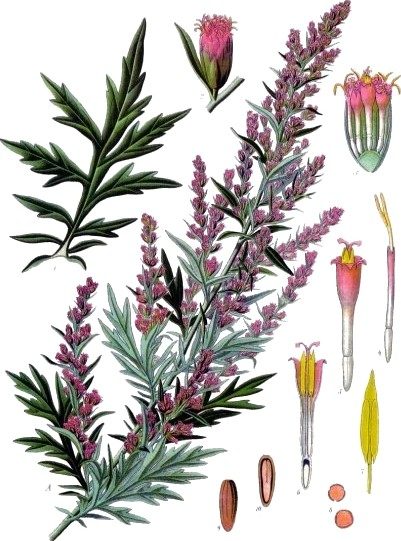
Mugwort
Artemisia
- Known today as
- Artemisia vulgaris.
- Kind
- Plant, in 2 older authorities
- Constituents
- thujone, cineole, vulgarin
- Earliest authority here
- Pliny (AD 23/24–79)
- In other databases
- Plants of the World Online search · GBIF search · Wikidata search
- In the Canale glossary
- On the Manner of Discerning and Healing the Bewitched, Appendix A: Part Three, Chapter 6: Remedies Given by Mouth After the Purge
Mugwort: what did Canale use it for?
Its powder in wine; in the cockerel and a julep; in the bath and the oils; worn as an amulet and burnt to drive out “every unclean spirit” (chs. 6–7, 9–10).
Mugwort: how is it taken as a tea?
An ounce to a pint of boiling water, prepared in a covered vessel and given warm by the half-teaspoonful, or cold as a tonic three times a day. Culpeper, Grieve notes, found a very slight infusion excellent for the stomach and too strong a one disgusting to the taste.
All the herbal teas of the database. Historical directions, not medical advice.
Mugwort: what does modern science say?
Mugwort was the herb of St. John’s Eve, worn as a crown or girdle against evil. It has traditional digestive uses and some uterine-stimulant action; nothing more is established.
Pharmacognosy & Toxicology
- Constituents
- Mechanism
- Thujone, in small amounts; the pollen is a chief cause of hay fever in late summer. Artemisinin, the malaria drug, is from the sweet wormwood Artemisia annua, a relative, for which Tu Youyou won the Nobel Prize in 2015.
- Toxic dose
- The herb is weak; the oil carries thujone.
- Syndrome
- Convulsant terpenes (thujone, pinocamphone, camphor)
- Standing
- No approved use in the West; moxibustion burns it on the skin in Chinese practice.
- Tu, Y. (2011). “The discovery of artemisinin (qinghaosu) and gifts from Chinese medicine.” Nature Medicine 17. Verified against its record · doi:10.1038/nm.2471
Constituent names open the compound’s record at PubChem, and “ChEMBL” beside a name opens its record at ChEMBL, the European Bioinformatics Institute’s database of bioactive molecules. Where a mechanism line was checked against ChEMBL (ChEMBL 37, read 1 October 2026), the check is shown with the measured value and its source paper, or says plainly that nothing has been measured. Doses are as the references give them, for description only; this is not medical advice. Each source carries the result of its check against Crossref, PubMed, or the authority’s page: see Verification.
Mugwort: what lore surrounds it?
Girdles of mugwort were worn on St. John’s Eve and thrown into the bonfire, carrying the year’s ill luck away with them.
Mugwort is the source of moxa, the aged, pulverized leaf that Chinese medicine burns on acupuncture points, still used, among other purposes, to try to turn breech babies before birth. Pliny’s claim that a traveler carrying mugwort will not tire has a soldierly cousin: Roman soldiers reportedly lined their footwear with the leaf against fatigue and cramp on the march. In Japan mugwort is still hung with iris leaves outside homes to keep evil spirits away by its scent.
Mugwort: what did the older authorities say?
- Pliny
- Says that a traveler who carries mugwort will not tire on the road.
- The Nine Herbs Charm
- The Old English charm names mugwort the first and eldest of the nine herbs, and bids it remember what it made known.
Sources
- [1] Abiri, R., et al. (2018). Towards a better understanding of Artemisia vulgaris: botany, phytochemistry, pharmacological and biotechnological potential. Food Research International 109: 403–415. doi:10.1016/j.foodres.2018.03.072 Verified against its record · doi:10.1016/j.foodres.2018.03.072
- [54] Grieve, M. (1931). A Modern Herbal. Online edition, botanical.com, cited under the plant concerned. Read in part · the text read
- Wikipedia, “Mugwort.” Book, not indexed
- Grieve, M. A Modern Herbal, “Mugwort.” As published on botanical.com.
Verification
- Checked
- October 1, 2026
- Passes
- Every sentence read against its sources, in the pass over the remaining 343 entries
- The Standing line checked against the authority it names (EMA, WHO, FDA, CITES, Commission E)
- Every dated or regulatory claim checked by category across the database
- Sources
- 5 cited: 1 read in part, 2 verified against its record, 1 book, not indexed, 1 not yet checked.
- Corrections
- None were needed.
What was checked, how, and what was found is set out on the Verification page. A checked source is one whose record was found; it does not make the entry medical advice.
Cite This Entry
Version 1 · first published September 25, 2026
- Chicago
“Mugwort.” In Materia Medica, edited by B. C. P. Statema. Version 1. The Thinking Press, 2026–. Last modified September 25, 2026. https://thethinkingpress.org/materia-medica/mugwort.
- MLA
“Mugwort.” Materia Medica, edited by B. C. P. Statema, version 1, The Thinking Press, 25 Sept. 2026, thethinkingpress.org/materia-medica/mugwort. Accessed 8 Oct. 2026.
- APA
Mugwort. (2026, September 25). In B. C. P. Statema (Ed.), Materia medica (Version 1). The Thinking Press. Retrieved October 8, 2026, from https://thethinkingpress.org/materia-medica/mugwort
Club members keep entries on a shelf with private notes, print the plates as cards, and receive an entry by email each week. Create a free account before January 1, 2027 and all of it is yours for good. About the Club
See Also
Poisoned alike: convulsant terpenes (thujone, pinocamphone, camphor)
Rosemary · Mint, oil of · Sage · Hyssop · Tansy · Hungary water · Wormwood, oil of · Camphor · the syndrome, with all of them →
Sharing thujone
Also in Pliny the Elder
Mullein in Pliny the Elder · Mithridate in Pliny the Elder · Nasturtium, that is, garden cress in Pliny the Elder · Mistletoe in Pliny the Elder · everything Pliny the Elder names →
Drawing on the same sources: Wikipedia, Grieve
Mummy · Manna · Musk · Motherwort · Mustard seed · the bibliography →
Historical description, not medical advice.