A1Book

An History Beside Time

A mythic-philosophical work
Chapter I

1In the beginning there was not a beginning, but a fullness without seam; and the fullness was like an acorn, closed upon its own secret. 2For within the small shell the whole tree sleepeth, and within the seed the forest hideth its thousand arms. 3So was the cosmos: little to the eye, yet measureless to the inward sight; a round silence containing its own thunder. 4And the acorn knew not that it knew; and the Whole knew not that it held its own sundering. 5Yet the law was already there, as the oak is already there: that what is whole must one day disclose what it containeth.

6Then came the first motion, which no tongue can name without lying. 7And the Whole clave itself—not as a thing broken by hatred, but as a seed broken by life. 8What was God hitherto became twain, and the twain became the first distance. 9From the Light there drew away a Blackening, and from the Blackening there flared a Light; and each called the other forth. 10For opposites do not merely war; they beget. 11And the rift between them was not emptiness, but a womb.
B1TTranslation

Discoveries in the Realm of the Soul

First Book: The Life of the Dream (Das Leben des Traumes) — Karl Albert Scherner, 1861
§ 3. The Life-Current in the Dream

Even in itself, the life of the soul flows more mobile than the subtlest imponderable of matter; its force streams swifter than light, falls upon the being it touches more gently than light; in its most sluggishly moving waves it still flits more lightly than the zephyr. And yet, in the chief force of its evolutions, so far as it is waking, daytime life, it moves only heavily and in fetters; for the almighty ruler of the whole psychical periphery, the ego, holds it in bonds, and to everything that dares stir freely within it, it holds up the iron measuring line of category and the dry rhythms of logic, to march it into step. Only when, with the closing of the eyelids, leaden sleep falls upon the strength of the ego, overpowering and subduing it, until its power awakens again in the morning, does the fleeting, generative force become free. In dream, life flows freely; scarcely has the fettering gravity of the ego vanished than it shoots forth in a frenzy.

C3TTranslation

The Cudgel of Demons

Fustis Daemonum · Girolamo Menghi, 1584
Chapter the First

The Exorcist must take care not to give credence to an unclean Spirit which declares itself to be the soul of some wicked man (a thing they are wont often to assert), lest men be led thereby into that Heresy which holds that the souls of wicked men, after death, are converted into Demons, or into whatsoever brute Animals are congruous to their deserts — a Heresy which Augustine, in his book Of Heresies, chapter 86, lays at the feet of Tertullian. What it was, however, that could have moved Tertullian to fall into this error, I confess I do not see, unless perhaps it was that saying of the Lord, spoken to the most wicked Jews in the Gospel of John: You are of your father the Devil.

From all these things it is plain what must be answered to Demons asserting such things: namely, that this is false, and heretical, and contrary to the determination of the Holy Roman Church. And the Exorcist ought to preach to the bystanders that this is by no means to be believed; nay rather, it is to be fled from, and condemned by all the faithful of Christ, as a heretical thing, and a device found out by the Devil.

C1TTranslation

On the Manner of Discerning and Healing the Bewitched

Del modo di conoscer et sanare i maleficiati · Floriano Canale, 1614
Part One · Chapter the First · Wherefore the Devil Enters into Human Bodies, and in What Manner

The devil enters into human bodies through despair, or through some other sin, or else it is granted him for trial. The first two ways are ordained to the vengeance of the Majesty of God, according to St. Jerome upon Joel, as is recalled in the Decretum, Causa 23, Question 5, where he says that not only men are ministers of the Divine wrath against those who do evil, whence not without cause do they bear arms, but the demons also. The third way is for the health of souls, as we read of certain saints who, even to the end of their life, were afflicted by evil spirits.

When the devil enters into human bodies, he first appears to them in the likeness of some man who has died an evil death, or else he represents to them some kinsman of theirs, or he appears in the form of some dreadful beast, and seems at once to vanish, but forthwith enters upon them; and this occurs almost always by night, or in stony places; whence afterward in those thus oppressed there appear the signs which we shall speak of below. He enters also into some by the mouth, or by the ears, or as though he were a mouse, according to what various afflicted persons have related to me; to some of whom, in sleeping, and in dream, it has seemed that the demons ran behind them, and, being awakened, they have given the underwritten signs of the entrance of evil spirits into their bodies, as afterward became manifestly apparent. Into some he has entered by striking them upon the neck, or upon their other limbs. Finally they enter in a thousand other manners, according to the disposition of the subject, which for brevity’s sake I here omit.

C1TTranslation

On the Manner of Discerning and Healing the Bewitched

Del modo di conoscer et sanare i maleficiati · Floriano Canale, 1614
Appendix C · The Flyleaf Passages

After Canale’s treatises conclude, the copy of the Milan 1663 printing from Giuseppe Marelli’s press, in part the copy from which this volume was prepared, carries several flyleaves written over by hand in Latin. This was an interesting bit of provenance, but the most interesting thing about the passages is that they are unsigned. If the writing was made near the time of the Index decrees of 1706 and 1707, whether before or after, it would make sense for the writer to leave his name out of it; an unsigned leaf leaves no paper trail of ownership in that legal and ecclesiastical climate. I saw no harm in including an English translation of these passages as the concluding appendix of this volume. Had they not found their way here, the words on these flyleaves might never have found the readers, or the appreciation, I believe they deserve, surviving as they do in a single copy of a work that is now nearly extinct. I am glad to have spared them that fate.

An Exorcism for Those Hindered from Marriage by the Maleficia of the Devil

Let the priest, laying his hand upon the head of the bewitched person, say: Let every diabolical power be extinguished in thee, N., through the laying-on of my hands, and yet more through the invocation of all the Saints: the Angels, the Archangels, the Patriarchs, the Prophets, the Apostles, the Martyrs, the Confessors, and the Virgins, and of all the Blessed together. In the name of the Father, and of the Son, and of the Holy Spirit. Amen.

Ninety-Two Pages in Full Color

Ninety-two pages, printed in full color, set every Galenic and medieval ingredient Canale prescribes beside a period botanical plate: what he called it, what it is known as today, what he used it for, and what modern evidence says of it. Four entries from the glossary follow.

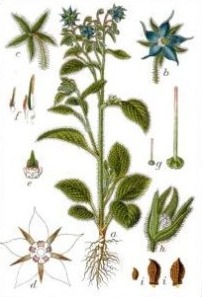
Borage, a botanical plate

Borage (Boragine)

Known today as
Borago officinalis.
Canale’s stated use
Juice, water, syrup, and flowers in the preparatives, a “cordial” to cheer the melancholic (chs. 3–4, 7).
Modern assessment
The old saying “borage for courage” has no clinical support. The plant contains liver-toxic pyrrolizidine alkaloids, and regular internal use is now discouraged.

Jacob Sturm, in J. G. Sturm, Deutschlands Flora in Abbildungen (1796 onward).

The full entry in the Materia Medica →
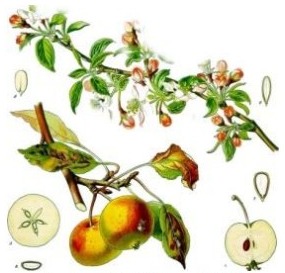
Apples, syrup of, a botanical plate

Apples, syrup of (Siroppo di pomi)

Known today as
A syrup of sweet apples.
Canale’s stated use
A preparative for phlegmatic patients (ch. 3). An apple also serves as a vessel for hellebore root (ch. 5).
Modern assessment
A pleasant vehicle; no medicinal effect.

F. E. Köhler, Köhler’s Medizinal-Pflanzen (1887–98).

The full entry in the Materia Medica →
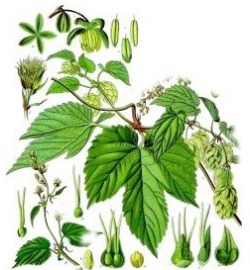
Hop, a botanical plate

Hop (Lupoli)

Known today as
Humulus lupulus.
Canale’s stated use
Syrup of hops in the preparative for the melancholic (ch. 3).
Modern assessment
Hops are mildly sedative, which suits the calming purpose; the effect is modest.

F. E. Köhler, Köhler’s Medizinal-Pflanzen (1887–98).

The full entry in the Materia Medica →
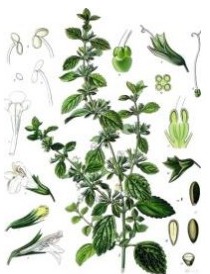
Balm, a botanical plate

Balm (Melissa)

Known today as
Lemon balm, Melissa officinalis.
Canale’s stated use
Its distilled water in the melancholic preparative (ch. 3).
Modern assessment
Lemon balm has mild calming effects supported by small modern trials. It was the classic Renaissance remedy for melancholy.

F. E. Köhler, Köhler’s Medizinal-Pflanzen (1887–98).

The full entry in the Materia Medica →

Every entry of the glossary is in the Materia Medica →

An History Beside Time, Read Aloud

The Introduction & Chapter I, free to hear · the audiobook and ebook, $20, or free to stream for Club members