
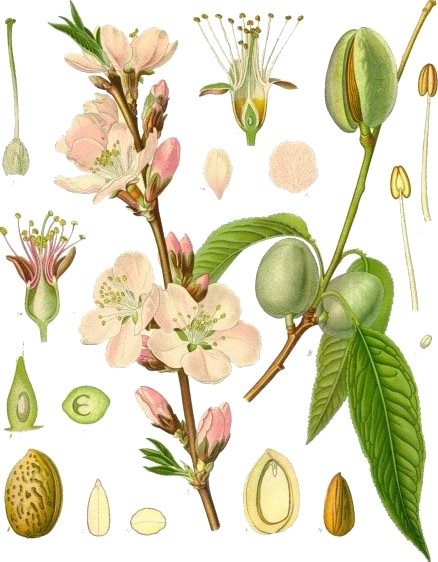
Sweet almond, oil of
Oglio di mandole dolci
- Known today as
- Oil pressed from sweet almonds.
- Kind
- Food & Drink, in 1 older authority
- Constituents
- oleic acid, linoleic acid, vitamin E
- Earliest authority here
- Pliny (AD 23/24–79)
- In the Canale glossary
- On the Manner of Discerning and Healing the Bewitched, Appendix A: Part Three, Chapter 5: Vomitory Medicines
Revised October 3, 2026: An older authority added from a text read in full. Lore added from texts read in full. Checked against its sources, each read in full, in part, or in its abstract. Version 1, first published September 25, 2026.
Sweet almond, oil of: what did Canale use it for?
In a gentle vomit, and to anoint the stomach before hellebore (ch. 5).
Sweet almond, oil of: what does modern science say?
A bland oil, given in mucilage for chronic coughs; Grieve adds “costiveness,” and its emulsions are emollient.
Pharmacognosy & Toxicology
- Constituents
- oleic acid ChEMBLthe chief glyceride; about 70 per cent of the oil is monounsaturated
- linoleic acid ChEMBLabout 17 per cent, polyunsaturated
- vitamin E ChEMBL
- Mechanism
- An emollient and a bland oil: on the skin it softens; swallowed, it was given for coughs and “costiveness,” and in Canale it went into a gentle vomit and onto the stomach before hellebore. Almond allergy is the one danger, from local reactions to anaphylaxis.
- Toxic dose
- A food; anaphylaxis in the allergic.
- Standing
- Official in the United States and British pharmacopoeias of King’s day (1898), and among the British Pharmacopoeia’s almond preparations in Grieve’s.
- Ahmad, Z. (2010). “The uses and properties of almond oil.” Complementary Therapies in Clinical Practice 16. Verified against its record · doi:10.1016/j.ctcp.2009.06.015
The abstract of each source, beneath its citation. For Club members. About the Club or sign in.
Constituent names open the compound’s record at PubChem, and “ChEMBL” beside a name opens its record at ChEMBL, the European Bioinformatics Institute’s database of bioactive molecules. Where a mechanism line was checked against ChEMBL (ChEMBL 37, read 1 October 2026), the check is shown with the measured value and its source paper, or says plainly that nothing has been measured. Doses are as the references give them, for description only; this is not medical advice. Each source carries the result of its check against Crossref, PubMed, or the authority’s page: see Verification.
Sweet almond, oil of: what lore surrounds it?
Folkard tells the Thracian legend from Servius: Phyllis, wedded to Demophoon and abandoned when he was recalled to Athens, “expired of grief, and was transformed into an Almond-tree,” and when he returned and “clasped the tree in remorseful embrace,” the leafless tree “suddenly shot forth and blossomed.” The Hebrew Shakad “means to make haste, or to awake early,” Aaron's rod that budded was of almond, and in Tuscany “a branch of the Almond-tree is employed to discover hidden treasures.” “Pliny considered Almonds a most powerful remedy against inebriation,” and “to dream of eating Almonds portends a journey: if they taste sweet, it will be a prosperous one; if bitter, the contrary.”
Sweet almond, oil of: what did the older authorities say?
- Pliny
- Says perfumes mixed with oil keep the better the thicker the oil is, “such as the oil of almonds, for instance,” and that the Egyptian metopion is an oil of bitter almonds; of bitter almonds he adds that they “are provocative of sleep, and sharpen the appetite,” are applied for headache, especially the headache of inebriation, with vinegar and rose oil, and with honey heal the bites of dogs.
Sources
- [43] Felter, H. W., & Lloyd, J. U. (1898). King’s American Dispensatory. Monographs as transcribed at Henriette’s Herbal Homepage, henriettes-herb.com, cited under the drug concerned. Read in full · the text read
- [54] Grieve, M. (1931). A Modern Herbal. Online edition, botanical.com, cited under the plant concerned. Read in part · the text read
- Pliny the Elder, Natural History 13.2–3, 23.75, trans. J. Bostock & H. T. Riley (1855), Perseus Digital Library. Read in part · the text read
- Folkard, R. (1884). Plant Lore, Legends, and Lyrics, “Almond.” Project Gutenberg #44638. Primary text
- “Almond” (Almond oil). Wikipedia (read 2 October 2026). Read in part · the text read
- Canale, F. (1622). Del modo di conoscer et sanare i maleficiati. Brescia. Read in part · the text read
Verification
- Checked
- October 1, 2026, and October 3, 2026
- Passes
- Every sentence read against its sources, in the pass over the remaining 343 entries
- The Standing line checked against the authority it names (EMA, WHO, FDA, CITES, Commission E)
- Every dated or regulatory claim checked by category across the database
- Each quotation from the older authorities checked word for word against the text, read in full
- Every source read, in full, in part, or in its abstract, and every sentence checked against what was read (October 3, 2026)
- Sources
- 7 cited: 1 read in full, 4 read in part, 1 verified against its record, 1 primary text. 1 with the abstract on file.
- Corrections
- None were needed.
What was checked, how, and what was found is set out on the Verification page. A checked source is one whose record was found; it does not make the entry medical advice.
Cite This Entry
Version 1 · first published September 25, 2026 · last revised October 3, 2026
- Chicago
“Sweet almond, oil of.” In Materia Medica, edited by B. C. P. Statema. Version 1. The Thinking Press, 2026–. Last modified October 3, 2026. https://thethinkingpress.org/materia-medica/sweet-almond-oil-of.
- MLA
“Sweet almond, oil of.” Materia Medica, edited by B. C. P. Statema, version 1, The Thinking Press, 3 Oct. 2026, thethinkingpress.org/materia-medica/sweet-almond-oil-of. Accessed 8 Oct. 2026.
- APA
Sweet almond, oil of. (2026, October 3). In B. C. P. Statema (Ed.), Materia medica (Version 1). The Thinking Press. Retrieved October 8, 2026, from https://thethinkingpress.org/materia-medica/sweet-almond-oil-of
Club members keep entries on a shelf with private notes, print the plates as cards, and receive an entry by email each week. Create a free account before January 1, 2027 and all of it is yours for good. About the Club
See Also
Sharing oleic acid, linoleic acid
Moringa oleifera · Olive oil and holy water · Blessed oil · Corylus avellana · Urtica dioica
Also in Pliny the Elder
Sweet flag in Pliny the Elder · Sugar in Pliny the Elder · Teasel in Pliny the Elder · Snapdragon in Pliny the Elder · everything Pliny the Elder names →
Drawing on the same sources: Folkard, Canale
Storax calamite · Turpentine · Vine ash · Spirit of wine · The amulet herbs · the bibliography →
Nearby in the alphabet
Sumac · Sweet woodruff · Sulfur (Brimstone) · Tamarind (The pod pulp of Tamarindus indica) · Tansy (Tanacetum vulgare)
Historical description, not medical advice.