
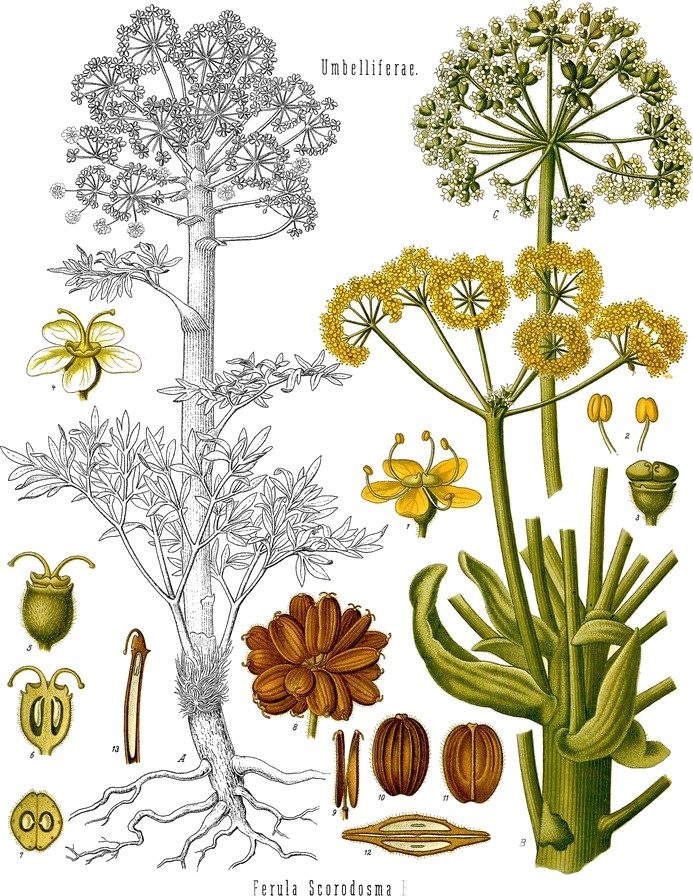
Asafoetida
Assa fetida
- Known today as
- The dried resin of Ferula assa-foetida, “devil’s dung.”
- Kind
- Resin & Wood, in 2 older authorities
- Constituents
- sec-butyl propenyl disulfide, ferulic acid esters, umbelliferone and other coumarins, and 1 more
- Earliest authority here
- Pliny and Strabo (c. 64 BC–c. AD 24)
- Qualities
- Hot and dry (Galenic tradition). What the degrees mean
- In other databases
- Plants of the World Online search · GBIF search · Wikidata search
- In the Canale glossary
- On the Manner of Discerning and Healing the Bewitched, Appendix A: Part Three, Chapters 7–8: The Bath and Fumigations
Asafoetida: what did Canale use it for?
Burnt in the fumigation; four grains in the oil (chs. 8–9).
Asafoetida: what does modern science say?
It is carminative and still used as a spice in Indian cooking.
Pharmacognosy & Toxicology
- Constituents
- sec-butyl propenyl disulfidethe stink; 10–17 per cent oil
- ferulic acid estersin the resin
- umbelliferone and other coumarins
- galbanic acid ChEMBLa sesquiterpene coumarin
- Mechanism
- The sulfides are carminative and antispasmodic in the gut and are excreted by the lungs, which is the old use for hysteria and asthma; in a fumigation they are the smell that was meant to drive the demon out. Given to infants for colic in American folk practice it has caused methaemoglobinaemia (Kelly, 1984).
- Toxic dose
- Safe as a spice; not for infants.
- Standing
- A spice of Indian cooking (hing) and in the Ayurvedic and Iranian pharmacopoeias; no European monograph.
- Kelly, K. J., et al. (1984). “Methemoglobinemia in an infant treated with the folk remedy glycerited asafoetida.” Pediatrics 73. Verified against its record · doi:10.1542/peds.73.5.717
- Iranshahy, M., and Iranshahi, M. (2011). “Traditional uses, phytochemistry and pharmacology of asafoetida: a review.” Journal of Ethnopharmacology 134. Verified against its record · doi:10.1016/j.jep.2010.11.067
The abstract of each source, beneath its citation. For Club members. About the Club or sign in.
Constituent names open the compound’s record at PubChem, and “ChEMBL” beside a name opens its record at ChEMBL, the European Bioinformatics Institute’s database of bioactive molecules. Where a mechanism line was checked against ChEMBL (ChEMBL 37, read 1 October 2026), the check is shown with the measured value and its source paper, or says plainly that nothing has been measured. Doses are as the references give them, for description only; this is not medical advice. Each source carries the result of its check against Crossref, PubMed, or the authority’s page: see Verification.
What Medicine Makes of It
- The Wandering Womb and the ConvulsionsSuffocation of the mother, hysteria, and functional neurological disorder.
Asafoetida: what lore surrounds it?
Its reek is the point: stench to torment the spirit that had taken up residence, as sweetness honored God.
Asafoetida: what did the older authorities say?
- Pliny and Strabo
- The Persian or Median resin was known in antiquity as a poorer substitute for the silphium of Cyrene, which had grown scarce (see Silphium).
- German folk names
- Teufelsdreck, “devil’s dung,” for its stench.
Sources
- [38] Encyclopaedia Britannica, online edition, britannica.com. Articles: Ambergris; Aristolochiaceae; Asafetida; Azurite; Castor-oil plant; Civet; Dragon’s blood; Garden cress; Jet; Kermes; Laudanum; Lye; Monemvasía; Musk; Precious coral; Saltpetre; Sulfur dioxide; Tartar emetic; Tropaeolum. Book, seen in reviews
- [74] Kumar, R., et al. (2024). Ferula assa-foetida L., an important Central and South Asian traditional spice and medicinal herb: a comprehensive review. Journal of Applied Research on Medicinal and Aromatic Plants 41: 100548. doi:10.1016/j.jarmap.2024.100548 Verified against its record · doi:10.1016/j.jarmap.2024.100548
Verification
- Checked
- October 1, 2026
- Passes
- Every sentence read against its sources, in the pass over the remaining 343 entries
- The Standing line checked against the authority it names (EMA, WHO, FDA, CITES, Commission E)
- Every dated or regulatory claim checked by category across the database
- Sources
- 4 cited: 3 verified against its record, 1 book, seen in reviews. 1 with the abstract on file.
- Corrections
- None were needed.
What was checked, how, and what was found is set out on the Verification page. A checked source is one whose record was found; it does not make the entry medical advice.
Cite This Entry
Version 1 · first published September 25, 2026
- Chicago
“Asafoetida.” In Materia Medica, edited by B. C. P. Statema. Version 1. The Thinking Press, 2026–. Last modified September 25, 2026. https://thethinkingpress.org/materia-medica/asafoetida.
- MLA
“Asafoetida.” Materia Medica, edited by B. C. P. Statema, version 1, The Thinking Press, 25 Sept. 2026, thethinkingpress.org/materia-medica/asafoetida. Accessed 8 Oct. 2026.
- APA
Asafoetida. (2026, September 25). In B. C. P. Statema (Ed.), Materia medica (Version 1). The Thinking Press. Retrieved October 8, 2026, from https://thethinkingpress.org/materia-medica/asafoetida
Club members keep entries on a shelf with private notes, print the plates as cards, and receive an entry by email each week. Create a free account before January 1, 2027 and all of it is yours for good. About the Club
See Also
Sharing galbanic acid
Of the same qualities: hot and dry
Balm · Aniseed · Betony · Wormwood, oil of · Bitter aloes · Thyme · what the degrees mean →
Nearby in the alphabet
Asarabacca (wild ginger of European woods) · Arthritica (named for its use against gout (note XLIX)) · The aspergillum (or perforated ball on a handle, with which holy water is sprinkled) · Armenian stone, pills of (azurite, a blue copper carbonate) · Aster (Aster amellus) · Armenian bole (colored by iron oxide) · Aurum potabile (Gold dissolved or suspended in liquid for drinking) · Apples, syrup of (A syrup of sweet apples)
Historical description, not medical advice.