
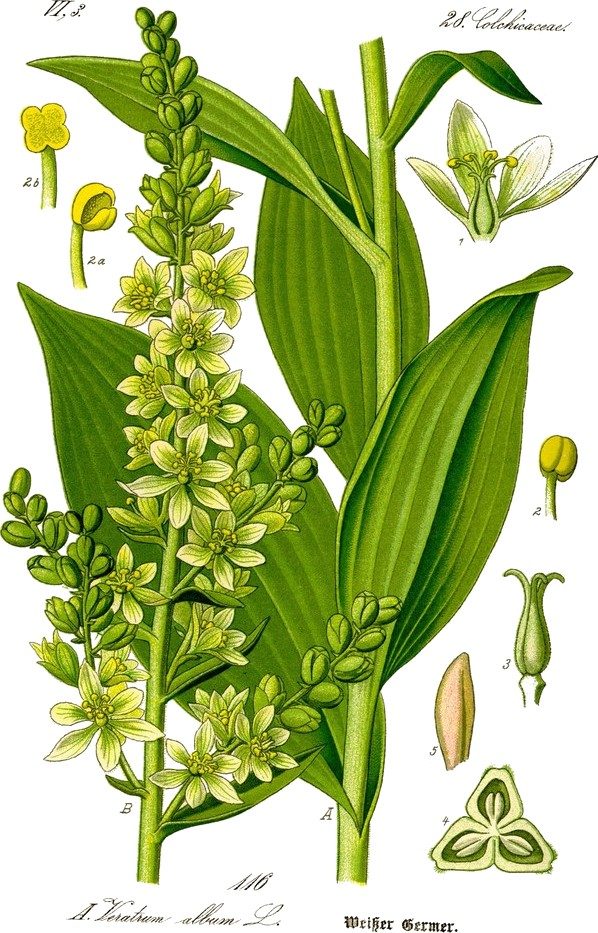
White hellebore
Elleboro bianco
- Known today as
- Veratrum album, false hellebore, of the family Melanthiaceae, unrelated to black hellebore (Ranunculaceae).
- Kind
- Plant, in 1 older authority
- Constituents
- protoveratrine A, veratridine, jervine
- Poisoning
- Aconitine poisoning
- Earliest authority here
- Antiquity
- In other databases
- Plants of the World Online search · GBIF search · Wikidata search
- In the Canale glossary
- On the Manner of Discerning and Healing the Bewitched, Appendix A: Part Three, Chapter 5: Vomitory Medicines
Revised October 1, 2026: Lore added from texts read in full. Version 1, first published September 25, 2026.
Caution. Hazardous in some form or dose; see the modern assessment below.
White hellebore: what did Canale use it for?
“So much used by Exorcists,” as a vomit; Canale warns that its violence can kill and prescribes careful infusion; its root in the oil for the bewitched (chs. 2, 5, 9).
White hellebore: what does modern science say?
Its alkaloids cause vomiting, slow the heart, and drop the blood pressure; deaths from it are still recorded. Canale’s alarm is fully justified.
White hellebore: is it poisonous?
Yes, in some form or dose. Its poisoning is aconitine poisoning: Minutes to two hours, through the skin too. Historical description, not medical advice; in a poisoning, call a poison centre.
Pharmacognosy & Toxicology
- Constituents
- Mechanism
- The veratrum alkaloids hold open sodium channels and trigger the reflex that drops the heart rate and blood pressure.
- Checked against ChEMBL
- veratridine: Measured, as the entry says (“hold open sodium channels”): Sodium channel alpha subunits; brain (Types I, II, III) (rat), IC50 22 µM, CHEMBL1130561.
- Toxic dose
- One to two grams of the root; the plant is mistaken for gentian in the Alps each year.
- Syndrome
- Aconitine poisoning
- Standing
- Veratrum alkaloids were used for high blood pressure until the 1950s; none now.
- Nelson, L. S., et al. (2007). Handbook of Poisonous and Injurious Plants. Verified against its record · doi:10.1007/978-1-4939-8926-3
Constituent names open the compound’s record at PubChem, and “ChEMBL” beside a name opens its record at ChEMBL, the European Bioinformatics Institute’s database of bioactive molecules. Where a mechanism line was checked against ChEMBL (ChEMBL 37, read 1 October 2026), the check is shown with the measured value and its source paper, or says plainly that nothing has been measured. Doses are as the references give them, for description only; this is not medical advice. Each source carries the result of its check against Crossref, PubMed, or the authority’s page: see Verification.
What Medicine Makes of It
- The Purge, the Vomit, and the BathWhat the regimen did to the body.
White hellebore: what lore surrounds it?
Folkard tells how Melampus learned the purge from goats that had fed on hellebore and cured the mad daughters of Prœtus, after which “Black Hellebore was used to purify houses, and to hallow dwellings, and the ancients entertained the belief that by strewing or perfuming their apartments with this plant, they drove away evil spirits.” The root was dug with rites: “the devotee first drawing a circle round the plant with a sword, and then, turning to the east, offering a prayer to Apollo and Æsculapius,” while an eagle overhead “was considered so ominous as to predict the certain death of the persons who took up the plant.” Hellebore “was thought to cure such as seemed to be possessed with the Devil, and therefore was by some called Fuga Dæmonum,” and the Anticyra of the proverb Naviga ad Anticyram grew it in abundance.
White hellebore: what did the older authorities say?
- Antiquity
- The “white” hellebore of the Greeks, an emetic rather than a purge, shared the Anticyra trade with the black; the two plants are unrelated.
Sources
- [101] Quatrehomme, G., Bertrand, F., Chauvet, C., & Ollier, A. (1993). Intoxication from Veratrum album. Human & Experimental Toxicology 12(2): 111–115. doi:10.1177/096032719301200203 Verified against its record · doi:10.1177/096032719301200203
- [106] Ren, Y., Xian, X., & Chen, F. (2025). Acute Veratrum poisoning: a case report and literature review. Asploro Journal of Biomedical and Clinical Case Reports 8(2): 173–179. doi:10.36502/2025/ASJBCCR.6408 Verified against its record · doi:10.36502/2025/asjbccr.6408
- [108] Royal Botanic Gardens, Kew. Plants of the World Online. powo.science.kew.org (accessed September 2026). Book, seen in reviews
- Folkard, R. (1884). Plant Lore, Legends, and Lyrics, “Hellebore.” Project Gutenberg #44638. Primary text
Verification
- Checked
- October 1, 2026
- Passes
- Every sentence read against its sources, in the pass over the remaining 343 entries
- The Standing line checked against the authority it names (EMA, WHO, FDA, CITES, Commission E)
- Every dated or regulatory claim checked by category across the database
- The mechanism read against ChEMBL (ChEMBL 37): curated mechanisms and measured activity
- Each quotation from the older authorities checked word for word against the text, read in full
- Sources
- 5 cited: 3 verified against its record, 1 primary text, 1 book, seen in reviews.
- Corrections
- None were needed.
What was checked, how, and what was found is set out on the Verification page. A checked source is one whose record was found; it does not make the entry medical advice.
Cite This Entry
Version 1 · first published September 25, 2026 · last revised October 1, 2026
- Chicago
“White hellebore.” In Materia Medica, edited by B. C. P. Statema. Version 1. The Thinking Press, 2026–. Last modified October 1, 2026. https://thethinkingpress.org/materia-medica/white-hellebore.
- MLA
“White hellebore.” Materia Medica, edited by B. C. P. Statema, version 1, The Thinking Press, 1 Oct. 2026, thethinkingpress.org/materia-medica/white-hellebore. Accessed 8 Oct. 2026.
- APA
White hellebore. (2026, October 1). In B. C. P. Statema (Ed.), Materia medica (Version 1). The Thinking Press. Retrieved October 8, 2026, from https://thethinkingpress.org/materia-medica/white-hellebore
Club members keep entries on a shelf with private notes, print the plates as cards, and receive an entry by email each week. Create a free account before January 1, 2027 and all of it is yours for good. About the Club
See Also
Poisoned alike: aconitine poisoning
Drawing on the same sources: Folkard, Nelson
Wild rue · Violet, lettuce, sow-thistle · Aloe · Woody nightshade · Turmeric · Yew · the bibliography →
Nearby in the alphabet
White lead (Basic lead carbonate) · White arsenic (Arsenic trioxide) · White willow (The bark and leaves of Salix alba) · Weapon-salve · Wild bergamot · Wax ex-votos · Wild carrot, seed of (Queen Anne’s lace) · Wax (Beeswax)
Historical description, not medical advice.