
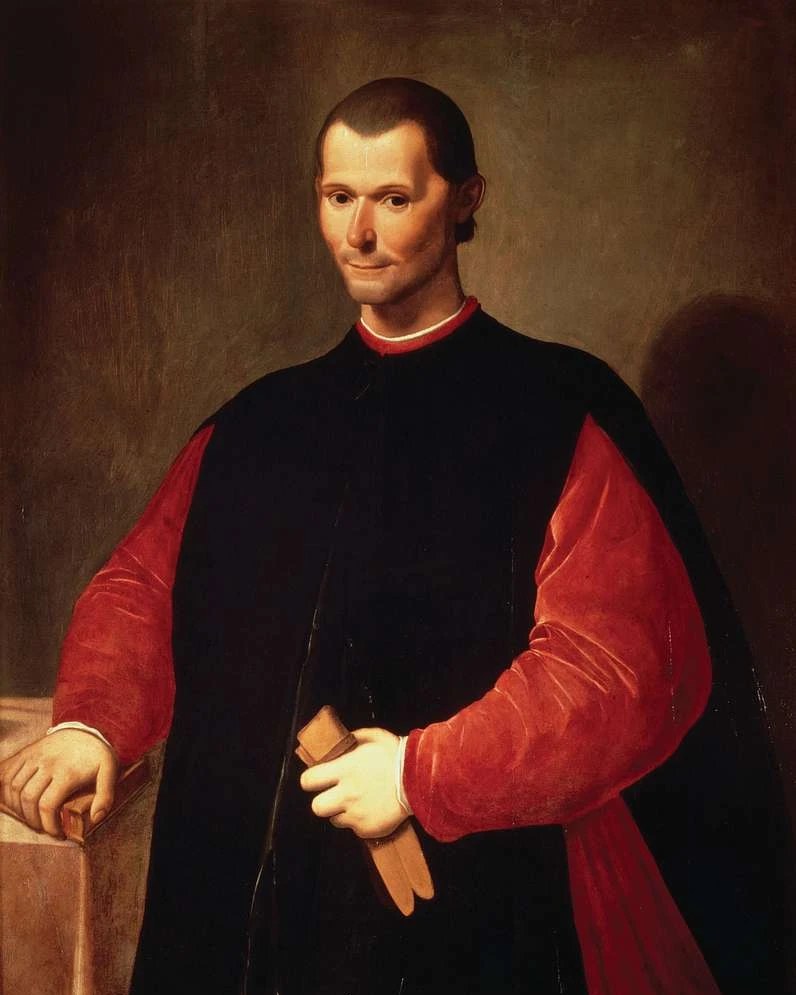
Niccolò Machiavelli
The Florentine who exposed the inner workings of power, and traced the shadow of human motive centuries before psychology gave it a name.
“It appears to me more appropriate to follow up the real truth of a matter than the imagination of it.”
The Prince, chapter XV, trans. W. K. Marriott
Why Machiavelli
Machiavelli belongs among the press’s inspirations for what he exposed. Where others wrote of how rulers ought to be, he laid open the inner workings of power as it actually moves: the fear and the ambition, the appearances kept up and the motives kept hidden, the calculation beneath the ceremony.
In that sense he was a psychologist before psychology had a name. What Jung would call the shadow, Machiavelli had already traced through the courts and councils of Renaissance Italy: a precursor, in the life of states, of what depth psychology would find in the life of the soul.
- The Prince (written 1513; printed 1532)
- Discourses on Livy (c. 1513–19; printed 1531)
- The Mandrake (La Mandragola), a comedy (c. 1518)
- The Art of War (1521)
- The Life of Castruccio Castracani (1520)
- Florentine Histories (presented 1525)
- Letter to Francesco Vettori, 10 December 1513
The Life
Florence, 1469
Niccolò Machiavelli was born in Florence on 3 May 1469, the son of Bernardo Machiavelli, a lawyer of old family and modest means whose small library was his son’s first school, and in which Livy’s history of Rome held an honored place. He was educated in Latin in the humanist manner, in the Florence of Lorenzo de’ Medici at the height of its splendor.
He came of age as that splendor broke. In 1494 the French invaded Italy, the Medici were driven from Florence, and the friar Girolamo Savonarola ruled the city’s conscience with prophecy until, in May 1498, he was hanged and burned in the Piazza della Signoria. Weeks later the young Machiavelli entered public life.
Secretary of the Republic
In June 1498 Machiavelli was made head of the Republic’s Second Chancery, and soon secretary to the Ten of War. For fourteen years he served Florence on missions to the court of Louis XII of France, to Pope Julius II, to the Emperor Maximilian, and, in 1502, to Cesare Borgia, whose ruthless brilliance he watched at close range as Borgia carved out a state in the Romagna.
Convinced that a city defended by mercenaries was at the mercy of their loyalty, he organized a citizen militia, which helped Florence recover Pisa in 1509. But in 1512 Spanish troops sacked nearby Prato, the militia broke, the Republic fell, and the Medici returned to power.
Prison, and the Rope
Machiavelli was dismissed from office in November 1512. In February 1513 his name was found on a list kept by young conspirators against the Medici; he was arrested, imprisoned in the Stinche, and tortured with the strappado, hoisted by his bound wrists and dropped. He confessed nothing, for he had nothing to confess.
He was released that March in the amnesty that followed the election of Giovanni de’ Medici as Pope Leo X, and retired, ruined and forty-three, to his small farm at Sant’Andrea in Percussina, south of the city.
Among the Ancients
There, in a letter to his friend Francesco Vettori of 10 December 1513, he described his evenings: he would take off the muddy clothes of the day, put on the garments of court, and enter the ancient courts of ancient men, where he was not ashamed to speak with them and ask the reasons for their actions, and they, in their kindness, answered him. From those conversations came a little work, On Principalities, the book we call The Prince.
That scene, a scholar in borrowed dignity asking the old books for their reasons, is the whole of the press’s practice of translation.
The Discourses, and the Later Works
The Prince was a handbook for founding and holding a new state; his larger work, the Discourses on Livy, was a meditation on free republics, the government he truly loved. In it he argued that it is not private advantage but the common good that makes cities great, that liberty is best guarded by the many, and that states endure only by returning, from time to time, to their first principles.
In his later years he wrote the comedy The Mandrake, the dialogue The Art of War (1521), the only one of his major political works printed in his lifetime, and, on the commission of Cardinal Giulio de’ Medici, the Florentine Histories, presented to him in 1525, by then Pope Clement VII.
Death, and a Name
In 1527 Rome was sacked by imperial troops, the Medici were driven from Florence once more, and a new republic was declared, which passed over the old servant of the Medici. Machiavelli died in Florence on 21 June 1527 and was buried in the Basilica of Santa Croce.
The Prince was printed only in 1532, and in 1559 it was placed on the Church’s Index of Prohibited Books. His name became a byword for cunning and cruelty, and in English the Devil himself was called “Old Nick.” In 1787 a monument was raised over his tomb in Santa Croce, bearing the words Tanto nomini nullum par elogium: no praise is equal to so great a name.
The Thought
The core of Machiavelli’s philosophy, and where each idea lives in the press’s own books.
The effectual truth: to study how people actually live and power actually moves, rather than imagined republics that never existed.
Not moral virtue but capacity: the energy, foresight, and resolve with which a person meets circumstance and shapes it.
Chance, which rules perhaps half of our affairs, like a river in flood; the other half is left to us, and to what we build in fair weather.
Necessity, which compels action and reveals character; the wise ruler does willingly, in time, what necessity would otherwise force.
The ruler must learn two natures: the lion, to frighten the wolves, and the fox, to recognize the snares. Either alone is ruin.
Everyone sees what you appear to be; few touch what you are. Men judge more by the eye than by the hand.
In the Discourses, it is not private advantage but the common good that makes cities great, and that is best kept by free republics.
States and institutions endure by being renewed, drawn back periodically toward the principles on which they were founded.
Within the Press
The Prince Within: Machiavelli in An History Beside Time
An History Beside Time does something few readers of Machiavelli have dared: it turns The Prince inward. The psyche becomes a principality, with its soldiers, counselors, builders, and ambassadors, and at its heart a rightful ruler: “the institution is the prince, though few have named it so.” The book’s third chapter is a handbook for that inner prince, and it takes its teachers from Florence.
“Now the Florentine spake also of the fox and the lion, that the prince must learn both natures.” The inner ruler must be neither only gentle nor only harsh: “A prince that is only gentle is devoured by his mercies. And a prince that is only cruel is devoured by hatred.” And the hardest of Machiavelli’s lessons is translated for the soul: “The Florentine taught that a prince must sometimes do what is not called good, lest he lose the state. Translate this with trembling: the institution must sometimes offend thy comfort to preserve thy soul.”
Its fourth chapter takes up Fortune as Machiavelli drew her, a river in flood that bears away trees and houses, yet can be checked by barriers raised in fair weather. “Even if Fortune rule half, she doth not rule all.” The canals of the soul, the book says, are habits, vows, and disciplines; and “a rule of life is a canal dug before the flood.”
The Shadow Before Psychology
Machiavelli saw that everyone sees what a ruler appears to be, and few touch what he is; that men judge more by the eye than by the hand; that ambition, fear, and ingratitude move beneath the most solemn ceremony. Four centuries before Freud and Jung, he mapped the gap between the mask and the face, and refused to pretend it was not there.
The Wisdom of Catastrophe draws on him for exactly this. Among its ideas is that power must be audited, because those who hold it are moved by self-interest as Machiavelli showed, and that the fittest auditors are those who have done the inner work and know their own capacity for evil. Naïveté about evil, in the treatise as in Machiavelli, is no virtue but a danger.
The Italy of the Translations
Machiavelli’s Italy is the world of the press’s Series C, a century on: Girolamo Menghi’s Cudgel of Demons (1584), Cesare della Riviera’s Magical World of the Heroes (1605), and Floriano Canale’s treatise on the bewitched (1614). The Prince was placed on the Index in 1559, the same Index whose later decrees may explain why the flyleaf passages in Canale’s volume were left unsigned.
Nietzsche, too, admired him: in Beyond Good and Evil he writes of how The Prince lets us breathe the dry, fine air of Florence. The inspirations of the press meet there.
Toward the Horizon of the Good
Machiavelli is remembered as the enemy of the good. The press reads him as its sternest teacher. He wrote that a ruler who would hold his state must learn to be able not to be good, and to use that knowledge according to necessity, and the sentence has frightened moralists for five hundred years. But its lesson for the good is severe and exact: a goodness that cannot see evil, cannot name it, and cannot defend itself against it will be devoured, and will leave the vulnerable undefended. A will toward the good without virtù is only a wish.
His effectual truth is the discipline that keeps the will toward the good honest. The good must be judged by what it actually produces, not by how it looks or how it feels. An History Beside Time puts it in the Florentine’s spirit: “watch thy fruits, not thy stories. For stories can lie sweetly, but fruit cannot hide its taste.” And his Fortune is the reason the good must be prepared before it is tested; the book’s answer to her is Machiavelli’s answer, turned inward: “the will toward the Good is the only thing that can withstand Fortune,” for “Fortune cannot take thy will unless thou hand it to her.”
Nor was his own horizon cynical. The Prince ends in an exhortation to free Italy from foreign domination; the Discourses hold that the common good, not private gain, makes cities great, and that a well-ordered republic can outlast the men who founded it. That is the good measured across generations, answerable not to one ruler’s moment but to the city and the world after him: the same test the will toward the good sets, now, in a week, in a year, and forever. Machiavelli did not preach the good. He showed what it would cost to make it real, and the press counts that the greater service.