
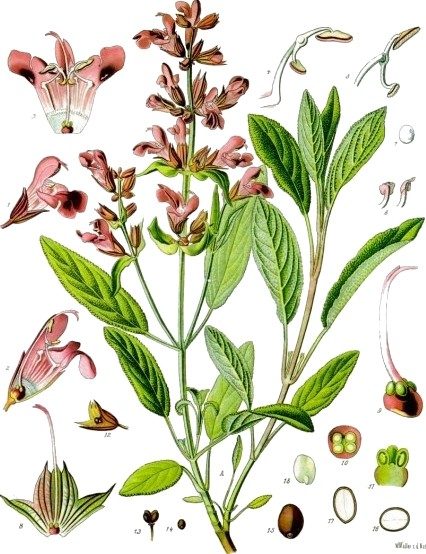
Sage
Salvia
- Known today as
- Salvia officinalis.
- Kind
- Plant, in 4 older authorities
- Constituents
- thujone, camphor, rosmarinic acid, and 1 more
- Earliest authority here
- The School of Salerno (10th–13th century)
- In other databases
- Plants of the World Online search · GBIF search · Wikidata search
- In the Canale glossary
- On the Manner of Discerning and Healing the Bewitched, Appendix A: Part Three, Chapter 9: Anointings
Revised October 1, 2026: Tradition, lore, modern assessment, and sources extended. Version 1, first published September 25, 2026.
Sage: what did Canale use it for?
In the oil; among the amulets; blessed, in the oil of Treatise Two (chs. 9–10; Treatise Two).
Sage: how is it taken as a tea?
A pint of boiling water on an ounce of the leaves, with lemon rind and sugar if liked, strained after half an hour: a gargle for the relaxed or ulcerated throat, and in small repeated doses for nervous headache and the delirium of fevers. The Chinese, Grieve says, once preferred it to their own tea.
All the herbal teas of the database. Historical directions, not medical advice.
Sage: what does modern science say?
“Why should a man die with sage in his garden?” ran the medieval proverb. It is still used for sore mouths and throats and minor wounds, and there is some evidence for memory. Two small British trials in 2003 and 2008 found extracts of sage improved word recall and attention for some hours, and its compounds inhibit the same enzyme as the drugs for Alzheimer’s disease; the research has not gone further. The oil contains thujone, the poison of wormwood, so regulators limit it to a few milligrams a day.
Pharmacognosy & Toxicology
- Constituents
- thujone ChEMBL
- camphor ChEMBL
- rosmarinic acid ChEMBLan antioxidant
- carnosic acid ChEMBL
- Mechanism
- The oil’s terpenes are antimicrobial and, in excess, convulsant; extracts inhibit acetylcholinesterase weakly.
- Toxic dose
- Thujone from the oil, not the leaf, is the hazard; a few millilitres of the oil have caused seizures in children.
- Syndrome
- Convulsant terpenes (thujone, pinocamphone, camphor)
- Standing
- Approved in Europe as a traditional remedy for the mouth and throat and for sweating; thujone limited to about 6 mg a day.
- European Medicines Agency (2016). Herbal monograph on Salvia officinalis. Book, seen in reviews
Constituent names open the compound’s record at PubChem, and “ChEMBL” beside a name opens its record at ChEMBL, the European Bioinformatics Institute’s database of bioactive molecules. Where a mechanism line was checked against ChEMBL (ChEMBL 37, read 1 October 2026), the check is shown with the measured value and its source paper, or says plainly that nothing has been measured. Doses are as the references give them, for description only; this is not medical advice. Each source carries the result of its check against Crossref, PubMed, or the authority’s page: see Verification.
Sage: what lore surrounds it?
The Chinese of the seventeenth century are said to have traded three chests of their tea for one of English sage. Where sage flourishes, said the proverb, the wife rules, and it was planted at weddings for the couple’s long life.
Used in These Compounds
Sage is an ingredient of 1 compound medicine in the database. For Club members. Create a free account or sign in.
Sage: what did the older authorities say?
- The School of Salerno
- “Why should a man die who has sage in his garden?” asks the Regimen sanitatis Salernitanum, and answers that against death there is no herb.
- Pliny
- Calls it salvia, the saving herb, from salvere, to be well, and gives it for snakebite, the memory, and the womb; the Romans gathered it with a rite, in white tunics with bare feet.
- Charlemagne
- Named it among the first herbs to be grown on the imperial farms, after the lily, the rose, fenugreek, and costmary, and every monastery garden had its bed.
- Gerard
- Says it “quickeneth the senses and memory, strengtheneth the sinewes, restoreth health to those that have the palsie.”
Sources
- [41] European Medicines Agency, Committee on Herbal Medicinal Products (HMPC). Herbal monographs, assessment reports and public statements, ema.europa.eu, cited under the herb concerned: aniseed (summary, EMA/305345/2016); Aristolochia (public statement, EMEA/HMPC/138381/2005); asarone (public statement, EMEA/HMPC/139215/2005); caraway (EMA/HMPC/715092/2013); centaury (EMA/HMPC/277493/2015); chicory root (assessment report, EMA/HMPC/113041/2010); cinnamon (EMA/HMPC/246774/2009); clove (assessment report, EMA/HMPC/534946/2010); ethanol in herbal products (reflection paper, EMA/HMPC/85114/2008); fennel (EMEA/HMPC/372839/2016, Rev. 1, 2024); fumitory (draft assessment report, EMA/HMPC/367013/2021); greater celandine (public statement, EMA/HMPC/743927/2010); hops (EMA/HMPC/682384/2013); horehound (EMA/HMPC/604271/2012); mallow (assessment report, EMA/HMPC/749518/2016); marshmallow root (Althaeae radix); melissa (summary, EMA/HMPC/310761/2013); myrrh (assessment report and monograph, EMA/HMPC/96910/2010 and 96911/2010); peppermint oil (assessment report, EMEA/HMPC/349465/2006); pyrrolizidine alkaloids (public statement, EMA/HMPC/893108/2011); rhubarb (EMA/HMPC/113700/2019); sage (Salviae officinalis folium); wormwood (EMA/HMPC/751490/2016). Read in full · the text read
- [76] Larkin, D. The Medieval Garden Enclosed (blog), The Metropolitan Museum of Art, The Cloisters: Herb Paris (23 June 2010); Salvia, Save Us (7 September 2010); Beneficent Betony (24 June 2011). Book, seen in reviews
- [88] Miroddi, M., Navarra, M., Quattropani, M. C., Calapai, F., Gangemi, S., & Calapai, G. (2014). Systematic review of clinical trials assessing pharmacological properties of Salvia species on memory, cognitive impairment and Alzheimer’s disease. CNS Neuroscience & Therapeutics 20(6): 485–495. doi:10.1111/cns.12270 Verified against its record · doi:10.1111/cns.12270
- Grieve, M. A Modern Herbal, “Sages.” As published on botanical.com.
- Tildesley, N. T., et al. (2003). “Salvia lavandulaefolia enhances memory in healthy young volunteers.” Pharmacology, Biochemistry and Behavior 75. Verified against its record · doi:10.1016/s0091-3057(03)00122-9
- Gerard, J. (1597). The Herball. Verified against its record · doi:10.5962/bhl.title.99400
Verification
- Checked
- October 1, 2026
- Passes
- Every sentence read against its sources, in the pass over the remaining 343 entries
- The Standing line checked against the authority it names (EMA, WHO, FDA, CITES, Commission E)
- Every dated or regulatory claim checked by category across the database
- Sources
- 7 cited: 1 read in full, 3 verified against its record, 2 book, seen in reviews, 1 not yet checked.
- Corrections
- Charlemagne's Capitulare de villis lists sage fifth, after lily, rose, fenugreek, and costmary, not "first."
What was checked, how, and what was found is set out on the Verification page. A checked source is one whose record was found; it does not make the entry medical advice.
Cite This Entry
Version 1 · first published September 25, 2026 · last revised October 1, 2026
- Chicago
“Sage.” In Materia Medica, edited by B. C. P. Statema. Version 1. The Thinking Press, 2026–. Last modified October 1, 2026. https://thethinkingpress.org/materia-medica/sage.
- MLA
“Sage.” Materia Medica, edited by B. C. P. Statema, version 1, The Thinking Press, 1 Oct. 2026, thethinkingpress.org/materia-medica/sage. Accessed 8 Oct. 2026.
- APA
Sage. (2026, October 1). In B. C. P. Statema (Ed.), Materia medica (Version 1). The Thinking Press. Retrieved October 8, 2026, from https://thethinkingpress.org/materia-medica/sage
Club members keep entries on a shelf with private notes, print the plates as cards, and receive an entry by email each week. Create a free account before January 1, 2027 and all of it is yours for good. About the Club
See Also
Poisoned alike: convulsant terpenes (thujone, pinocamphone, camphor)
Tansy · Rosemary · Wormwood, oil of · Mugwort · Camphor · Mint, oil of · Hungary water · Hyssop · the syndrome, with all of them →
Sharing thujone, camphor, rosmarinic acid
Artemisia abrotanum · Blessed herbs · Vinegar of the four thieves · Paregoric · Prunella vulgaris
Also in Pliny the Elder
Saltpetre in Pliny the Elder · Rue in Pliny the Elder · Savin in Pliny the Elder · Rowan in Pliny the Elder · everything Pliny the Elder names →
Drawing on the same sources: Grieve, Gerard
Nearby in the alphabet
Sal ammoniac (from volcanic vents and later made from soot and urine) · Saffron milk cap (An orange mushroom of pine woods that weeps carrot-colored milk) · Salt · Saffron (The stigmas of Crocus sativus) · Sandalwood (The heartwood of Santalum album)
Historical description, not medical advice.