
The Thinkers
Reference Material
The editions, sources, and reference works the press’s books are built on, gathered in one place for readers who want to follow a thread back to its origin.
The Source Texts
- Scherner, Karl Albert. Das Leben des Traumes. Berlin, 1861. The source of Discoveries in the Realm of the Soul, translated from the first printing.
- Menghi, Girolamo. Fustis Daemonum. Bologna, 1584. The source of The Cudgel of Demons; the companion to his Flagellum Daemonum.
- Canale, Floriano. Del modo di conoscer et sanare i maleficiati. First printed 1614; the edition used is the Milan printing of Giuseppe Marelli, 1663, whose flyleaves carry the passages of Appendix C. The source of On the Manner of Discerning and Healing the Bewitched.
- Della Riviera, Cesare. Il Mondo Magico de gli Heroi. 1605. The source of The Magical World of the Heroes.
Nietzsche
- Nietzsche, Friedrich. Thus Spake Zarathustra. Translated by Thomas Common. Edinburgh and London: T. N. Foulis, 1909. The text of Volume I of the Nietzsche Set.
- Nietzsche, Friedrich. Beyond Good and Evil. Translated by Helen Zimmern. Edinburgh and London: T. N. Foulis, 1907. The text of Volume II of the Nietzsche Set.
- Nietzsche, Friedrich. The Gay Science (Die fröhliche Wissenschaft). 1882; expanded 1887. For the death of God (§125) and the eternal return (§341).
Jung
- Jung, C. G. The Collected Works of C. G. Jung. Edited by Herbert Read, Michael Fordham, and Gerhard Adler; translated by R. F. C. Hull. Bollingen Series XX. Princeton University Press, 1953–1979. Especially Psychology and Alchemy (vol. 12), Alchemical Studies (vol. 13), and Mysterium Coniunctionis (vol. 14).
- Jung, C. G. Nietzsche’s Zarathustra: Notes of the Seminar Given in 1934–1939. Edited by James L. Jarrett. Princeton University Press, 1988.
- Jung, C. G. Memories, Dreams, Reflections. Recorded and edited by Aniela Jaffé. 1962.
- Jung, C. G. The Red Book: Liber Novus. Edited by Sonu Shamdasani. W. W. Norton, 2009.
Machiavelli
- Machiavelli, Niccolò. Il Principe (The Prince). Written 1513; printed 1532. Quoted here in the translation of W. K. Marriott.
- Machiavelli, Niccolò. Discorsi sopra la prima deca di Tito Livio (Discourses on Livy). Printed 1531.
- Machiavelli, Niccolò. Letter to Francesco Vettori, 10 December 1513.
Alchemy
- The Emerald Tablet (Tabula Smaragdina). First known from Arabic sources; quoted on the Alchemy page in the translation of Isaac Newton.
- Ficino, Marsilio, trans. Pimander (the Corpus Hermeticum). Translated 1463; printed 1471.
- Maier, Michael. Atalanta Fugiens. Oppenheim, 1617.
- Boyle, Robert. The Sceptical Chymist. London, 1661.
- Wilhelm, Richard, and C. G. Jung. The Secret of the Golden Flower. 1929.
Dreams and the Psyche
- Freud, Sigmund. Die Traumdeutung (The Interpretation of Dreams). 1899, dated 1900. Where Scherner is credited by name as a predecessor.
- Freud, Sigmund. “A Seventeenth-Century Demonological Neurosis” (“Eine Teufelsneurose im siebzehnten Jahrhundert”). 1923.
- Freud, Sigmund. Civilization and Its Discontents (Das Unbehagen in der Kultur). 1930.
- Freud, Sigmund. An Autobiographical Study. 1925. For his remark on Nietzsche.
Illustrations
- Köhler, F. E. Köhler’s Medizinal-Pflanzen. Gera-Untermhaus, 1887–1898. Botanical plates for the illustrated glossary of the Canale edition.
- Sturm, Jacob, in J. G. Sturm. Deutschlands Flora in Abbildungen. Nuremberg, 1796 onward. Botanical plates for the same glossary.
- Dürer, Albrecht. Knight, Death and the Devil. Engraving, 1513. The image behind the press’s home page.
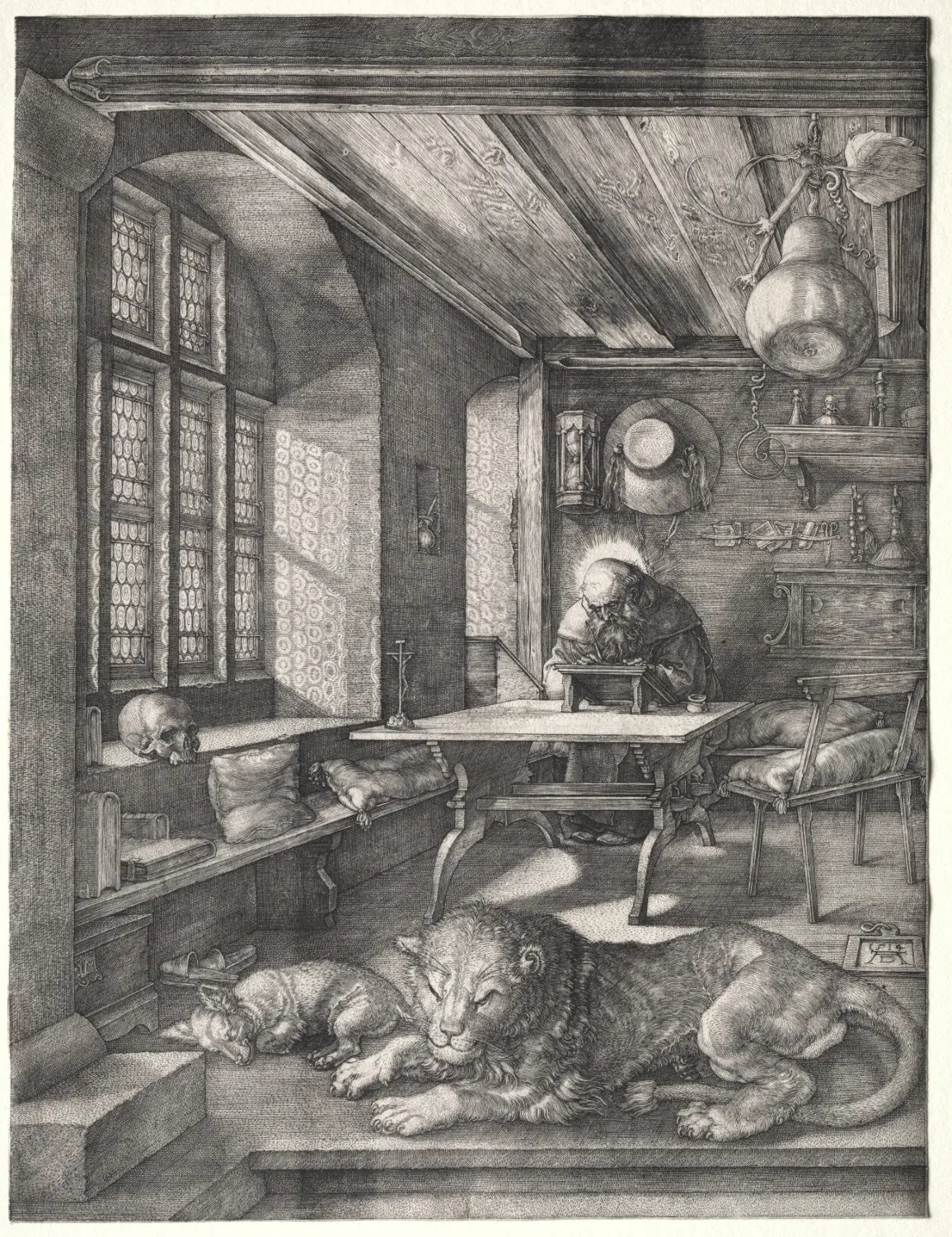
- Dürer, Albrecht. Saint Jerome in His Study. Engraving, 1514. On the Write for TTP, Reference Material, and Colophon pages.
- Teniers, David, the Younger, after. The Alchymist. Mezzotint. On the Alchemy page, with an early modern woodcut of an alchemical laboratory and an engraving of an alchemist at his furnace.
- Goya, Francisco. The Sleep of Reason Produces Monsters. From Los Caprichos, 1799. The image behind The Wisdom of Catastrophe.