
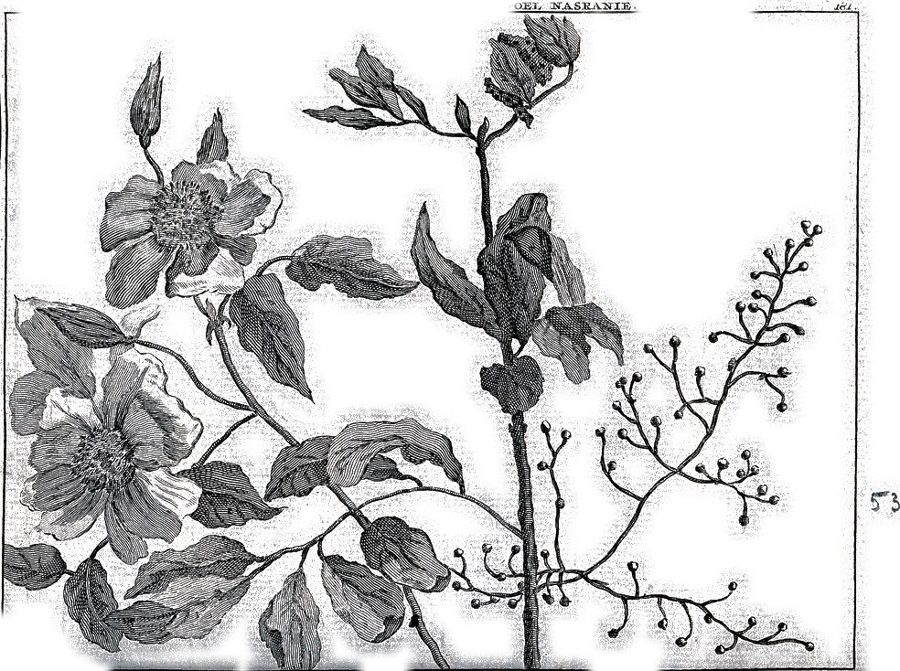
Turpentine
Trementina
- Known today as
- The oleoresin of the larch (“Venice” turpentine) or of the terebinth (“Chian” turpentine).
- Kind
- Resin & Wood, in 1 older authority
- Constituents
- alpha-pinene, beta-pinene, delta-3-carene, and 1 more
- Earliest authority here
- Pliny (AD 23/24–79)
- In the Canale glossary
- On the Manner of Discerning and Healing the Bewitched, Appendix A: Part Three, Chapter 9: Anointings
Revised October 1, 2026: An older authority added from a text read in full. Lore added from texts read in full. Version 1, first published September 25, 2026.
Turpentine: what did Canale use it for?
The base of the oil for hexes, bewitchments, chills, and wounds, to be drunk a quarter ounce a day for a month (ch. 9).
Turpentine: what does modern science say?
A poison in quantity: as little as 15 ml can kill a child. From the seventeenth to the nineteenth century it was widely used on wounds.
Pharmacognosy & Toxicology
- Constituents
- alpha-pinene ChEMBL60–90 per cent of the oil
- beta-pinene ChEMBL
- delta-3-carene ChEMBL
- abietic acid ChEMBLin the rosin left after distillation
- Mechanism
- On the skin the oil is a rubefacient that dilates the vessels and counter-irritates, and it is antiseptic; swallowed, it irritates the stomach and is excreted by the kidney, which it inflames, and the lungs, giving the urine a violet smell. Aspiration into the lungs is the danger in children. Canale’s quarter ounce a day for a month is a dose that would damage the kidneys.
- Toxic dose
- Fatal doses in adults are recorded from 120 ml; children have died from 15 ml; the Commission E allows it externally only.
- Standing
- Commission E approves purified turpentine oil externally for rheumatic complaints and in inhalations; internal use is obsolete.
- Blumenthal, M., ed. (1998). The Complete German Commission E Monographs, “Turpentine oil, purified.” Standard reference work
- Goldfrank’s Toxicologic Emergencies, 11th ed. (2019), “Hydrocarbons.” Standard reference work
Constituent names open the compound’s record at PubChem, and “ChEMBL” beside a name opens its record at ChEMBL, the European Bioinformatics Institute’s database of bioactive molecules. Where a mechanism line was checked against ChEMBL (ChEMBL 37, read 1 October 2026), the check is shown with the measured value and its source paper, or says plainly that nothing has been measured. Doses are as the references give them, for description only; this is not medical advice. Each source carries the result of its check against Crossref, PubMed, or the authority’s page: see Verification.
Turpentine: what lore surrounds it?
Of the terebinth, the tree of Chian turpentine, Folkard writes that it “is a tree much venerated by the Jews. Abraham pitched his tent beneath the shade of a Terebinth at Mamre,” that Josephus held “the Terebinth of Abraham had flourished ever since the creation of the world,” and that “the Jews, by preference, bury their dead beneath the shadow of a Terebinth.” Of the larch he notes that “Ben Jonson, in the ‘Masque of Queens,’ speaks of the gum or turpentine of the Larch as being used in witchcraft,” the witch bringing “juice that from the Larch-tree comes,” and that from the balm of Gilead fir “a very fine turpentine is obtained, which is sometimes sold as the true Balm of Gilead.”
Turpentine: what did the older authorities say?
- Pliny
- Of the terebinth of Syria, the male bears no fruit and the female a red fruit the size of a lentil or a pale one ripening with the grape, “of a very agreeable smell, and sticky and resinous to the touch”; about Ida and in Macedonia the tree is short and shrubby, at Damascus large; and resin of terebinth is among the ingredients of the Mendesian unguent.
Sources
- [43] Felter, H. W., & Lloyd, J. U. (1898). King’s American Dispensatory. Monographs as transcribed at Henriette’s Herbal Homepage, henriettes-herb.com, cited under the drug concerned. Read in full · the text read
- [92] National Institute for Occupational Safety and Health. NIOSH Pocket Guide to Chemical Hazards: Turpentine. cdc.gov/niosh. Book, seen in reviews
- [113] Tennessee Poison Center, Vanderbilt University Medical Center. Toxicology Question of the Week: N. Bowman, “Nutmeg, a potentially uninvited holiday guest?” (23 November 2020); B. Frazier, “What are the clinical manifestations of turpentine poisoning?” (21 November 2022). vumc.org. Book, not indexed
- Pliny the Elder, Natural History 13.12, 13.2, trans. J. Bostock & H. T. Riley (1855), Perseus Digital Library. Primary text
- Folkard, R. (1884). Plant Lore, Legends, and Lyrics, “Terebinth.” Project Gutenberg #44638. Primary text
- Folkard, R. (1884). Plant Lore, Legends, and Lyrics, “Larch.” Project Gutenberg #44638. Primary text
- Folkard, R. (1884). Plant Lore, Legends, and Lyrics, “Fir.” Project Gutenberg #44638. Primary text
Verification
- Checked
- October 1, 2026
- Passes
- Every sentence read against its sources, in the fifty-entry sample
- The Standing line checked against the authority it names (EMA, WHO, FDA, CITES, Commission E)
- Every dated or regulatory claim checked by category across the database
- Each quotation from the older authorities checked word for word against the text, read in full
- Sources
- 9 cited: 1 read in full, 4 primary text, 2 standard reference work, 1 book, seen in reviews, 1 book, not indexed.
- Corrections
- the violet smell is of the urine, not the breath.
What was checked, how, and what was found is set out on the Verification page. A checked source is one whose record was found; it does not make the entry medical advice.
Cite This Entry
Version 1 · first published September 25, 2026 · last revised October 1, 2026
- Chicago
“Turpentine.” In Materia Medica, edited by B. C. P. Statema. Version 1. The Thinking Press, 2026–. Last modified October 1, 2026. https://thethinkingpress.org/materia-medica/turpentine.
- MLA
“Turpentine.” Materia Medica, edited by B. C. P. Statema, version 1, The Thinking Press, 1 Oct. 2026, thethinkingpress.org/materia-medica/turpentine. Accessed 8 Oct. 2026.
- APA
Turpentine. (2026, October 1). In B. C. P. Statema (Ed.), Materia medica (Version 1). The Thinking Press. Retrieved October 8, 2026, from https://thethinkingpress.org/materia-medica/turpentine
Club members keep entries on a shelf with private notes, print the plates as cards, and receive an entry by email each week. Create a free account before January 1, 2027 and all of it is yours for good. About the Club
See Also
Sharing alpha-pinene, beta-pinene, delta-3-carene
Daucus carota · Pistacia lentiscus · Cupressus sempervirens · Juniperus communis · Cuminum cyminum
Also in Pliny the Elder
Verbena in Pliny the Elder · Truffle in Pliny the Elder · Violet, lettuce, sow-thistle in Pliny the Elder · Troche of agaric in Pliny the Elder · everything Pliny the Elder names →
Drawing on the same sources: Folkard, Blumenthal
Sweet flag · White hellebore · Blackthorn · Sarsaparilla · Cardamom · the bibliography →
Nearby in the alphabet
Unicorn’s horn (Monodon monoceros) · Turmeric (of the ginger family, whose root is deep yellow within) · Valerian (Valeriana officinalis) · Turkey tail (banded bracket of dead wood, common worldwide) · Verdigris (the green rust of copper)
Historical description, not medical advice.