
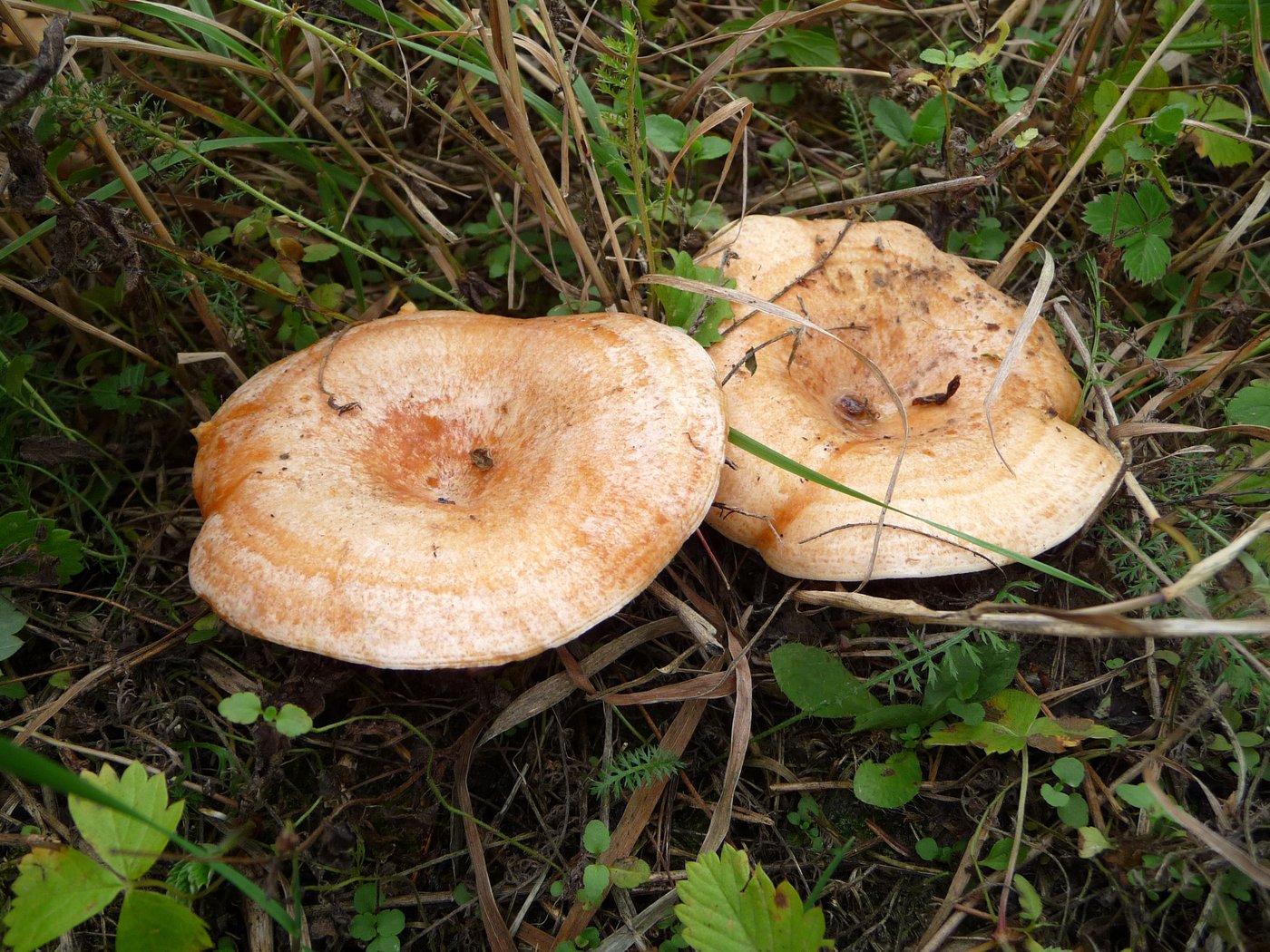
Saffron milk cap
Lactarius deliciosus
- Known today as
- An orange mushroom of pine woods that weeps carrot-colored milk.
- Kind
- Fungus
- Constituents
- lactaroviolin and lactarazulene, stearic acid esters
- Qualities
- Cold and moist, as Galen held of all mushrooms. What the degrees mean
- In other databases
- GBIF search · Wikidata search
Saffron milk cap: what was it used for?
Eaten across the Mediterranean since antiquity.
Saffron milk cap: what does modern science say?
A good edible; it can harmlessly turn the urine red.
Pharmacognosy & Toxicology
- Constituents
- lactaroviolin and lactarazulenethe sesquiterpenes that bruise green and turn the urine red
- stearic acid estersin the latex
- Mechanism
- A safe edible, painted at Herculaneum, whose azulene pigments pass into the urine and colour it, harmlessly; it has been confused with the woolly milk cap, which gives gastroenteritis.
- Toxic dose
- A food.
- Standing
- A food of Catalonia and Provence.
- Phillips, R. (2006). Mushrooms. Macmillan. Verified against its record · doi:10.5325/j.ctt7v3rx.7
Constituent names open the compound’s record at PubChem, and “ChEMBL” beside a name opens its record at ChEMBL, the European Bioinformatics Institute’s database of bioactive molecules. Where a mechanism line was checked against ChEMBL (ChEMBL 37, read 1 October 2026), the check is shown with the measured value and its source paper, or says plainly that nothing has been measured. Doses are as the references give them, for description only; this is not medical advice. Each source carries the result of its check against Crossref, PubMed, or the authority’s page: see Verification.
Saffron milk cap: what lore surrounds it?
It is painted, recognizably, on a fresco at Herculaneum.
In Their Own Words
Badham calls Agaricus deliciosus one of the best agarics he knows, fully deserving its name, with firm, juicy and nutritious flesh, growing under old Scotch firs and pines.
“This is one of the best Agarics with which I am acquainted; fully deserving both its name and the estimation in which it is held abroad. Its flesh is firm, juicy, sapid, and nutritious. It grows under old Scotch firs and pines”
Charles David Badham, M.D., A Treatise on the Esculent Funguses of England, Agaricus deliciosus, p. 89. London: Reeve, Brothers, King William Street, Strand, 1847 (Internet Archive OCR text). The text, read in part
M. C. Cooke reports a difference of opinion over the orange milk mushroom, some agreeing with Sir J. E. Smith that it is the most delicious mushroom known and others thinking it overrated.
“There is a diversity of opinion as to the estimation in which the orange milk mushroom should be held as an esculent. Some will not hesitate to endorse the opinion of Sir J. E. Smith, that "it is the most delicious mushroom known; " whilst others will contend that it has been much overrated.”
M. C. Cooke, M.A., LL.D., A.L.S., British Edible Fungi: How to Distinguish and How to Cook Them, Lactarius deliciosus, pp. 89–90. London: Kegan Paul, Trench, Trübner & Co. Ltd., Paternoster House, Charing Cross Road, 1891 (Internet Archive OCR text). The text, read in part
Each passage is quoted from the text named, which the press fetched and read, and was checked word for word against a fresh copy of it; the link opens that copy. Passages are given as printed, without the editors’ footnote numbers, and with words broken across lines joined.
Sources
- Phillips, R. (2006). Mushrooms. Verified against its record · doi:10.5325/j.ctt7v3rx.7
Verification
- Checked
- October 1, 2026
- Passes
- Every sentence read against its sources, in the pass over the remaining 343 entries
- The Standing line checked against the authority it names (EMA, WHO, FDA, CITES, Commission E)
- Every dated or regulatory claim checked by category across the database
- Sources
- 2 cited: 2 verified against its record.
- Corrections
- the fresco is at Herculaneum (as the lore says), not Pompeii.
What was checked, how, and what was found is set out on the Verification page. A checked source is one whose record was found; it does not make the entry medical advice.
Cite This Entry
Version 1 · first published September 25, 2026
- Chicago
“Saffron milk cap.” In Materia Medica, edited by B. C. P. Statema. Version 1. The Thinking Press, 2026–. Last modified September 25, 2026. https://thethinkingpress.org/materia-medica/saffron-milk-cap.
- MLA
“Saffron milk cap.” Materia Medica, edited by B. C. P. Statema, version 1, The Thinking Press, 25 Sept. 2026, thethinkingpress.org/materia-medica/saffron-milk-cap. Accessed 8 Oct. 2026.
- APA
Saffron milk cap. (2026, September 25). In B. C. P. Statema (Ed.), Materia medica (Version 1). The Thinking Press. Retrieved October 8, 2026, from https://thethinkingpress.org/materia-medica/saffron-milk-cap
Club members keep entries on a shelf with private notes, print the plates as cards, and receive an entry by email each week. Create a free account before January 1, 2027 and all of it is yours for good. About the Club
See Also
Drawing on the same sources: Phillips
Of the same qualities: cold and moist
Truffle · Quicksilver · Violet, lettuce, sow-thistle · Purslane · Caesar’s mushroom · Houseleek · what the degrees mean →
Nearby in the alphabet
Sage (Salvia officinalis) · Saffron (The stigmas of Crocus sativus) · Sal ammoniac (from volcanic vents and later made from soot and urine) · Rue (garden rue) · Salt · Rowan (Sorbus aucuparia) · Saltpetre (scraped as a white bloom from cellar walls, stables, and dung heaps) · Round birthwort (Aristolochia rotunda)

Historical description, not medical advice.