
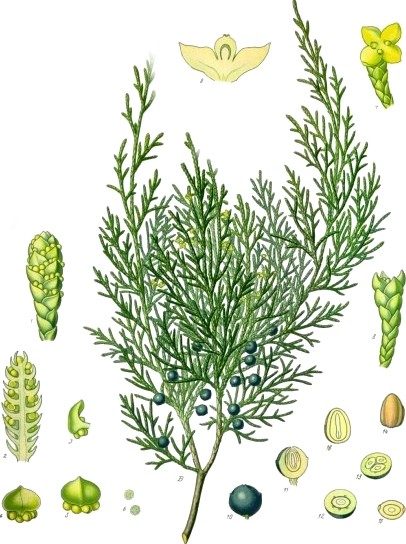
Savin
Sabina
- Known today as
- Juniperus sabina, a low juniper.
- Kind
- Plant, in 1 older authority
- Constituents
- sabinene, sabinyl acetate
- Poisoning
- Hepatotoxic monoterpenes (pulegone)
- Earliest authority here
- Pliny (AD 23/24–79)
- In other databases
- Plants of the World Online search · GBIF search · Wikidata search
- In the Canale glossary
- On the Manner of Discerning and Healing the Bewitched, Appendix A: Part Three, Chapters 7–8: The Bath and Fumigations
Revised October 1, 2026: An older authority added from a text read in full. Lore added from texts read in full. Version 1, first published September 25, 2026.
Caution. Hazardous in some form or dose; see the modern assessment below.
Savin: what did Canale use it for?
In the bath; among the amulets (chs. 7, 10).
Savin: what does modern science say?
One of the most notorious abortifacients of early modern Europe, and highly toxic; an irritant whether taken or applied.
Savin: is it poisonous?
Yes, in some form or dose. Its poisoning is hepatotoxic monoterpenes (pulegone): Hours. Historical description, not medical advice; in a poisoning, call a poison centre.
Pharmacognosy & Toxicology
- Constituents
- sabinene ChEMBL
- sabinyl acetatethe abortifacient and toxic principle
- Mechanism
- Sabinyl acetate injures the kidney and liver and provokes the uterus.
- Toxic dose
- The oil in a few millilitres has killed women who took it to end pregnancies.
- Syndrome
- Hepatotoxic monoterpenes (pulegone)
- Standing
- No medicinal use.
- Nelson, L. S., et al. (2007). Handbook of Poisonous and Injurious Plants. Verified against its record · doi:10.1007/978-1-4939-8926-3
Constituent names open the compound’s record at PubChem, and “ChEMBL” beside a name opens its record at ChEMBL, the European Bioinformatics Institute’s database of bioactive molecules. Where a mechanism line was checked against ChEMBL (ChEMBL 37, read 1 October 2026), the check is shown with the measured value and its source paper, or says plainly that nothing has been measured. Doses are as the references give them, for description only; this is not medical advice. Each source carries the result of its check against Crossref, PubMed, or the authority’s page: see Verification.
Savin: what lore surrounds it?
“The Savin (Juniperus Sabina), in some parts of Italy, is held in great abhorrence as a plant of evil repute: it is called the ‘Devil's-tree,’ and the ‘Magician's Cypress,’ on account of the great use of it made in olden times by sorcerers and witches when working their spells.” Astrologers, Folkard adds, made it a herb of Mars.
Savin: what did the older authorities say?
- Pliny
- Of savin, “known as brathy by the Greeks,” there are two kinds, one with the leaf of the tamarisk and one with that of the cypress, called by some the Cretan cypress; “it is used by many for fumigations, as a substitute for frankincense,” and in medicine is said to have the effect of cinnamon in doses twice as large; it reduces gatherings and disperses corrosive sores.
Sources
- [43] Felter, H. W., & Lloyd, J. U. (1898). King’s American Dispensatory. Monographs as transcribed at Henriette’s Herbal Homepage, henriettes-herb.com, cited under the drug concerned. Read in full · the text read
- [54] Grieve, M. (1931). A Modern Herbal. Online edition, botanical.com, cited under the plant concerned. Read in part · the text read
- [110] Schiebinger, L. (2008). Exotic abortifacients and lost knowledge. The Lancet 371(9614): 718–719. doi:10.1016/S0140-6736(08)60330-X Verified against its record · doi:10.1016/s0140-6736(08)60330-x
- Pliny the Elder, Natural History 24.61, trans. J. Bostock & H. T. Riley (1855), Perseus Digital Library. Primary text
- Folkard, R. (1884). Plant Lore, Legends, and Lyrics, “Savin.” Project Gutenberg #44638. Primary text
Verification
- Checked
- October 1, 2026
- Passes
- Every sentence read against its sources, in the pass over the remaining 343 entries
- The Standing line checked against the authority it names (EMA, WHO, FDA, CITES, Commission E)
- Every dated or regulatory claim checked by category across the database
- Each quotation from the older authorities checked word for word against the text, read in full
- Sources
- 6 cited: 1 read in full, 1 read in part, 2 verified against its record, 2 primary text.
- Corrections
- None were needed.
What was checked, how, and what was found is set out on the Verification page. A checked source is one whose record was found; it does not make the entry medical advice.
Cite This Entry
Version 1 · first published September 25, 2026 · last revised October 1, 2026
- Chicago
“Savin.” In Materia Medica, edited by B. C. P. Statema. Version 1. The Thinking Press, 2026–. Last modified October 1, 2026. https://thethinkingpress.org/materia-medica/savin.
- MLA
“Savin.” Materia Medica, edited by B. C. P. Statema, version 1, The Thinking Press, 1 Oct. 2026, thethinkingpress.org/materia-medica/savin. Accessed 8 Oct. 2026.
- APA
Savin. (2026, October 1). In B. C. P. Statema (Ed.), Materia medica (Version 1). The Thinking Press. Retrieved October 8, 2026, from https://thethinkingpress.org/materia-medica/savin
Club members keep entries on a shelf with private notes, print the plates as cards, and receive an entry by email each week. Create a free account before January 1, 2027 and all of it is yours for good. About the Club
See Also
Poisoned alike: hepatotoxic monoterpenes (pulegone)
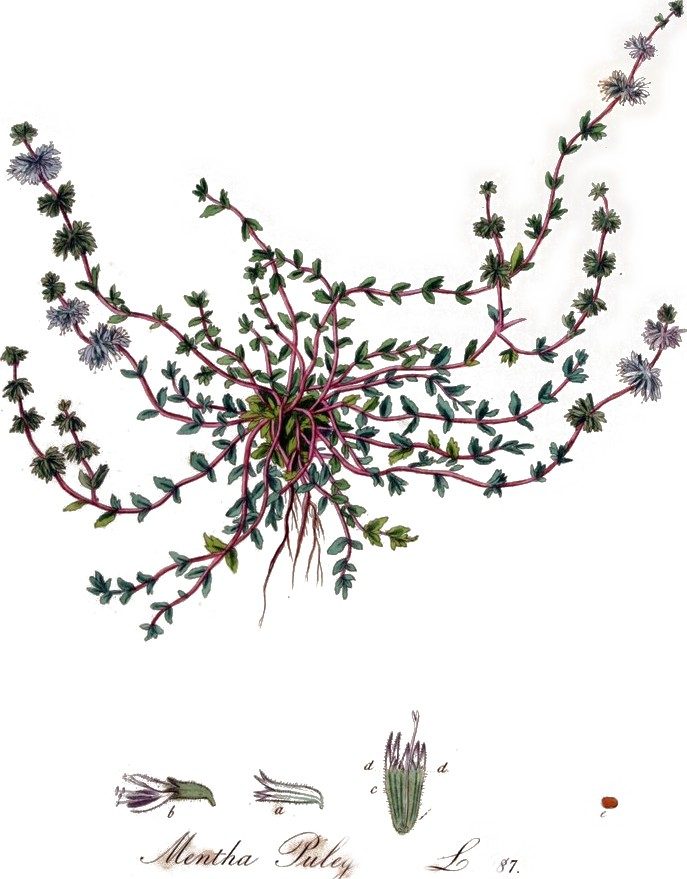
Water germander · Rue · Parsley · Pennyroyal · the syndrome, with all of them →
Sharing sabinene
Also in Pliny the Elder
Scammony in Pliny the Elder · Saltpetre in Pliny the Elder · Shepherd’s purse in Pliny the Elder · Sage in Pliny the Elder · everything Pliny the Elder names →
Drawing on the same sources: Folkard, Nelson
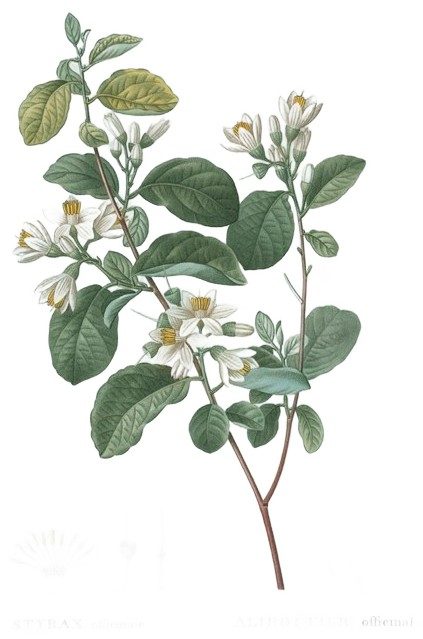
Spikenard · Round birthwort · Storax calamite · Squill · Thorn apple · the bibliography →
Nearby in the alphabet
The SATOR square (A five-line Latin word square that can be read in four directions) · Scapular (worn over the shoulders, a miniature of the monastic scapular) · Sassafras (The root bark of Sassafras albidum) · Self-heal (Prunella vulgaris) · Sarsaparilla (thorny climbers of Central and South America) · Senna (The leaves and pods of Senna alexandrina) · Sandalwood (The heartwood of Santalum album)
Historical description, not medical advice.