
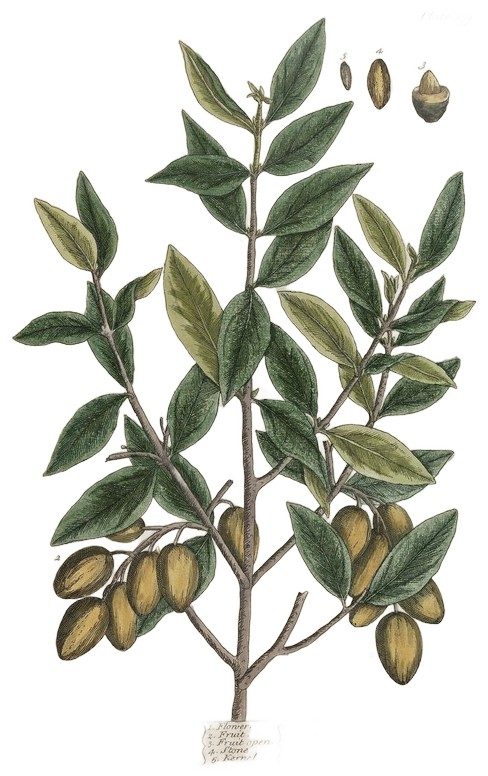
Olive oil and holy water
Oglio d’oliva; acqua santa
- Known today as
- Fine olive oil; water blessed by the Church.
- Kind
- Compound, in 1 older authority
- Constituents
- oleic acid, oleocanthal, hydroxytyrosol, and 1 more
- Earliest authority here
- Pliny (AD 23/24–79)
- In the Canale glossary
- On the Manner of Discerning and Healing the Bewitched, Appendix A: Part Three, Chapter 9: Anointings
Revised October 3, 2026: An older authority added from a text read in full. Lore added from texts read in full. Checked against its sources, each read in full, in part, or in its abstract. Version 1, first published September 25, 2026.
Olive oil and holy water: what did Canale use it for?
Three pounds of oil and half a pound of holy water form the base of the oil for the bewitched (ch. 9).
Olive oil and holy water: what does modern science say?
Olive oil is the vehicle: Canale has the other liquors, holy water among them, boiled away in a bain-marie until only the oil is left.
Pharmacognosy & Toxicology
- Constituents
- oleic acid ChEMBL55–83 per cent of the fatty acids
- oleocanthal ChEMBLthe peppery anti-inflammatory of fresh oil
- hydroxytyrosol ChEMBL
- water ChEMBL
- Mechanism
- Three pounds of olive oil to half a pound of holy water, which Canale boils off with the other liquors until only the oil is left: the oil is a demulcent and, as Grieve says, a good vehicle for liniments. In the PREDIMED trial a Mediterranean diet supplemented with extra-virgin olive oil was followed by fewer major cardiovascular events than a reduced-fat diet; the oleocanthal of fresh oil inhibits the same cyclooxygenase enzymes as ibuprofen.
- Checked against ChEMBL
- oleocanthal: No measurement in ChEMBL for “inhibits the same enzymes as ibuprofen” (20 activities recorded, none against the target named); the line rests on its references.
- Toxic dose
- A food.
- Standing
- A food; in 2025 the EFSA panel found that a cause-and-effect relationship had not been established between the phenolic compounds of olive oil and lower LDL cholesterol or blood pressure.
- Beauchamp, G. K., et al. (2005). “Ibuprofen-like activity in extra-virgin olive oil.” Nature 437. Abstract read · the text read
- Estruch, R., et al. (2018). “Primary prevention of cardiovascular disease with a Mediterranean diet supplemented with extra-virgin olive oil or nuts.” New England Journal of Medicine 378. Abstract read · the text read
The abstract of each source, beneath its citation. For Club members. About the Club or sign in.
Constituent names open the compound’s record at PubChem, and “ChEMBL” beside a name opens its record at ChEMBL, the European Bioinformatics Institute’s database of bioactive molecules. Where a mechanism line was checked against ChEMBL (ChEMBL 37, read 1 October 2026), the check is shown with the measured value and its source paper, or says plainly that nothing has been measured. Doses are as the references give them, for description only; this is not medical advice. Each source carries the result of its check against Crossref, PubMed, or the authority’s page: see Verification.
Olive oil and holy water: what lore surrounds it?
Folkard tells the contest of Neptune and Minerva for Athens, settled by the olive “which at her command had sprung from the soil,” so that “Minerva became the tutelary deity of the city”; the sacred olive in her temple “was burnt by Xerxes with the temple; but it was stated to have shot up again suddenly.” The dove of Noah brought back an olive-leaf, a garland of olive was given to Judith, and “as an emblem of peace and reconciliation, the Olive is figured on the tombs of the early martyrs,” borne by the angel Gabriel, St. Agnes and St. Pantaleon, and “by Romanists the Olive is deemed a fitting emblem of the Virgin Mary.” The Athenians consulted the Delphic oracle “holding in their hands branches of Olive.”
Thiselton-Dyer: “In Italy, an olive branch which has been blessed keeps the witch from the dwelling.” The olive “is the well-known tree of Minerva,” it is of good omen when seen in dreams, and “a wreath of a fragrant kind of olive is the reward of literary merit in China.”
Grieve recalls “that Moses exempted from military service men who would work at its cultivation,” that the oil “was burnt in the sacred lamps of temples, while the victor in the Olympic games was crowned with its leaves,” and that in Scripture and the classics “the oil is mentioned as a symbol of goodness and purity, and the tree as representing peace and happiness.”
The Recipe
The recipe: 2 ingredients, with the apothecaries’ weights in modern measure. For Club members. Create a free account or sign in.
Olive oil and holy water: what did the older authorities say?
- Pliny
- “It is not with olive oil as it is with wine, for by age it acquires a bad flavour, and at the end of a year it is already old,” a provision of Nature, since wine is for the drunkard and oil for use; he records that in the year 680 of Rome the aedile M. Seius fixed the price at ten pounds for an as, and that Hesiod held no man had ever gathered fruit from an olive he had sown himself.
Sources
- Pliny the Elder, Natural History 15.1, 15.3, trans. J. Bostock & H. T. Riley (1855), Perseus Digital Library. Read in full · the text read
- Folkard, R. (1884). Plant Lore, Legends, and Lyrics, “Olive.” Project Gutenberg #44638. Read in part · the text read
- Thiselton-Dyer, T. F. (1889). The Folk-lore of Plants. Project Gutenberg #10118. Read in part · the text read
- Grieve, M. (1931). A Modern Herbal, “Olive.” botanical.com/botanical/mgmh/o/olive-06.html Read in full · the text read
- EFSA Panel on Nutrition, Novel Foods and Food Allergens (2025). Phenolic compounds naturally present in olive oil and lowering of blood LDL-cholesterol and systolic blood pressure: evaluation of a health claim pursuant to Article 14 of Regulation (EC) No 1924/2006. EFSA Journal. Read in full · the text read
- Abrante-Pascual, S., et al. (2024). Vegetable oils and their use for frying: a review of their compositional differences and degradation. Foods 13. Read in full · the text read
Verification
- Checked
- October 1, 2026, and October 3, 2026
- Passes
- Every sentence read against its sources, in the pass over the remaining 343 entries
- The Standing line checked against the authority it names (EMA, WHO, FDA, CITES, Commission E)
- Every dated or regulatory claim checked by category across the database
- The mechanism read against ChEMBL (ChEMBL 37): curated mechanisms and measured activity
- Each quotation from the older authorities checked word for word against the text, read in full
- Every source read, in full, in part, or in its abstract, and every sentence checked against what was read (October 3, 2026)
- Sources
- 8 cited: 4 read in full, 2 read in part, 2 abstract read. 2 with the abstract on file.
- Corrections
- None were needed.
What was checked, how, and what was found is set out on the Verification page. A checked source is one whose record was found; it does not make the entry medical advice.
Cite This Entry
Version 1 · first published September 25, 2026 · last revised October 3, 2026
- Chicago
“Olive oil and holy water.” In Materia Medica, edited by B. C. P. Statema. Version 1. The Thinking Press, 2026–. Last modified October 3, 2026. https://thethinkingpress.org/materia-medica/olive-oil-and-holy-water.
- MLA
“Olive oil and holy water.” Materia Medica, edited by B. C. P. Statema, version 1, The Thinking Press, 3 Oct. 2026, thethinkingpress.org/materia-medica/olive-oil-and-holy-water. Accessed 8 Oct. 2026.
- APA
Olive oil and holy water. (2026, October 3). In B. C. P. Statema (Ed.), Materia medica (Version 1). The Thinking Press. Retrieved October 8, 2026, from https://thethinkingpress.org/materia-medica/olive-oil-and-holy-water
Club members keep entries on a shelf with private notes, print the plates as cards, and receive an entry by email each week. Create a free account before January 1, 2027 and all of it is yours for good. About the Club
See Also
Sharing oleic acid, hydroxytyrosol, water
Sweet almond, oil of · Corylus avellana · Moringa oleifera · Chrism · Exidia glandulosa
Also in Pliny the Elder
Orache in Pliny the Elder · Oak galls in Pliny the Elder · Orpiment and realgar in Pliny the Elder · Nutmeg and clove in Pliny the Elder · everything Pliny the Elder names →
Drawing on the same sources: Folkard, Thiselton-Dyer, Grieve
Olive-wood ash lye · Nasturtium, that is, garden cress · Oxymel, and oxymel of squill · Purslane · Mustard seed · Radish · the bibliography →
Nearby in the alphabet
Oil of the sick · Onion (Allium cepa) · Oil of catechumens · Onycha and stacte (Ingredients of the Temple incense (Exodus 30) · Oil of bricks · Opium poppy (Papaver somniferum)
Historical description, not medical advice.