Saffron
Zafferano
- Known today as
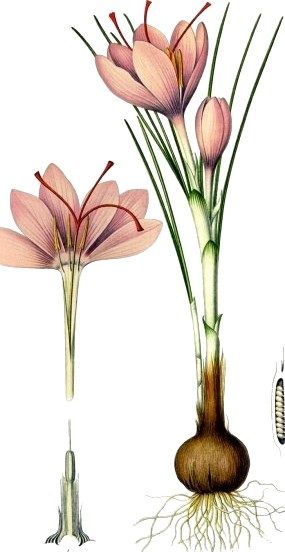
- The stigmas of Crocus sativus.
- Kind
- Plant, in 2 older authorities
- Constituents
- crocin, safranal, picrocrocin
- Qualities
- Hot in the second degree, dry in the first (Galenic tradition). What the degrees mean
- In other databases
- Plants of the World Online search · GBIF search · Wikidata search
- In the Canale glossary
- On the Manner of Discerning and Healing the Bewitched, Appendix A: Part Three, Chapter 6: Remedies Given by Mouth After the Purge
Revised November 1, 2026: What the studies show in polyendocrine metabolic ovarian syndrome (PMOS, formerly PCOS), with sources. Checked against its sources, each read in full, in part, or in its abstract. Corrected from the press's evidence dossier on the entry, every change checked in the sources read. Version 1, first published September 25, 2026.
Saffron: what did Canale use it for?
In the electuary and the oil for the bewitched (chs. 6, 9).
Before anyone takes it
- Warnings
- The autumn crocus (colchicum), which is poisonous, is easily confused with the saffron crocus. Sedgwick, 2026
Saffron: what does modern science say?
A costly spice and dye.
Before anyone takes it
- Warnings
- The autumn crocus (colchicum), which is poisonous, is easily confused with the saffron crocus. Sedgwick, 2026
- With other medicines
- Its interactions with medicines and other herbs are not fully understood. Matraszek-Gawron and colleagues, 2022
- Pregnancy and breast-feeding
- Higher doses, or work with saffron, are linked to uterine stimulation and a greater risk of miscarriage; the evidence on safety in pregnancy is limited. Alshdefat and colleagues, 2026
- Side effects
- In the depression trials, adverse effects were no more common than on placebo or antidepressants. Dai and colleagues, 2020
- Toxic dose
- Dioscorides reports that some held three drachms taken in water to be a fatal poison. Dioscorides, 1829
The toxic dose and the poisoning
- Toxic dose
- Higher doses are linked to uterine stimulation and miscarriage (Alshdefat and colleagues, 2026); Dioscorides reports that some held three drachms in water a fatal poison.
The references for these lines are listed under Pharmacognosy, in Science. Doses are as the references give them, for description only; this is not medical advice. In a poisoning, call a poison centre.
Saffron: what did the older authorities say?
- Dioscoridesc. AD 40–90
- Commends the Corycian saffron of Cilicia as the best, and warns of its adulteration.
- Nuremberg, 1444
- Nuremberg, fifteenth century: the city held a regular saffron inspection, and men were burned in the market-place with their adulterated saffron; on another occasion three were buried alive for the same crime (Encyclopaedia Britannica, 1911).
Saffron: what lore surrounds it?
A cordial for the melancholic, meant to gladden the heart; in Culpeper’s gladdening powder, Laetificans, it goes with gold and silver, and ‘causeth a merry heart’.
Greek myth accounts for the flower, Icy Sedgwick writes. In the most common version the youth Crocus had an affair with the nymph Smilax, and the gods turned him into a plant and her into a yew; in another, Crocus killed himself when the gods refused him leave to marry her, and Flora, goddess of flowers, turned both into plants out of pity; in a third, which she takes from Selenophile at Elune Blue, Smilax turned him into a flower to be rid of his advances.
Used in These Compounds
Saffron is an ingredient of 4 compound medicines in the database. For Club members. Create a free account or sign in.
Its history and lore, checked
The evidence beneath each verdict here, in the words of the sources read, is for members. Join free
History and names12 claims
ConfirmedQualities: hot in the second degree, dry in the first (Galenic tradition).
Gerard 1597, after Galen.
ConfirmedCanale puts saffron in the oil for the bewitched (chapter 9).
Canale 1622, read in a garbled OCR.
UncertainCanale puts saffron in the electuary for the bewitched (chapter 6).
The chapter 6 recipes are too garbled in both OCR texts to find saffron in them.
ConfirmedPMOS is the new name of PCOS.
Bahri-Khomami and colleagues, 2026.
ConfirmedSaffron was a cordial for the melancholic, meant to gladden the heart.
Gerard: it strengthens the heart and makes merry; Culpeper’s cordial powders with saffron for melancholy and a merry heart.
ConfirmedSaffron went with gold in the cordial powders.
Culpeper 1653: the powder Laetificans, with saffron, gold and silver.
Not supportedIts gold colour made saffron a fitting companion to gold itself.
No text read gives the colour as the reason for the pairing.
ConfirmedIcy Sedgwick: in the most common version of the myth the youth Crocus had an affair with the nymph Smilax, and the gods turned him into a plant and her into a yew.
Icy Sedgwick, without an ancient source.
ConfirmedIcy Sedgwick: in another version Crocus killed himself when the gods refused him leave to marry Smilax, and Flora turned both into plants out of pity.
Icy Sedgwick.
ConfirmedIcy Sedgwick: in a third version Smilax turned Crocus into a flower to be rid of his advances.
Icy Sedgwick, after Selenophile at Elune Blue.
ConfirmedDioscorides commends the Corycian saffron of Cilicia as the best, and warns of its adulteration.
Dioscorides I.25, Sprengel’s Latin.
Partly confirmedNuremberg, 1444: the city’s saffron inspectors (the Safranschau) had a merchant burned together with his adulterated saffron, the most famous of many harsh penalties for falsifying the costliest spice of Europe.
The 1911 Britannica: a regular saffron inspection at Nuremberg, men burned with their adulterated saffron in the 15th century, three buried alive on another occasion; the year 1444, the name Safranschau and a single merchant are not in the text read.
Each verdict is on the press’s scale, from confirmed to never documented, and rests on the sources read, in full, in part or in their abstracts. How the press checks. A summary of what was read, not medical advice.
Saffron: what does the evidence say?
The press read 16 sources for this entry and checked 31 of its claims against them (November 1, 2026). The claims are given as they stood when checked; where the reading found the entry wrong, the entry was corrected that day. Of the verdicts in this entry, 15 confirmed, 4 partly confirmed, 1 uncertain and 1 not supported. The verdicts on 10 medical and safety claims wait until a named pharmacologist or physician has read them.
The evidence beneath each verdict here, in the words of the sources read, is for members. One verdict’s is open, as a sample. Join free
Medicine3 claims
Partly confirmedCycles: FSH improved with crocin and metformin.
FSH rose, but it is a serum hormone level, which the trial calls a sex hormone; no cycle outcome is reported in the abstract.
The evidence: one source read
Crocin significantly improved the serum level of follicle-stimulating hormone (FSH) (P = 0.048)
increasing FSH sex hormone levels in patients with PCOS
Saghafi, F., Javaheri, A., Mohammadi, F., Hatamizadeh, N., Khanizadeh, F., Safakish, M., and Sahebnasagh, A. (2025). Evaluation of therapeutic effects of crocin in patients with polycystic ovary syndrome: a randomized double-blind clinical trial. Journal of Pharmaceutical Health Care and Sciences 11: 69. Abstract read · the text read
This verdict’s evidence is open to every reader, as a sample of what members read under each.
Higher doses are linked to uterine stimulation and miscarriage, and its safety in pregnancy is not established; the poisonous autumn crocus (colchicum) is easily mistaken for the saffron crocus.
Partly confirmedExtracts of the petals lowered LH and testosterone and reduced the inflammatory markers in mice made polycystic with testosterone.
In mice: LH and testosterone fell; the inflammatory genes are said to be ‘regulated’, not reduced.
Partly confirmedCrocin and safranal act on serotonin and have antioxidant effects.
Serotonergic and antioxidant actions are proposed for saffron and its compounds, from laboratory and animal work; the abstracts read do not name crocin and safranal for them.
The plant6 claims
ConfirmedKnown today as the stigmas of Crocus sativus.
Grieve; the 1911 Britannica; a 2018 review.
ConfirmedCrocin gives saffron its colour.
Two reviews’ abstracts; the 1911 Britannica calls crocin a red colouring matter.
ConfirmedSafranal gives saffron its scent.
Two reviews’ abstracts.
ConfirmedPicrocrocin gives saffron its taste.
Two reviews’ abstracts: the bitter taste.
ConfirmedCrocin is the main component of saffron.
As stated in Saghafi and colleagues’ abstract.
ConfirmedSaffron is a costly spice and dye.
Grieve; a 2017 review; the 1911 Britannica.
The verdicts on its history and lore under History.
What no one yet knows
- Does saffron itself, not crocin, help women with PMOS? The two trials gave crocin, one of them with metformin; the petal study was in mice; no trial of the spice was found.
- How much saffron is safe in pregnancy, and at what dose does it stimulate the uterus? An integrative review finds the evidence limited and dose-dependent, with no standard preparations or long-term safety data.
- Does saffron lift depression as a clinician measures it, not only as patients rate it? The newest review found effects on self-rated scales but none on the Hamilton scale, and asks for high-quality trials.
- How does saffron act on mood? Serotonergic, antioxidant and other actions are proposed from laboratory and animal work; the mechanism is not fully understood.
- Does Canale’s electuary in chapter 6 contain saffron? The chapter’s recipes are too garbled in both OCR texts read.
- Which ancient author tells the story of Crocus and Smilax? Icy Sedgwick gives no ancient source; Gerard says Ovid mentions the damsel the name was taken from; Ovid was not read.
- When and to whom did Nuremberg’s burning for adulterated saffron happen? The 1911 Britannica gives the 15th century and no name or year; no source read gives 1444.
Each verdict is on the press’s scale, from confirmed to never documented, and rests on the sources read, in full, in part or in their abstracts. How the press checks. A summary of what was read, not medical advice.
Pharmacognosy
- Constituents
- crocin ChEMBLthe colour
- safranal ChEMBLthe scent
- picrocrocinthe taste
- Mechanism
- Reviews propose serotonergic, antioxidant, anti-inflammatory and other actions for saffron and its compounds, from laboratory and animal studies; the mechanism in mood is not fully understood.
- Standing
- The newest review (34 placebo-controlled trials, 2026, moderate certainty) found saffron lowered self-rated depression and anxiety scores but not the clinician-rated Hamilton scale; earlier reviews (2013, 2020, 2024) found it better than placebo and about as good as antidepressants. All ask for larger, better trials.
- Hausenblas, H. A., et al. (2013). “Saffron and major depressive disorder: a meta-analysis.” Journal of Integrative Medicine 11. Abstract read · the text read
- Lopresti, A. L., and Drummond, P. D. (2014). Saffron (Crocus sativus) for depression: a systematic review of clinical studies and examination of underlying antidepressant mechanisms of action. Human Psychopharmacology 29: 517–527. Abstract read · the text read
- Alshdefat, A., Ayed, A., Aqtam, I., Ibitoye, O., Vincent, S., and Furqani, A. A. (2026). Saffron and pregnancy: cultural practices, beliefs, and safety evidence: an integrative review. Journal of Evidence-Based Integrative Medicine 31: 2515690X261455162. Abstract read · the text read
- Dioscorides, De materia medica libri quinque, Greek text with Latin translation, ed. C. Sprengel, vol. 1. Leipzig, 1829. Internet Archive, BIUSante_dioscsprengelx01. Read in part · the text read
- Mahmoudi, R., Mohammadi-Sartang, M., Servatyari, K., and Rafieipour, N. (2026). Effect of saffron on depression, anxiety and mood disorder: a GRADE assessed systematic review and meta-analysis of 34 randomized controlled trials. Nutritional Neuroscience 29: 816–837. Abstract read · the text read
- Dai, L., Chen, L., and Wang, W. (2020). Safety and efficacy of saffron (Crocus sativus L.) for treating mild to moderate depression: a systematic review and meta-analysis. Journal of Nervous and Mental Disease 208: 269–276. Abstract read · the text read
- Han, S., Cao, Y., Wu, X., Xu, J., Nie, Z., and Qiu, Y. (2024). New horizons for the study of saffron (Crocus sativus L.) and its active ingredients in the management of neurological and psychiatric disorders: a systematic review of clinical evidence and mechanisms. Phytotherapy Research 38: 2276–2302. Abstract read · the text read
The abstract of each source, beneath its citation. For Club members. About the Club or sign in.
Constituent names open the compound’s record at PubChem, and “ChEMBL” beside a name opens its record at ChEMBL, the European Bioinformatics Institute’s database of bioactive molecules. Where a mechanism line was checked against ChEMBL (ChEMBL 37, read 1 October 2026), the check is shown with the measured value and its source paper, or says plainly that nothing has been measured. Doses are as the references give them, for description only; this is not medical advice. Each source carries the result of its check against Crossref, PubMed, or the authority’s page: see Verification.
Saffron and PMOS, formerly PCOS: what do the studies show?
Crocin, its main component, improved lipids, insulin, hirsutism and acne in two trials
- Androgens
- DHEA-S and LH unchanged (crocin with metformin)
- Insulin and glucose
- Insulin indices improved (crocin)
- Cycles
- No effect on the cycles is reported; crocin with metformin improved FSH.
- Hirsutism and skin
- Hirsutism score and acne improved (crocin with metformin)
The trials are of crocin, the main component of saffron, not of the spice itself, which is the stigma of the flower. In 50 women with PMOS, 15 mg of crocin twice a day for twelve weeks raised HDL cholesterol, held back the rises in LDL, triglycerides and cholesterol and in the inflammatory markers IL-6 and TNF-α seen on placebo, and improved the insulin indices (Rahimi and colleagues, 2022). Added to metformin in 50 women with PMOS and hirsutism, 15 mg once a day for twelve weeks improved FSH, the Ferriman–Gallwey hirsutism score and acne, but not fasting glucose, DHEA-S, LH, quality of life or blood pressure (Saghafi and colleagues, 2025). Extracts of the petals lowered LH and testosterone and reduced the inflammatory markers in mice made polycystic with testosterone. A 2024 systematic review of fifty studies of saffron and the female reproductive system concluded that it can ease polycystic ovary disease among other disorders, crediting crocin, crocetin and safranal.
All seven herbs side by side. The studies are listed among the sources below, each with its abstract. A summary of research, not medical advice.
Sources
- Icy Sedgwick, on crocus folklore. Read in full · the text read
- Rahimi, G., Shams, S., and Aslani, M. R. (2022). “Effects of crocin supplementation on inflammatory markers, lipid profiles, insulin and cardioprotective indices in women with PCOS: a randomized, double-blind, placebo-controlled trial.” Phytotherapy Research 36: 2605–2615. doi:10.1002/ptr.7474. Abstract read · the text read
- Saghafi, F., Javaheri, A., Mohammadi, F., et al. (2025). “Evaluation of therapeutic effects of crocin in patients with polycystic ovary syndrome: a randomized double-blind clinical trial.” Journal of Pharmaceutical Health Care and Sciences 11: 69. doi:10.1186/s40780-025-00432-7. Abstract read · the text read
- Moshfegh, F., Balanejad, S. Z., Shahrokhabady, K., and Attaranzadeh, A. (2022). “Crocus sativus (saffron) petals extract and its active ingredient, anthocyanin improves ovarian dysfunction, regulation of inflammatory genes and antioxidant factors in testosterone-induced PCOS mice.” Journal of Ethnopharmacology 282: 114594. doi:10.1016/j.jep.2021.114594. Abstract read · the text read
- Hasheminasab, F. S., Azimi, M., and Raeiszadeh, M. (2024). “Therapeutic effects of saffron (Crocus sativus L) on female reproductive system disorders: a systematic review.” Phytotherapy Research 38: 2832–2846. doi:10.1002/ptr.8186. Abstract read · the text read
- Culpeper, N. (1653). Pharmacopoeia Londinensis, or the London Dispensatory, in English. London: Peter Cole. Text Creation Partnership edition A35381. Read in part · the text read
- Encyclopaedia Britannica, 11th edition (1911), vol. 23, “Saffron.” As transcribed on Wikisource (Page:EB1911 - Volume 23.djvu/1044). Read in full · the text read
- Sedgwick, I. Spring has sprung: origin myths and crocus folklore. icysedgwick.com. Read in full · the text read
Verification
- Checked
- October 1, 2026, October 17, 2026
- Passes
- Read against its sources in the pass over the remaining 343 entries
- Every dated or regulatory claim checked by category across the database
- Every source read, in full, in part, or in its abstract, and every sentence checked against what was read (October 17, 2026)
- Sources
- 15 cited: 3 read in full, 2 read in part, 10 abstract read. 10 with the abstract on file.
- Corrections
- None recorded.
What was checked, how, and what was found is set out on the Verification page. A checked source is one whose record was found; it does not make the entry medical advice.
Club members can point at a technical term in this entry, such as a constituent, an action, or a word of Jung’s, to read its definition from the source. The Club.
Cite This Entry
Version 1 · first published September 25, 2026 · last revised November 1, 2026
- Chicago
“Saffron.” In Materia Medica, edited by B. C. P. Statema. Version 1. The Thinking Press, 2026–. Last modified November 1, 2026. https://thethinkingpress.org/materia-medica/saffron.
- MLA
“Saffron.” Materia Medica, edited by B. C. P. Statema, version 1, The Thinking Press, 1 Nov. 2026, thethinkingpress.org/materia-medica/saffron. Accessed 22 Nov. 2026.
- APA
Saffron. (2026, November 1). In B. C. P. Statema (Ed.), Materia medica (Version 1). The Thinking Press. Retrieved November 22, 2026, from https://thethinkingpress.org/materia-medica/saffron
See Also
Also in Dioscorides
Soapwort in Dioscorides · Rue in Dioscorides · Sorrel, syrup of in Dioscorides · Rosemary in Dioscorides · everything Dioscorides names →
Drawing on the same sources: Icy Sedgwick, Culpeper, Dioscorides, Han
Thyme · Sandalwood · Rupturewort · Self-heal · Scammony · Rocket · Wild ginger · the bibliography →
Of the same qualities: hot and dry
St. John’s wort · Sulfur · Theriac · Parsley · what the degrees mean →
Nearby in the alphabet
Saffron milk cap (orange-tinged mushroom of conifer woods whose orange milk turns green) · Sage (Salvia officinalis) · Sal ammoniac (from volcanic vents and later made from soot and urine) · Rowan (Sorbus aucuparia) · Salt · Round birthwort (Aristolochia rotunda)
Historical description, not medical advice.
