
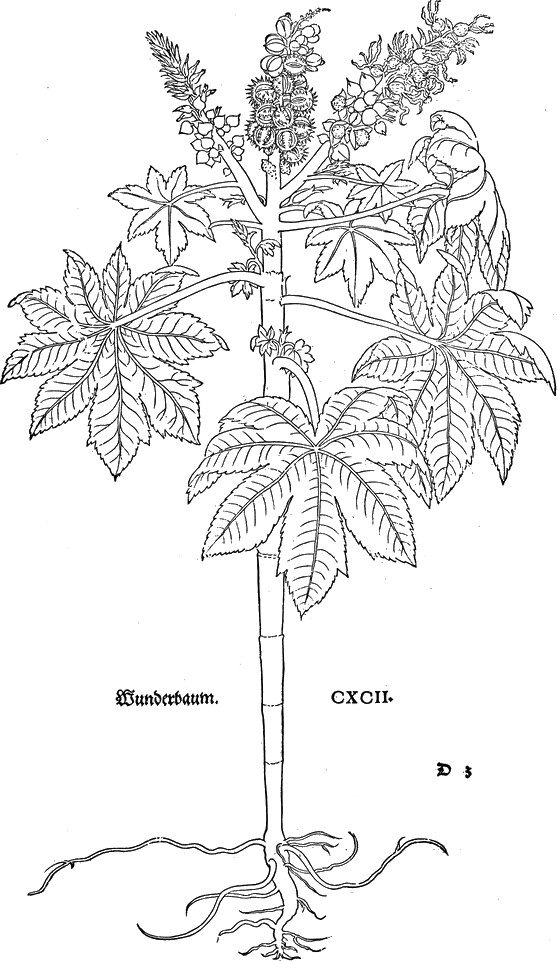
Palm of Christ
Palma Christi
- Known today as
- The castor-oil plant, Ricinus communis (note XLII). The oil “of castor” in the anointings is this oil, not the animal substance castoreum.
- Kind
- Plant, in 1 older authority
- Constituents
- ricin, ricinine, ricinoleic acid
- Poisoning
- The ribosome-inactivating lectins
- Earliest authority here
- Pliny (AD 23/24–79)
- In other databases
- Plants of the World Online search · GBIF search · Wikidata search
- In the Canale glossary
- On the Manner of Discerning and Healing the Bewitched, Appendix A: Part Three, Chapter 9: Anointings
Revised October 1, 2026: An older authority added from a text read in full. Version 1, first published September 25, 2026.
Caution. Hazardous in some form or dose; see the modern assessment below.
Palm of Christ: what did Canale use it for?
Its flowers in a conserve; in the bath; its oil for anointing; among the amulets (chs. 6–7, 9–10).
Palm of Christ: what does modern science say?
Castor oil is a stimulant laxative taken by mouth, and a skin-conditioning oil. See Castor-oil plant, seeds of, p. 215.
Palm of Christ: is it poisonous?
Yes, in some form or dose. Its poisoning is the ribosome-inactivating lectins: Four to twelve hours by mouth; the full picture over two to five days. Historical description, not medical advice; in a poisoning, call a poison centre.
Pharmacognosy & Toxicology
- Constituents
- ricina ribosome-inactivating lectin of the seed
- ricinine ChEMBLan alkaloid
- ricinoleic acid ChEMBL90 per cent of the oil
- Mechanism
- The castor plant. The oil, pressed cold, is free of ricin: in the gut lipase frees ricinoleic acid, which activates the prostaglandin receptor EP3 on the gut muscle, the purge, and on the uterus, which is why it was given to start labour. The seed is another matter: ricin shuts down the ribosome, and a few chewed seeds have killed. The flowers in a conserve and the oil in the bath are harmless.
- Toxic dose
- The oil at 15–60 ml purges; one to eight chewed seeds have been fatal, though most reported ingestions survive.
- Syndrome
- The ribosome-inactivating lectins
- Standing
- Castor oil has an EMA monograph (2016) for short-term constipation; it is not on the WHO essential list, which carries senna and lactulose instead; ricin is a scheduled chemical weapon.
- Tunaru, S., et al. (2012). “Castor oil induces laxation and uterus contraction via ricinoleic acid activating prostaglandin EP3 receptors.” PNAS 109. Verified against its record · doi:10.1073/pnas.1201627109
- Audi, J., et al. (2005). “Ricin poisoning: a comprehensive review.” JAMA 294. Verified against its record · doi:10.1001/jama.294.18.2342
The abstract of each source, beneath its citation. For Club members. About the Club or sign in.
Constituent names open the compound’s record at PubChem, and “ChEMBL” beside a name opens its record at ChEMBL, the European Bioinformatics Institute’s database of bioactive molecules. Where a mechanism line was checked against ChEMBL (ChEMBL 37, read 1 October 2026), the check is shown with the measured value and its source paper, or says plainly that nothing has been measured. Doses are as the references give them, for description only; this is not medical advice. Each source carries the result of its check against Crossref, PubMed, or the authority’s page: see Verification.
Palm of Christ: what did the older authorities say?
- Pliny
- Describes the cicus or croton of Egypt, in Spain shooting up to the size of an olive tree, with a stem like the ferula, the leaf of the vine, and a seed like a small pale grape, “our people are in the habit of calling it ricinus, from the resemblance of the seed to that insect”: the oil, boiled out in water or in Egypt pressed from salted seed, is “repulsive” to eat “but it is very useful for burning in lamps”; and castor oil taken with an equal quantity of warm water “acts as a purgative upon the bowels,” said to work particularly on the diaphragm, and is used for the joints, indurations, the uterus, the ears, and burns.
Sources
- [26] Cosmetic Ingredient Review Expert Panel (2007). Final report on the safety assessment of Ricinus communis (castor) seed oil, hydrogenated castor oil [and related ingredients]. International Journal of Toxicology 26(Suppl. 3): 31–77. Book, seen in reviews
- [115] Touwaide, A., & Appetiti, E. (2024). Herbs in History: Ricinus. American Herbal Products Association, April 2024. ahpa.org. Book, not indexed
- Pliny the Elder, Natural History 15.7, 23.41, trans. J. Bostock & H. T. Riley (1855), Perseus Digital Library. Primary text
Verification
- Checked
- October 1, 2026
- Passes
- Every sentence read against its sources, in the pass over the remaining 343 entries
- The Standing line checked against the authority it names (EMA, WHO, FDA, CITES, Commission E)
- Every dated or regulatory claim checked by category across the database
- Each quotation from the older authorities checked word for word against the text, read in full
- Sources
- 5 cited: 2 verified against its record, 1 primary text, 1 book, seen in reviews, 1 book, not indexed. 1 with the abstract on file.
- Corrections
- said castor oil is on the WHO essential list. It is not; the list carries senna and lactulose. The EMA monograph (2016) is real and now stands alone.
What was checked, how, and what was found is set out on the Verification page. A checked source is one whose record was found; it does not make the entry medical advice.
Cite This Entry
Version 1 · first published September 25, 2026 · last revised October 1, 2026
- Chicago
“Palm of Christ.” In Materia Medica, edited by B. C. P. Statema. Version 1. The Thinking Press, 2026–. Last modified October 1, 2026. https://thethinkingpress.org/materia-medica/palm-of-christ.
- MLA
“Palm of Christ.” Materia Medica, edited by B. C. P. Statema, version 1, The Thinking Press, 1 Oct. 2026, thethinkingpress.org/materia-medica/palm-of-christ. Accessed 8 Oct. 2026.
- APA
Palm of Christ. (2026, October 1). In B. C. P. Statema (Ed.), Materia medica (Version 1). The Thinking Press. Retrieved October 8, 2026, from https://thethinkingpress.org/materia-medica/palm-of-christ
Club members keep entries on a shelf with private notes, print the plates as cards, and receive an entry by email each week. Create a free account before January 1, 2027 and all of it is yours for good. About the Club
See Also
Sharing ricin, ricinoleic acid
Also in Pliny the Elder
Pearls, prepared in Pliny the Elder · Oxymel, and oxymel of squill in Pliny the Elder · Pennyroyal in Pliny the Elder · Orpiment and realgar in Pliny the Elder · everything Pliny the Elder names →
Nearby in the alphabet
Panther cap (white-spotted amanita of European woods) · Palm and olive branches (Branches blessed on Palm Sunday) · Paregoric (camphor, benzoic acid, and anise oil in spirit) · Oyster mushroom (A shell-shaped mushroom of dead hardwood) · Parsley (Petroselinum crispum) · Paschal candle · Ox eye (yellow ox-eye)
Historical description, not medical advice.