
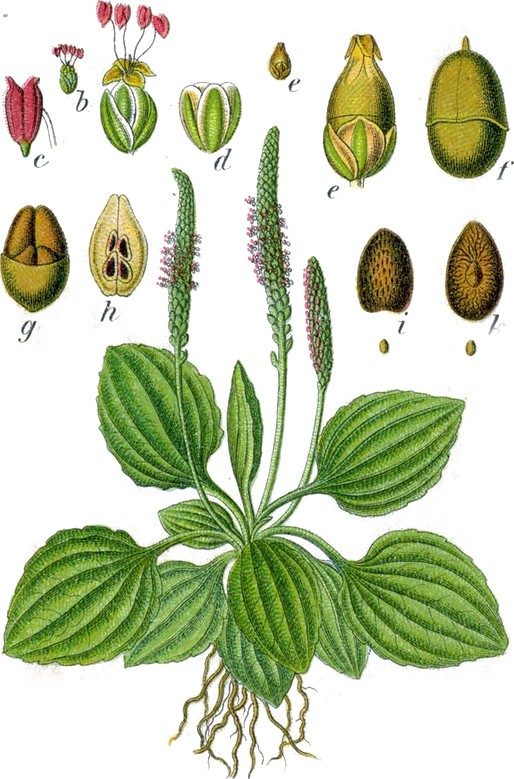
Plantain
Piantagine
- Known today as
- Plantago major.
- Kind
- Plant, in 1 older authority
- Constituents
- aucubin and catalpol, acteoside, mucilage, and 1 more
- Earliest authority here
- The Nine Herbs Charm
- In other databases
- Plants of the World Online search · GBIF search · Wikidata search
- In the Canale glossary
- On the Manner of Discerning and Healing the Bewitched, Appendix A: Part Three, Chapter 9: Anointings
Plantain: what did Canale use it for?
Its water as the alternative vehicle for the oil (ch. 9).
Plantain: foraging it in the Midwest
- Part
- Leaves
- When
- Whole season
The Flambeau Ojibwe soaked the leaves in warm water and bound them on bruises, sprains, and sores, and used them for burns, scalds, bee stings, and snake bites; the Pillager Ojibwe the same. A dooryard weed everywhere.
After Smith. All the foragables of the Midwest. Historical record, not a field guide: identify before you gather, and read the whole entry.
Plantain: how is it taken as a tea?
A pint of boiling water on an ounce of the herb, a wineglassful to half a teacupful three or four times a day, still recommended in herbal medicine for diarrhoea and piles.
All the herbal teas of the database. Historical directions, not medical advice.
Plantain: what does modern science say?
A traditional wound herb with anti-inflammatory activity.
Pharmacognosy & Toxicology
- Constituents
- aucubin and catalpoliridoid glycosides
- acteoside ChEMBLa phenylethanoid
- mucilage
- tannins
- Mechanism
- The mucilage soothes the throat and the iridoids are mildly anti-inflammatory and antibacterial; the leaf on a sting or a cut is a folk dressing with astringent and antibacterial reason behind it. The seed of the related psyllium is the bulk laxative.
- Toxic dose
- Safe.
- Standing
- EMA monograph (2011, revised 2024) for ribwort plantain leaf for irritation of the mouth and throat and dry cough.
- EMA/HMPC (2024). European Union herbal monograph on Plantago lanceolata L., folium (EMA/HMPC/887979/2022, Revision 1). Verified against its record
Constituent names open the compound’s record at PubChem, and “ChEMBL” beside a name opens its record at ChEMBL, the European Bioinformatics Institute’s database of bioactive molecules. Where a mechanism line was checked against ChEMBL (ChEMBL 37, read 1 October 2026), the check is shown with the measured value and its source paper, or says plainly that nothing has been measured. Doses are as the references give them, for description only; this is not medical advice. Each source carries the result of its check against Crossref, PubMed, or the authority’s page: see Verification.
Plantain: what lore surrounds it?
Plantain earned a name among Native American peoples for how faithfully it followed colonization: arriving with European settlers and spreading along their paths, roads, and cleared ground, it became “white man’s footprint” or “Englishman’s foot,” a plant whose presence announced that settlement had already come.
Plantain: what did the older authorities say?
- The Nine Herbs Charm
- Plantain, “waybread,” is the mother of herbs, open to the east, over which carts have creaked, queens have ridden, and brides cried out.
Sources
- [109] Samuelsen, A. B. (2000). The traditional uses, chemical constituents and biological activities of Plantago major L.: a review. Journal of Ethnopharmacology 71(1–2): 1–21. doi:10.1016/s0378-8741(00)00212-9 Verified against its record · doi:10.1016/s0378-8741(00)00212-9
- Awkward Botany, “White Man’s Foot.” Book, not indexed
- Grieve, M. A Modern Herbal, “Plantain, Common.” As published on botanical.com.
Verification
- Checked
- October 1, 2026
- Passes
- Every sentence read against its sources, in the fifty-entry sample
- The Standing line checked against the authority it names (EMA, WHO, FDA, CITES, Commission E)
- Every dated or regulatory claim checked by category across the database
- Sources
- 4 cited: 2 verified against its record, 1 book, not indexed, 1 not yet checked.
- Corrections
- None were needed.
What was checked, how, and what was found is set out on the Verification page. A checked source is one whose record was found; it does not make the entry medical advice.
Cite This Entry
Version 1 · first published September 25, 2026
- Chicago
“Plantain.” In Materia Medica, edited by B. C. P. Statema. Version 1. The Thinking Press, 2026–. Last modified September 25, 2026. https://thethinkingpress.org/materia-medica/plantain.
- MLA
“Plantain.” Materia Medica, edited by B. C. P. Statema, version 1, The Thinking Press, 25 Sept. 2026, thethinkingpress.org/materia-medica/plantain. Accessed 8 Oct. 2026.
- APA
Plantain. (2026, September 25). In B. C. P. Statema (Ed.), Materia medica (Version 1). The Thinking Press. Retrieved October 8, 2026, from https://thethinkingpress.org/materia-medica/plantain
Club members keep entries on a shelf with private notes, print the plates as cards, and receive an entry by email each week. Create a free account before January 1, 2027 and all of it is yours for good. About the Club
See Also
Sharing aucubin and catalpol, mucilage, tannins
Veronica chamaedrys · Cydonia oblonga · Verbascum thapsus · Polygonatum multiflorum · Pulmonaria officinalis · Rosa gallica · Ficaria verna · Rheum officinale
Drawing on the same sources: Grieve
Nearby in the alphabet
Poison fire coral (finger-like fungus of Japan, Korea, and Southeast Asia) · Pilgrim badges and ampullae · Polypody of mercurialis, syrup of · Periwinkle (the lesser periwinkle, a trailing evergreen with blue flowers) · Pomander (of ambergris, musk, civet, and spices, carried in a pierced case) · Peony (the kind formerly grown for its medicinal root)
Historical description, not medical advice.