
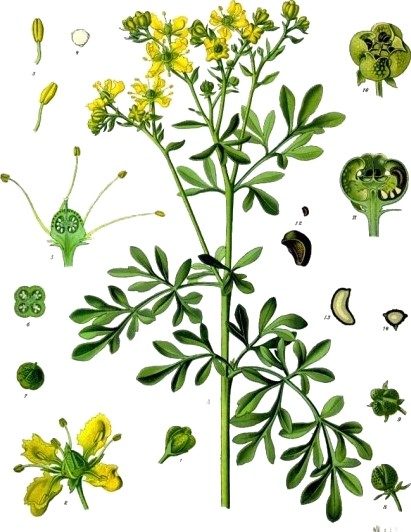
Rue
Ruta
- Known today as
- Ruta graveolens, garden rue.
- Kind
- Plant, in 2 older authorities
- Constituents
- rutin, bergapten, 2-undecanone
- Poisoning
- Hepatotoxic monoterpenes (pulegone)
- Earliest authority here
- Dioscorides (c. AD 40–90)
- Qualities
- Hot and dry in the third degree (Galen); the wild kind hotter still. What the degrees mean
- In other databases
- Plants of the World Online search · GBIF search · Wikidata search
- In the Canale glossary
- On the Manner of Discerning and Healing the Bewitched, Appendix A: Part Three, Chapter 6: Remedies Given by Mouth After the Purge
Caution. Hazardous in some form or dose; see the modern assessment below.
Rue: what did Canale use it for?
The most frequent herb in the book: in the powder, electuary, and julep; in the bath and the anointing oils; in fumigations to expel a spirit; as an amulet; and blessed in Treatise Two, where “the devil may withdraw and tremble” wherever it is placed (chs. 5–10; Treatise Two).
Rue: how is it taken as a tea?
A warm infusion, strongly stimulating and antispasmodic, often employed as an emmenagogue.
All the herbal teas of the database. Historical directions, not medical advice.
Rue: what does modern science say?
Rue was the herb of grace, a classic protection against witchcraft. Pharmacologically it is a strong irritant that causes blistering in sunlight, and in quantity induces abortion; it has no effect on spirits that can be measured.
Rue: is it poisonous?
Yes, in some form or dose. Its poisoning is hepatotoxic monoterpenes (pulegone): Hours. Historical description, not medical advice; in a poisoning, call a poison centre.
Pharmacognosy & Toxicology
- Constituents
- Mechanism
- The furanocoumarins make the skin react to sunlight: blisters where the leaf touched it. The oil provokes the uterus.
- Toxic dose
- Phytophotodermatitis from handling; the oil in quantity has caused abortion and liver damage.
- Syndrome
- Hepatotoxic monoterpenes (pulegone)
- Standing
- A food flavouring in small amounts; no medicinal use.
- Nelson, L. S., et al. (2007). Handbook of Poisonous and Injurious Plants. Verified against its record · doi:10.1007/978-1-4939-8926-3
Constituent names open the compound’s record at PubChem, and “ChEMBL” beside a name opens its record at ChEMBL, the European Bioinformatics Institute’s database of bioactive molecules. Where a mechanism line was checked against ChEMBL (ChEMBL 37, read 1 October 2026), the check is shown with the measured value and its source paper, or says plainly that nothing has been measured. Doses are as the references give them, for description only; this is not medical advice. Each source carries the result of its check against Crossref, PubMed, or the authority’s page: see Verification.
What Medicine Makes of It
- The Evil EyeEnvy, the glance, and the anthropology of misfortune.
- The Wandering Womb and the ConvulsionsSuffocation of the mother, hysteria, and functional neurological disorder.
Rue: what lore surrounds it?
Carried against witchcraft and the evil eye across the Mediterranean; its bitterness made it the “herb of grace,” and Italian households kept the cimaruta, a silver charm of a rue sprig, against the malocchio.
Used in These Compounds
Rue is an ingredient of 2 compound medicines in the database. For Club members. Create a free account or sign in.
Rue: what did the older authorities say?
- Dioscorides
- Counts rue among the antidotes, against deadly drugs and the bites of serpents, and describes it for the eyes and for pains of the joints.
- Pliny
- Ranks rue among the chief medicinal plants, and tells that the antidote Pompey found among the papers of Mithridates was of rue leaves, walnuts, figs, and a pinch of salt.
Sources
- [54] Grieve, M. (1931). A Modern Herbal. Online edition, botanical.com, cited under the plant concerned. Read in part · the text read
- [81] Luo, P., Feng, X., Liu, S., & Jiang, Y. (2024). Traditional uses, phytochemistry, pharmacology and toxicology of Ruta graveolens L.: a critical review and future perspectives. Drug Design, Development and Therapy 18: 6459–6485. doi:10.2147/DDDT.S494417 Verified against its record · doi:10.2147/dddt.s494417
- [99] Pronczuk, J. (1989). Ruta graveolens L. Poisons Information Monograph PIM 475. International Programme on Chemical Safety. inchem.org. Book, seen in reviews
- Grieve, M. A Modern Herbal, “Rue.” As published on botanical.com.
Verification
- Checked
- October 1, 2026
- Passes
- Every sentence read against its sources, in the pass over the remaining 343 entries
- The Standing line checked against the authority it names (EMA, WHO, FDA, CITES, Commission E)
- Every dated or regulatory claim checked by category across the database
- Sources
- 5 cited: 1 read in part, 2 verified against its record, 1 book, seen in reviews, 1 not yet checked.
- Corrections
- None were needed.
What was checked, how, and what was found is set out on the Verification page. A checked source is one whose record was found; it does not make the entry medical advice.
Cite This Entry
Version 1 · first published September 25, 2026
- Chicago
“Rue.” In Materia Medica, edited by B. C. P. Statema. Version 1. The Thinking Press, 2026–. Last modified September 25, 2026. https://thethinkingpress.org/materia-medica/rue.
- MLA
“Rue.” Materia Medica, edited by B. C. P. Statema, version 1, The Thinking Press, 25 Sept. 2026, thethinkingpress.org/materia-medica/rue. Accessed 8 Oct. 2026.
- APA
Rue. (2026, September 25). In B. C. P. Statema (Ed.), Materia medica (Version 1). The Thinking Press. Retrieved October 8, 2026, from https://thethinkingpress.org/materia-medica/rue
Club members keep entries on a shelf with private notes, print the plates as cards, and receive an entry by email each week. Create a free account before January 1, 2027 and all of it is yours for good. About the Club
See Also
Poisoned alike: hepatotoxic monoterpenes (pulegone)
Savin · Pennyroyal · Water germander · Parsley · the syndrome, with all of them →
Sharing rutin, bergapten
Also in Dioscorides
Saffron in Dioscorides · Rosemary in Dioscorides · Sorrel, syrup of in Dioscorides · Rose in Dioscorides · everything Dioscorides names →
Also in Pliny the Elder
Sage in Pliny the Elder · Rowan in Pliny the Elder · Saltpetre in Pliny the Elder · Rosemary rice water in Pliny the Elder · everything Pliny the Elder names →
Drawing on the same sources: Grieve, Nelson
Of the same qualities: hot and dry
Nearby in the alphabet
Saffron milk cap (An orange mushroom of pine woods that weeps carrot-colored milk) · Round birthwort (Aristolochia rotunda) · Sal ammoniac (from volcanic vents and later made from soot and urine)
Historical description, not medical advice.