
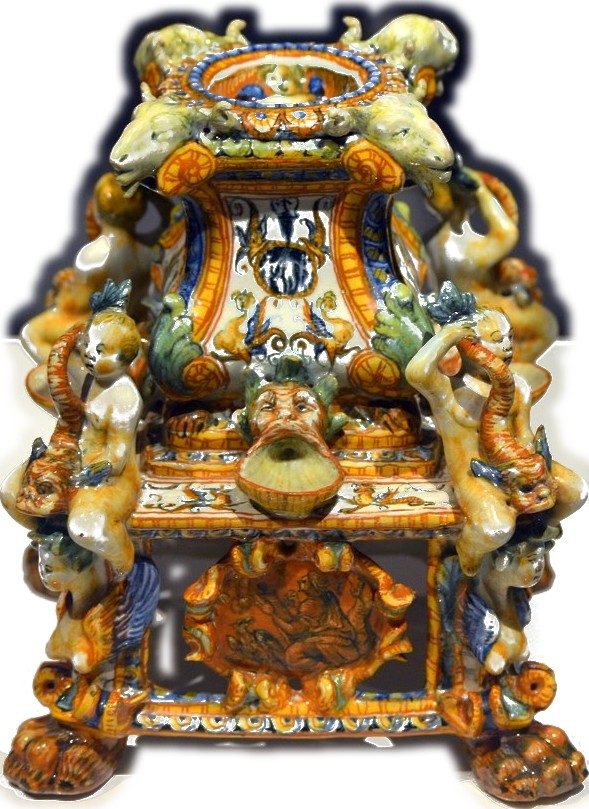
Salt
Sale
- Known today as
- Salt exorcized and blessed, “by the God who commanded you to be cast into the water through the Prophet Elisha” (2 Kings 2:19–22).
- Kind
- Sacramental, in 1 older authority
- Constituents
- sodium chloride, iodide, magnesium and calcium salts
- Earliest authority here
- Paracelsus (1493/94–1541)
- In the Canale glossary
- On the Manner of Discerning and Healing the Bewitched, Appendix A: Treatise Two: Blessed Objects and Materials
Salt: what did Canale use it for?
To be tasted by the sick, worn in packets, and put into holy water, for “the health of mind and body” and “to drive away every hexing and malefice” (Treatise Two).
Salt: what does modern science say?
Exorcized salt belongs to the older Roman Ritual, whose Latin blessings some priests still use.
Pharmacognosy & Toxicology
- Constituents
- sodium chloride ChEMBL
- iodide ChEMBLadded since 1924 against goitre
- magnesium and calcium saltsin sea salt
- Mechanism
- On the tongue salt is taste; in water it is the hypertonic wash that cleans a wound and the gargle that shrinks a sore throat; as a preservative it draws water from microbes. The health of body and mind that the rite asks of it is a sign; the real physiology is the iodine in the packet, which ended endemic goitre and cretinism in the Alpine valleys of Switzerland within a generation of its iodisation programme of 1922.
- Toxic dose
- The WHO asks for under 5 g a day; a tablespoon in a child is an emergency.
- Standing
- A food and a sacramental; iodisation is a WHO public-health measure in 120 countries.
- Zimmermann, M. B. (2008). “Research on iodine deficiency and goiter in the 19th and early 20th centuries.” Journal of Nutrition 138. Verified against its record · doi:10.1093/jn/138.11.2060
The abstract of each source, beneath its citation. For Club members. About the Club or sign in.
Constituent names open the compound’s record at PubChem, and “ChEMBL” beside a name opens its record at ChEMBL, the European Bioinformatics Institute’s database of bioactive molecules. Where a mechanism line was checked against ChEMBL (ChEMBL 37, read 1 October 2026), the check is shown with the measured value and its source paper, or says plainly that nothing has been measured. Doses are as the references give them, for description only; this is not medical advice. Each source carries the result of its check against Crossref, PubMed, or the authority’s page: see Verification.
Salt: what lore surrounds it?
The story that Roman soldiers were paid in salt, and that “salary” comes from it, has no ancient source: the link between salarium and sal is real, but the salt-payment tale was a guess of eighteenth-century Latin dictionaries, repeated ever since, once with a fabricated quotation attributed to Pliny. The habit of throwing spilled salt over the left shoulder to blind the Devil waiting there is old and genuine, though the claim that it comes from Judas upsetting the saltcellar in Leonardo’s Last Supper has it backwards: the superstition already existed, which is why Leonardo painted the detail.
Used in These Compounds
Salt is an ingredient of 1 compound medicine in the database. For Club members. Create a free account or sign in.
Salt: what did the older authorities say?
- Paracelsus
- Salt was the third of his principles, with sulfur and mercury: the principle of fixity and body.
Sources
- [84] McNamara, E. (2010). Extraordinary Form; Book of Blessings. Liturgy Q&A, 2 and 16 November 2010. EWTN Library, ewtn.com. Verified against its record · doi:10.1159/000287797
- [120] Weller, P. T. (trans.) (1964). The Roman Ritual, Part XI: Blessings and Other Sacramentals. EWTN Library, ewtn.com. Primary text
- Kiwi Hellenist, on salt and salary. Book, not indexed
- Wikipedia, “Spilling salt.” Book, not indexed
In Symbols of the Psyche
Salt: what it stood for in alchemy and in analytical psychology.
Verification
- Checked
- October 1, 2026
- Passes
- Every sentence read against its sources, in the fifty-entry sample
- The Standing line checked against the authority it names (EMA, WHO, FDA, CITES, Commission E)
- Every dated or regulatory claim checked by category across the database
- Sources
- 5 cited: 2 verified against its record, 1 primary text, 2 book, not indexed. 1 with the abstract on file.
- Corrections
- the goitre programme of 1922 was Swiss, not "the exorcists' own country."
What was checked, how, and what was found is set out on the Verification page. A checked source is one whose record was found; it does not make the entry medical advice.
Cite This Entry
Version 1 · first published September 25, 2026
- Chicago
“Salt.” In Materia Medica, edited by B. C. P. Statema. Version 1. The Thinking Press, 2026–. Last modified September 25, 2026. https://thethinkingpress.org/materia-medica/salt.
- MLA
“Salt.” Materia Medica, edited by B. C. P. Statema, version 1, The Thinking Press, 25 Sept. 2026, thethinkingpress.org/materia-medica/salt. Accessed 8 Oct. 2026.
- APA
Salt. (2026, September 25). In B. C. P. Statema (Ed.), Materia medica (Version 1). The Thinking Press. Retrieved October 8, 2026, from https://thethinkingpress.org/materia-medica/salt
Club members keep entries on a shelf with private notes, print the plates as cards, and receive an entry by email each week. Create a free account before January 1, 2027 and all of it is yours for good. About the Club
See Also
Also in Paracelsus
St. John’s wort in Paracelsus · Quicksilver in Paracelsus · Sulfur in Paracelsus · Opium poppy in Paracelsus · everything Paracelsus names →
Drawing on the same sources: Wikipedia
Nearby in the alphabet
Saltpetre (scraped as a white bloom from cellar walls, stables, and dung heaps) · Sal ammoniac (from volcanic vents and later made from soot and urine) · Sandalwood (The heartwood of Santalum album) · Sage (Salvia officinalis) · Sarsaparilla (thorny climbers of Central and South America) · Saffron milk cap (An orange mushroom of pine woods that weeps carrot-colored milk) · Sassafras (The root bark of Sassafras albidum) · Saffron (The stigmas of Crocus sativus)

Historical description, not medical advice.