
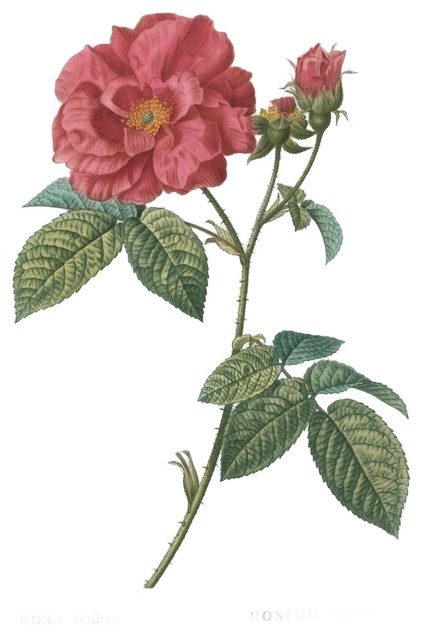
Red roses
Rose rosse
- Known today as
- Dried petals of Rosa gallica.
- Kind
- Plant, in 2 older authorities
- Constituents
- citronellol and geraniol, tannins, anthocyanins, and 1 more
- Earliest authority here
- Mesue (11th–13th century)
- In other databases
- Plants of the World Online search · GBIF search · Wikidata search
- In the Canale glossary
- On the Manner of Discerning and Healing the Bewitched, Appendix A: Part Three, Chapter 9: Anointings
Revised October 1, 2026: Tradition, lore, modern assessment, and sources extended. Version 1, first published September 25, 2026.
Red roses: what did Canale use it for?
In the oil (ch. 9).
Red roses: what does modern science say?
Rich in tannins, and fragrant. The petals hold tannins, anthocyanins, and a little of the oil, so the astringency is real; rose water and oil of roses are the perfumer’s, and the apothecary’s syrup survives as a flavouring.
Pharmacognosy & Toxicology
- Constituents
- citronellol and geraniolthe rose oil
- tanninsthe astringency of the petal
- anthocyaninsthe colour
- phenylethyl alcohol ChEMBL
- Mechanism
- The red rose of the apothecary, Rosa gallica, dried for its astringent and cordial petals: the tannins tighten, the scent is the perfume, and the sugar of the conserve was the vehicle. See the rose.
- Toxic dose
- Safe.
- Standing
- A flavour and perfume; the hip, not the petal, has the vitamin C.
- Boskabady, M. H., et al. (2011). “Pharmacological effects of Rosa damascena.” Iranian Journal of Basic Medical Sciences 14. Verified against its record · PMID 23493250
The abstract of each source, beneath its citation. For Club members. About the Club or sign in.
Constituent names open the compound’s record at PubChem, and “ChEMBL” beside a name opens its record at ChEMBL, the European Bioinformatics Institute’s database of bioactive molecules. Where a mechanism line was checked against ChEMBL (ChEMBL 37, read 1 October 2026), the check is shown with the measured value and its source paper, or says plainly that nothing has been measured. Doses are as the references give them, for description only; this is not medical advice. Each source carries the result of its check against Crossref, PubMed, or the authority’s page: see Verification.
Red roses: what lore surrounds it?
Rosa gallica, the apothecary’s rose, was grown by the acre at Provins near Paris from the thirteenth century for the dried petals, and the Provins conserve was sold across Europe; the petals keep their colour and scent dried, which the white and damask roses do not. See the rose in the Symbolarium.
Red roses: what did the older authorities say?
- Mesue
- The Arabic pharmacy made the red rose a cold and dry medicine of the first degree, astringent and cordial: the petals in conserve and syrup for the heart, the liver, and the fluxes, and the distilled water for the eyes.
- Culpeper
- Says the red rose strengthens the heart, stomach, and liver, and that the conserve of red roses “is a very good cordial” against faintness and the consumption.
Sources
- [75] Kunc, N., Hudina, M., Mikulič-Petkovšek, M., Bavcon, J., Ravnjak, B., & Osterc, G. (2023). Detailed metabolic characterization of flowers and hips of Rosa gallica L. grown in open nature. Plants 12(16): 2979. doi:10.3390/plants12162979 Verified against its record · doi:10.3390/plants12162979
- Culpeper, N. (1653). Pharmacopœia Londinensis. Read in full · the text read
- Mesue, Grabadin. Read in part · the text read
Verification
- Checked
- October 1, 2026
- Passes
- Every sentence read against its sources, in the pass over the remaining 343 entries
- The Standing line checked against the authority it names (EMA, WHO, FDA, CITES, Commission E)
- Every dated or regulatory claim checked by category across the database
- Sources
- 4 cited: 1 read in full, 1 read in part, 2 verified against its record. 2 with the abstract on file.
- Corrections
- None were needed.
What was checked, how, and what was found is set out on the Verification page. A checked source is one whose record was found; it does not make the entry medical advice.
Cite This Entry
Version 1 · first published September 25, 2026 · last revised October 1, 2026
- Chicago
“Red roses.” In Materia Medica, edited by B. C. P. Statema. Version 1. The Thinking Press, 2026–. Last modified October 1, 2026. https://thethinkingpress.org/materia-medica/red-roses.
- MLA
“Red roses.” Materia Medica, edited by B. C. P. Statema, version 1, The Thinking Press, 1 Oct. 2026, thethinkingpress.org/materia-medica/red-roses. Accessed 8 Oct. 2026.
- APA
Red roses. (2026, October 1). In B. C. P. Statema (Ed.), Materia medica (Version 1). The Thinking Press. Retrieved October 8, 2026, from https://thethinkingpress.org/materia-medica/red-roses
Club members keep entries on a shelf with private notes, print the plates as cards, and receive an entry by email each week. Create a free account before January 1, 2027 and all of it is yours for good. About the Club
See Also
Sharing tannins, anthocyanins, phenylethyl alcohol
Rheum officinale · Plantago major · Rosa gallica · Ficaria verna · Sambucus nigra · Malva sylvestris · Amelanchier canadensis
Also in Mesue
Diamoschu, sweet in Mesue · Indian electuary, greater and lesser in Mesue · Diatrion piperion in Mesue · Gallia moschata in Mesue · everything Mesue names →
Also in Nicholas Culpeper
Rosemary rice water in Nicholas Culpeper · Raisins in Nicholas Culpeper · Self-heal in Nicholas Culpeper · Ragwort in Nicholas Culpeper · everything Nicholas Culpeper names →
Drawing on the same sources: Culpeper, Mesue
Sandalwood · Senna · Marking-nut electuary · the bibliography →
Nearby in the alphabet
Red yeast rice (Rice fermented with a red mould) · Ramps (the wild leek of the hardwood forests of the Great Lakes and the East) · Reishi (red-brown bracket of hardwoods) · Rocket (salad rocket) · Radish (Raphanus sativus (now classed by Kew as Raphanus raphanistrum subsp)
Historical description, not medical advice.