
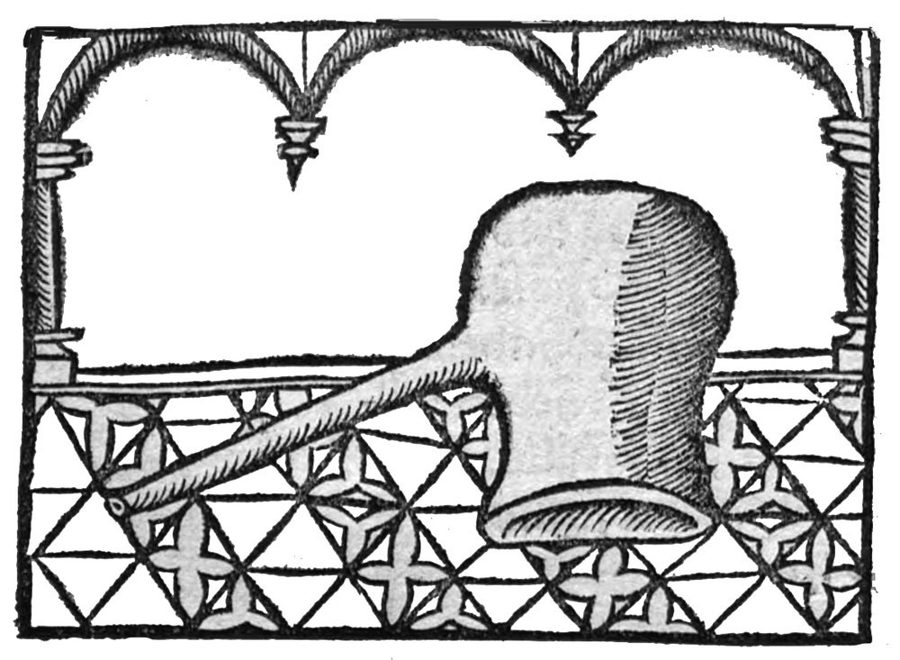
Oil of bricks
Oglio de lateribus
- Known today as
- Oleum latericium philosophorum, “philosophers’ oil,” made by quenching red-hot brick in oil, powdering it, and distilling it.
- Kind
- Compound
- Constituents
- acrolein and aldehydes, polycyclic aromatic hydrocarbons, fatty acids and their cracking products
- In the Canale glossary
- On the Manner of Discerning and Healing the Bewitched, Appendix A: Part Three, Chapter 9: Anointings
Revised October 3, 2026: Checked against its sources, each read in full, in part, or in its abstract. Version 1, first published September 25, 2026.
Oil of bricks: what did Canale use it for?
For anointing (ch. 9).
Oil of bricks: what does modern science say?
The London Dispensatory of 1653 calls it “a soveraign remedy for the gout,” and for cold afflictions of the joints and nerves, cramps, the falling sickness, and palsies.
Pharmacognosy & Toxicology
- Constituents
- acrolein and aldehydesformed when oil is strongly heated, acrolein the most reactive
- polycyclic aromatic hydrocarbons
- fatty acids and their cracking products
- Mechanism
- Bricks heated red, quenched in oil, then broken and distilled in a retort: what comes over is oil broken down by the heat. Strongly heated oils crack into aldehydes, acrolein among them, and yield polycyclic aromatic hydrocarbons. It was the “oil of the philosophers” for numbness, palsy, and gout, though Quincy in 1718 found it of little virtue and seldom trusted.
- Toxic dose
- Quincy found it of little virtue; the acrolein and polycyclic hydrocarbons of strongly heated oil are counted carcinogens.
- Standing
- Already “seldom trusted” by 1718, says Quincy.
- Quincy, J. (1718). Pharmacopoeia Officinalis et Extemporanea, “Oleum Laterinum.” Read in part · the text read
Constituent names open the compound’s record at PubChem, and “ChEMBL” beside a name opens its record at ChEMBL, the European Bioinformatics Institute’s database of bioactive molecules. Where a mechanism line was checked against ChEMBL (ChEMBL 37, read 1 October 2026), the check is shown with the measured value and its source paper, or says plainly that nothing has been measured. Doses are as the references give them, for description only; this is not medical advice. Each source carries the result of its check against Crossref, PubMed, or the authority’s page: see Verification.
Sources
- [28] Culpeper, N. (1653). Pharmacopœia Londinensis, or, The London Dispensatory [the Royal College of Physicians’ pharmacopoeia in English, with Culpeper’s commentary]. London: Peter Cole. Text Creation Partnership edition A35381. Read in part · the text read
- Wang, Z., Chen, J., & Liu, W. (2026). Formation mechanisms, molecular pathways, mitigation strategies, and indoor safety risk analysis of cooking oil fumes. Foods. Read in full · the text read
- Scianò, F., et al. (2025). Toxic aldehydes in cooking vegetable oils: generation, toxicity and disposal methods. Food Chemistry: X. Read in full · the text read
Verification
- Checked
- October 1, 2026, and October 3, 2026
- Passes
- Every sentence read against its sources, in the pass over the remaining 343 entries
- The Standing line checked against the authority it names (EMA, WHO, FDA, CITES, Commission E)
- Every dated or regulatory claim checked by category across the database
- Every source read, in full, in part, or in its abstract, and every sentence checked against what was read (October 3, 2026)
- Sources
- 4 cited: 2 read in full, 2 read in part.
- Corrections
- None were needed.
What was checked, how, and what was found is set out on the Verification page. A checked source is one whose record was found; it does not make the entry medical advice.
Cite This Entry
Version 1 · first published September 25, 2026 · last revised October 3, 2026
- Chicago
“Oil of bricks.” In Materia Medica, edited by B. C. P. Statema. Version 1. The Thinking Press, 2026–. Last modified October 3, 2026. https://thethinkingpress.org/materia-medica/oil-of-bricks.
- MLA
“Oil of bricks.” Materia Medica, edited by B. C. P. Statema, version 1, The Thinking Press, 3 Oct. 2026, thethinkingpress.org/materia-medica/oil-of-bricks. Accessed 8 Oct. 2026.
- APA
Oil of bricks. (2026, October 3). In B. C. P. Statema (Ed.), Materia medica (Version 1). The Thinking Press. Retrieved October 8, 2026, from https://thethinkingpress.org/materia-medica/oil-of-bricks
Club members keep entries on a shelf with private notes, print the plates as cards, and receive an entry by email each week. Create a free account before January 1, 2027 and all of it is yours for good. About the Club
See Also
Sharing polycyclic aromatic hydrocarbons
Drawing on the same sources: Wang, Quincy
Nearby in the alphabet
Oil of catechumens · Oak galls (Round growths raised on oaks by gall wasps) · Oil of the sick · Nutmeg and clove (Myristica fragrans and Syzygium aromaticum) · Olive oil and holy water (Fine olive oil) · Niter, pills of (potassium nitrate) · Olive-wood ash lye (Lye made by steeping the ash of olive wood in river water) · Nettle seed (Urtica dioica)
Historical description, not medical advice.