
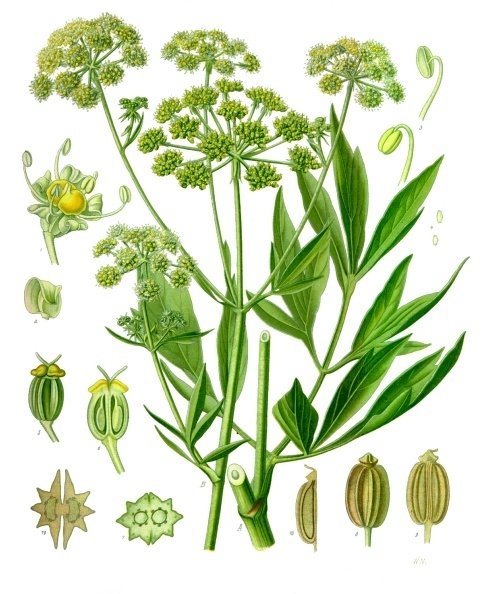
Lovage
Levisticum
- Known today as
- Levisticum officinale, of the carrot family.
- Kind
- Plant, in 1 older authority
- Constituents
- ligustilide, butylidenephthalide, bergapten and psoralen, and 1 more
- Poisoning
- Phytophotodermatitis
- Earliest authority quoted here
- Charlemagne (c. 747–814)
- In other databases
- Plants of the World Online · GBIF · Wikidata
Revised October 17, 2026: Lore added from texts read in full. Checked against its sources, each read in full, in part, or in its abstract. Version 1, first published September 25, 2026.
Lovage: what was it used for?
Hot and dry, “exceeding good for any diseases coming of wind”; for the stomach and the urine; a herb of Charlemagne’s imperial gardens.
Lovage: what does modern science say?
Accepted in the EU as a traditional remedy to increase the urine and flush the urinary tract in minor complaints; no clinical studies of lovage root alone have been published.
The toxic dose and the poisoning
- Toxic dose
- No serious adverse events are reported at therapeutic doses; German handbooks give inflammation of the kidneys as a contraindication and advise against strong sun in long use; the EU monograph limits use to two to four weeks and not under eighteen.
- Syndrome
- Phytophotodermatitis
The references for these lines are listed under Pharmacognosy, in Science. Doses are as the references give them, for description only; this is not medical advice. In a poisoning, call a poison centre.
Lovage: what did the older authorities say?
- Charlemagnec. 747–814
- Lovage is among the plants the Capitulare de villis orders to be grown on the royal estates.
Lovage: what lore surrounds it?
Grieve is candid that lovage “is not a striking enough plant to have claimed the attention of poets and painters, and no myths or legends are connected with it,” and notes of the related spignel, or bald-money, whose root smells much like lovage, that the name “is said to be a corruption of Balder, the Apollo of the northern nations, to whom the plant was dedicated,” and that “the public-house cordial named ‘Lovage,’ formerly much in vogue, however, owed such virtue as it may have possessed to Tansy.”
Pharmacognosy
- Constituents
- ligustilide ChEMBLthe chief phthalide of the root oil; the phthalides give its smell
- butylidenephthalidea phthalide of the root oil
- bergapten and psoralenfuranocoumarins
- sotolone ChEMBLan intense smell like hydrolysed vegetable protein, or curry
- Mechanism
- The phthalides relax smooth muscle in the laboratory; an infusion of the root raised the urine of rabbits and mice a little in early experiments, though other tests found no diuresis; the furanocoumarins can make the skin react to sunlight, as in harvesters who handled the plant in strong sun. A related phthalide from celery seed, 3-n-butylphthalide, is approved in China for ischaemic stroke.
- Standing
- EU herbal monograph (adopted 2012) for the root, as a traditional remedy to increase the urine and flush the urinary tract in minor urinary complaints.
- EMA/HMPC (2013). Community herbal monograph on Levisticum officinale Koch, radix (EMA/HMPC/524621/2011). Read in full · the text read
Constituent names open the compound’s record at PubChem, and “ChEMBL” beside a name opens its record at ChEMBL, the European Bioinformatics Institute’s database of bioactive molecules. Where a mechanism line was checked against ChEMBL (ChEMBL 37, read 1 October 2026), the check is shown with the measured value and its source paper, or says plainly that nothing has been measured. Doses are as the references give them, for description only; this is not medical advice. Each source carries the result of its check against Crossref, PubMed, or the authority’s page: see Verification.
Sources
- Capitulare de villis (c. 800). Read in full · the text read
- Grieve, M. (1931). A Modern Herbal, “Lovage.” botanical.com/botanical/mgmh/l/lovage42.html Read in full · the text read
- Culpeper, N. (1653). Pharmacopoeia Londinensis: or the London Dispensatory. London: Peter Cole. Text Creation Partnership A35381. Read in part · the text read
- EMA/HMPC (2012). Assessment report on Levisticum officinale Koch, radix (EMA/HMPC/524623/2011). Read in full · the text read
- Xu, S., et al. (2023). Neuroprotective effect of Dl-3-n-butylphthalide against ischemia-reperfusion injury is mediated by ferroptosis regulation via the SLC7A11/GSH/GPX4 pathway and the attenuation of blood-brain barrier disruption. Frontiers in Aging Neuroscience 15: 1028178. Abstract read · the text read
Verification
- Checked
- October 1, 2026, October 17, 2026
- Passes
- Read against its sources in the pass over the remaining 343 entries
- Every dated or regulatory claim checked by category across the database
- Each quotation from the older authorities checked word for word against the text, read in full
- Every source read, in full, in part, or in its abstract, and every sentence checked against what was read (October 17, 2026)
- Sources
- 6 cited: 4 read in full, 1 read in part, 1 abstract read. 1 with the abstract on file.
- Corrections
- None recorded.
What was checked, how, and what was found is set out on the Verification page. A checked source is one whose record was found; it does not make the entry medical advice.
Club members can point at a technical term in this entry, such as a constituent, an action, or a word of Jung’s, to read its definition from the source. The Club.
Cite This Entry
Version 1 · first published September 25, 2026 · last revised October 17, 2026
- Chicago
“Lovage.” In Materia Medica, edited by B. C. P. Statema. Version 1. The Thinking Press, 2026–. Last modified October 17, 2026. https://thethinkingpress.org/materia-medica/lovage.
- MLA
“Lovage.” Materia Medica, edited by B. C. P. Statema, version 1, The Thinking Press, 17 Oct. 2026, thethinkingpress.org/materia-medica/lovage. Accessed 22 Nov. 2026.
- APA
Lovage. (2026, October 17). In B. C. P. Statema (Ed.), Materia medica (Version 1). The Thinking Press. Retrieved November 22, 2026, from https://thethinkingpress.org/materia-medica/lovage
See Also
Poisoned alike: phytophotodermatitis
Masterwort and angelica · Fig · Bergamot · Dittany · Citron · the syndrome, with all of them →
Also in Charlemagne
Rosemary in Charlemagne · Houseleek in Charlemagne · Sage in Charlemagne · Tansy in Charlemagne · everything Charlemagne names →
Drawing on the same sources: Grieve, Culpeper, Xu
Lucerne · Long pepper · Lungwort · Madder · Mandrake · Pokeweed · Skullcap · the bibliography →
Nearby in the alphabet
Lourdes water · Lodestone (naturally magnetic iron ore) · Madonna lily (Lilium candidum) · Lobelia
Historical description, not medical advice.

