
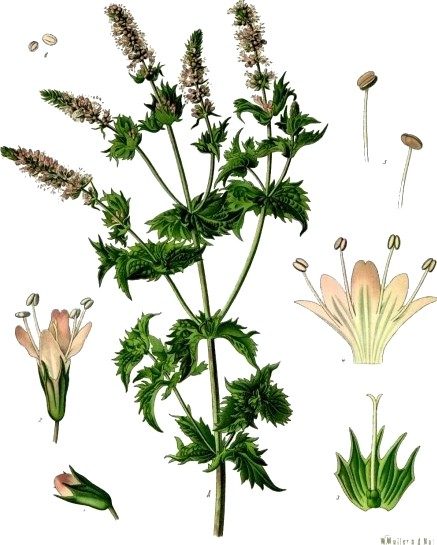
Mint, oil of
Oglio di menta
- Known today as
- Oil of garden or spear mint.
- Kind
- Plant, in 1 older authority
- Constituents
- menthol, menthone, pulegone, and 1 more
- Earliest authority here
- Matthew 23:23 (the Hebrew Bible and the New Testament)
- In the Canale glossary
- On the Manner of Discerning and Healing the Bewitched, Appendix A: Part Three, Chapter 5: Vomitory Medicines
Revised October 1, 2026: Lore added from texts read in full. The mechanism extended from ChEMBL's curated records. Version 1, first published September 25, 2026.
Mint, oil of: what did Canale use it for?
Rubbed on the stomach after vomiting (ch. 5).
Mint, oil of: what does modern science say?
Spearmint is carminative and antispasmodic; peppermint oil, the best studied of the mint oils, relaxes gut muscle.
Pharmacognosy & Toxicology
- Constituents
- Mechanism
- Menthol activates the cold receptor TRPM8, which is the cool on the skin and in the stomach; it also opens the irritant channel TRPA1, and blocks calcium channels in gut muscle, which is the antispasmodic action proven in trials of enteric-coated peppermint oil for irritable bowel; on the skin it is a counter-irritant and a mild local anaesthetic.
- Checked against ChEMBL
- menthol: ChEMBL’s curated mechanism: opener Transient receptor potential cation channel subfamily A member 1; opener Transient receptor potential cation channel subfamily M member 8.
- Toxic dose
- Safe in capsule doses of 0.2–0.4 ml; the neat oil burns, and menthol near an infant’s nose can stop its breathing by reflex.
- Syndrome
- Convulsant terpenes (thujone, pinocamphone, camphor)
- Standing
- EMA monograph (2007, revised 2020) for peppermint oil in irritable bowel syndrome, and for tension headache on the skin; a Cochrane-grade body of trials supports the bowel use.
- EMA/HMPC (2007; revised 2020). Community herbal monograph on Mentha x piperita L., aetheroleum (EMEA/HMPC/349466/2006; Revision 1, EMA/HMPC/522410/2013, 2020). Verified against its record
- Alammar, N., et al. (2019). “The impact of peppermint oil on the irritable bowel syndrome: a meta-analysis.” BMC Complementary and Alternative Medicine 19. Verified against its record · doi:10.1186/s12906-018-2409-0
The abstract of each source, beneath its citation. For Club members. About the Club or sign in.
Constituent names open the compound’s record at PubChem, and “ChEMBL” beside a name opens its record at ChEMBL, the European Bioinformatics Institute’s database of bioactive molecules. Where a mechanism line was checked against ChEMBL (ChEMBL 37, read 1 October 2026), the check is shown with the measured value and its source paper, or says plainly that nothing has been measured. Doses are as the references give them, for description only; this is not medical advice. Each source carries the result of its check against Crossref, PubMed, or the authority’s page: see Verification.
Mint, oil of: what lore surrounds it?
Of the mint Folkard gives Ovid's nymph Minthe, beloved of Pluto, whom Proserpine “transformed his mistress into the herb which is called by her name.” It was Herba bona and Herba sancta, woven into brides' garlands as the corona Veneris, later “dedicated to the Virgin, under the name of Herba Sanctæ Mariæ,” and strewn in churches. Among the women of the Abruzzi, a mint plant met on a walk is bruised between the fingers “in order to ensure that, on the day of their death, Jesus Christ will assist them,” and in Holstein mint is carried at peasant funerals. Pliny held that “the smell of Mint doth stir up the minde and taste to a greedy desire of meat.”
Grieve has Pliny's Greeks and Romans who “crowned themselves with Peppermint at their feasts and adorned their tables with its sprays,” and notes that peppermint “only came into general use in the medicine of Western Europe about the middle of the eighteenth century,” the oldest district being Mitcham in Surrey, where cultivation “dates from about 1750.” The round-leaved Egyptian mint “is frequently found on the ruins of monasteries, the monks having used it for the languor following epileptic fits, as it was considered refreshing to the brain,” and spearmint's names include Our Lady's Mint and Sage of Bethlehem.
Used in These Compounds
Mint, oil of is an ingredient of 1 compound medicine in the database. For Club members. Create a free account or sign in.
Mint, oil of: what did the older authorities say?
- Matthew 23:23
- Among the herbs tithed by the Pharisees.
Sources
- [41] European Medicines Agency, Committee on Herbal Medicinal Products (HMPC). Herbal monographs, assessment reports and public statements, ema.europa.eu, cited under the herb concerned: aniseed (summary, EMA/305345/2016); Aristolochia (public statement, EMEA/HMPC/138381/2005); asarone (public statement, EMEA/HMPC/139215/2005); caraway (EMA/HMPC/715092/2013); centaury (EMA/HMPC/277493/2015); chicory root (assessment report, EMA/HMPC/113041/2010); cinnamon (EMA/HMPC/246774/2009); clove (assessment report, EMA/HMPC/534946/2010); ethanol in herbal products (reflection paper, EMA/HMPC/85114/2008); fennel (EMEA/HMPC/372839/2016, Rev. 1, 2024); fumitory (draft assessment report, EMA/HMPC/367013/2021); greater celandine (public statement, EMA/HMPC/743927/2010); hops (EMA/HMPC/682384/2013); horehound (EMA/HMPC/604271/2012); mallow (assessment report, EMA/HMPC/749518/2016); marshmallow root (Althaeae radix); melissa (summary, EMA/HMPC/310761/2013); myrrh (assessment report and monograph, EMA/HMPC/96910/2010 and 96911/2010); peppermint oil (assessment report, EMEA/HMPC/349465/2006); pyrrolizidine alkaloids (public statement, EMA/HMPC/893108/2011); rhubarb (EMA/HMPC/113700/2019); sage (Salviae officinalis folium); wormwood (EMA/HMPC/751490/2016). Read in full · the text read
- [54] Grieve, M. (1931). A Modern Herbal. Online edition, botanical.com, cited under the plant concerned. Read in part · the text read
- Folkard, R. (1884). Plant Lore, Legends, and Lyrics, “Mint.” Project Gutenberg #44638. Primary text
- Grieve, M. (1931). A Modern Herbal, “Mints.” botanical.com/botanical/mgmh/m/mints-39.html Standard reference work
Verification
- Checked
- October 1, 2026
- Passes
- Every sentence read against its sources, in the pass over the remaining 343 entries
- The Standing line checked against the authority it names (EMA, WHO, FDA, CITES, Commission E)
- Every dated or regulatory claim checked by category across the database
- The mechanism read against ChEMBL (ChEMBL 37): curated mechanisms and measured activity
- Each quotation from the older authorities checked word for word against the text, read in full
- Sources
- 6 cited: 1 read in full, 1 read in part, 2 verified against its record, 1 primary text, 1 standard reference work. 1 with the abstract on file.
- Corrections
- None were needed.
What was checked, how, and what was found is set out on the Verification page. A checked source is one whose record was found; it does not make the entry medical advice.
Cite This Entry
Version 1 · first published September 25, 2026 · last revised October 1, 2026
- Chicago
“Mint, oil of.” In Materia Medica, edited by B. C. P. Statema. Version 1. The Thinking Press, 2026–. Last modified October 1, 2026. https://thethinkingpress.org/materia-medica/mint-oil-of.
- MLA
“Mint, oil of.” Materia Medica, edited by B. C. P. Statema, version 1, The Thinking Press, 1 Oct. 2026, thethinkingpress.org/materia-medica/mint-oil-of. Accessed 8 Oct. 2026.
- APA
Mint, oil of. (2026, October 1). In B. C. P. Statema (Ed.), Materia medica (Version 1). The Thinking Press. Retrieved October 8, 2026, from https://thethinkingpress.org/materia-medica/mint-oil-of
Club members keep entries on a shelf with private notes, print the plates as cards, and receive an entry by email each week. Create a free account before January 1, 2027 and all of it is yours for good. About the Club
See Also
Poisoned alike: convulsant terpenes (thujone, pinocamphone, camphor)
Mugwort · Hyssop · Rosemary · Hungary water · Sage · Camphor · Tansy · Wormwood, oil of · the syndrome, with all of them →
Sharing pulegone, 1,8-cineole
Mentha pulegium · Glechoma hederacea · Laurus nobilis · Artemisia abrotanum · Alpinia officinarum
Also in Scripture
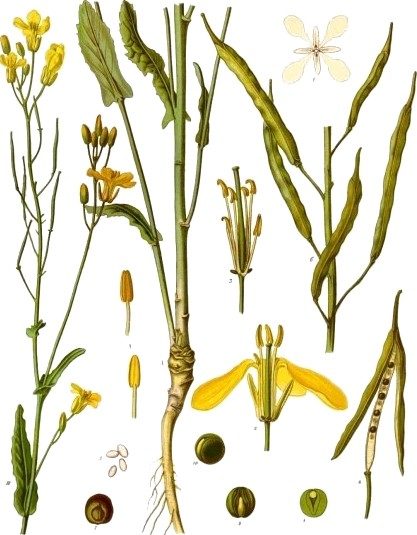
Mustard seed in Scripture · Mandrake in Scripture · Myrrh in Scripture · everything Scripture names →
Drawing on the same sources: Folkard, Grieve
Motherwort · Masterwort and angelica · Meadowsweet · the bibliography →
Nearby in the alphabet
The Miraculous Medal · Milkweed · Mistletoe (especially when found on oak) · Melon root (Cucumis melo) · Mithridate (the forerunner of theriac) · Moly (Unidentified) · Meadow saffron (Colchicum autumnale)
Historical description, not medical advice.