
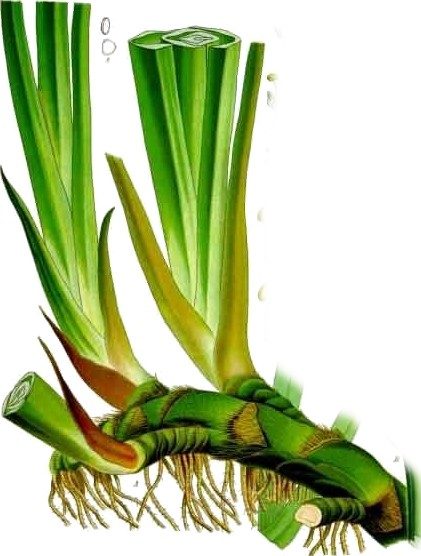
Sweet flag
Calamo aromatico
- Known today as
- Acorus calamus.
- Kind
- Plant, in 1 older authority
- Constituents
- beta-asarone, alpha-asarone
- Earliest authority here
- Pliny (AD 23/24–79)
- In other databases
- Plants of the World Online search · GBIF search · Wikidata search
- In the Canale glossary
- On the Manner of Discerning and Healing the Bewitched, Appendix A: Part Three, Chapter 9: Anointings
Revised October 1, 2026: An older authority added from a text read in full. Lore added from texts read in full. Version 1, first published September 25, 2026.
Caution. Hazardous in some form or dose; see the modern assessment below.
Sweet flag: what did Canale use it for?
In the oil; the “calamus” of Scripture’s anointing oil (ch. 9; Treatise Two).
Sweet flag: what does modern science say?
Most strains contain beta-asarone, which causes cancer in laboratory animals; its internal use is now restricted, and the United States bans calamus in food.
Sweet flag: is it poisonous?
Yes, in some form or dose. Historical description, not medical advice; in a poisoning, call a poison centre.
Pharmacognosy & Toxicology
- Constituents
- beta-asarone ChEMBLup to 80 per cent of the oil in the Asian tetraploid plants
- alpha-asarone ChEMBL
- Mechanism
- β-Asarone is genotoxic and caused tumours of the duodenum in rats; it also has sedative and anticonvulsant actions in animals, the basis of the Ayurvedic use.
- Checked against ChEMBL
- beta-asarone: No measurement in ChEMBL for “sedative and anticonvulsant actions in animals” (35 activities recorded, none against the target named); the line rests on its references.
- Toxic dose
- Chronic; the European limit for β-asarone in foods and drinks is 0.1 mg per kilogram.
- Standing
- Forbidden as a food additive in the United States since 1968; the European diploid plant, nearly free of β-asarone, is permitted in bitters.
- European Medicines Agency (2005). Public statement on the use of herbal medicinal products containing asarone. Book, not indexed
- Taylor, J. M., et al. (1967). “Toxicity of oil of calamus.” Toxicology and Applied Pharmacology 10. Matched to its record and reviewed
Constituent names open the compound’s record at PubChem, and “ChEMBL” beside a name opens its record at ChEMBL, the European Bioinformatics Institute’s database of bioactive molecules. Where a mechanism line was checked against ChEMBL (ChEMBL 37, read 1 October 2026), the check is shown with the measured value and its source paper, or says plainly that nothing has been measured. Doses are as the references give them, for description only; this is not medical advice. Each source carries the result of its check against Crossref, PubMed, or the authority’s page: see Verification.
Sweet flag: what lore surrounds it?
Folkard: “This aromatic Reed, or Sweet Flag, is absurdly said to have been called Acorus, from the Greek koré, pupil, because it was esteemed good for diseases of the eye.” The sacred oil of the Jews, “the ‘oil of holy ointment’—used to anoint the tabernacle, the ark of the testimony, the altar of burnt offerings, the altar of incense, the candlesticks, and all the sacred vessels, has the oil of Acorus as one of its ingredients. It is the ‘Sweet Calamus’ mentioned in Exodus xxx.” Astrologers made it “a plant of the Moon.”
Sweet flag: what did the older authorities say?
- Pliny
- Says the scented calamus of Arabia is common to India and Syria, the Syrian best of all, growing in a valley near a lake between Mount Lebanon and a lesser hill, whose marshes dry up every summer; it went into the oldest unguents with myrtle, cypress, and mastic, and into oil of roses, and Plautus’s Persian has calamus added to the myrrh-wine of the old Romans.
Sources
- [25] U.S. Code of Federal Regulations, 21 CFR 189.110: Calamus and its derivatives. ecfr.gov. Book, seen in reviews
- [41] European Medicines Agency, Committee on Herbal Medicinal Products (HMPC). Herbal monographs, assessment reports and public statements, ema.europa.eu, cited under the herb concerned: aniseed (summary, EMA/305345/2016); Aristolochia (public statement, EMEA/HMPC/138381/2005); asarone (public statement, EMEA/HMPC/139215/2005); caraway (EMA/HMPC/715092/2013); centaury (EMA/HMPC/277493/2015); chicory root (assessment report, EMA/HMPC/113041/2010); cinnamon (EMA/HMPC/246774/2009); clove (assessment report, EMA/HMPC/534946/2010); ethanol in herbal products (reflection paper, EMA/HMPC/85114/2008); fennel (EMEA/HMPC/372839/2016, Rev. 1, 2024); fumitory (draft assessment report, EMA/HMPC/367013/2021); greater celandine (public statement, EMA/HMPC/743927/2010); hops (EMA/HMPC/682384/2013); horehound (EMA/HMPC/604271/2012); mallow (assessment report, EMA/HMPC/749518/2016); marshmallow root (Althaeae radix); melissa (summary, EMA/HMPC/310761/2013); myrrh (assessment report and monograph, EMA/HMPC/96910/2010 and 96911/2010); peppermint oil (assessment report, EMEA/HMPC/349465/2006); pyrrolizidine alkaloids (public statement, EMA/HMPC/893108/2011); rhubarb (EMA/HMPC/113700/2019); sage (Salviae officinalis folium); wormwood (EMA/HMPC/751490/2016). Read in full · the text read
- Pliny the Elder, Natural History 12.48, 13.2, 14.15, trans. J. Bostock & H. T. Riley (1855), Perseus Digital Library. Primary text
- Folkard, R. (1884). Plant Lore, Legends, and Lyrics, “Acorus.” Project Gutenberg #44638. Primary text
Verification
- Checked
- October 1, 2026
- Passes
- Every sentence read against its sources, in the pass over the remaining 343 entries
- The Standing line checked against the authority it names (EMA, WHO, FDA, CITES, Commission E)
- Every dated or regulatory claim checked by category across the database
- The mechanism read against ChEMBL (ChEMBL 37): curated mechanisms and measured activity
- Each quotation from the older authorities checked word for word against the text, read in full
- Sources
- 6 cited: 1 read in full, 1 matched to its record and reviewed, 2 primary text, 1 book, seen in reviews, 1 book, not indexed.
- Corrections
- None were needed.
What was checked, how, and what was found is set out on the Verification page. A checked source is one whose record was found; it does not make the entry medical advice.
Cite This Entry
Version 1 · first published September 25, 2026 · last revised October 1, 2026
- Chicago
“Sweet flag.” In Materia Medica, edited by B. C. P. Statema. Version 1. The Thinking Press, 2026–. Last modified October 1, 2026. https://thethinkingpress.org/materia-medica/sweet-flag.
- MLA
“Sweet flag.” Materia Medica, edited by B. C. P. Statema, version 1, The Thinking Press, 1 Oct. 2026, thethinkingpress.org/materia-medica/sweet-flag. Accessed 8 Oct. 2026.
- APA
Sweet flag. (2026, October 1). In B. C. P. Statema (Ed.), Materia medica (Version 1). The Thinking Press. Retrieved October 8, 2026, from https://thethinkingpress.org/materia-medica/sweet-flag
Club members keep entries on a shelf with private notes, print the plates as cards, and receive an entry by email each week. Create a free account before January 1, 2027 and all of it is yours for good. About the Club
See Also
Also in Pliny the Elder
Teasel in Pliny the Elder · Sweet almond, oil of in Pliny the Elder · Thyme in Pliny the Elder · Sugar in Pliny the Elder · everything Pliny the Elder names →
Drawing on the same sources: Folkard
Turpentine · Violet, lettuce, sow-thistle · the bibliography →
Historical description, not medical advice.