
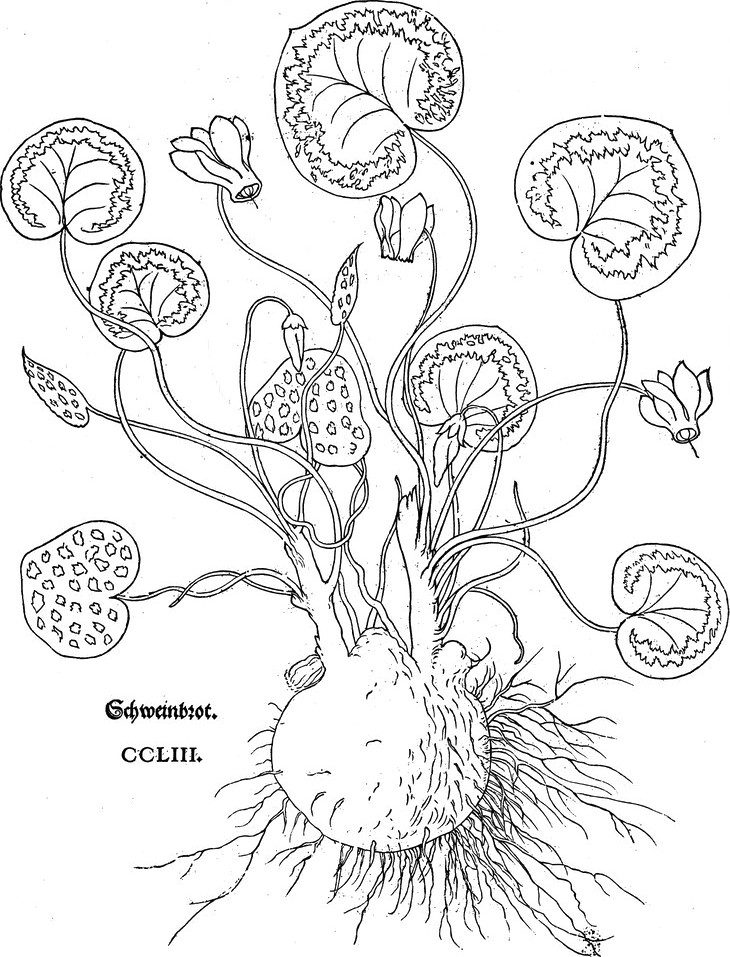
Cyclamen, greater
Ciclamino; pan porcino
- Known today as
- Sowbread, Cyclamen purpurascens or C. hederifolium, eaten by pigs, hence the name.
- Kind
- Plant, in 1 older authority
- Constituents
- cyclamin
- Poisoning
- Gastrointestinal irritants
- Earliest authority here
- Pliny (AD 23/24–79)
- In other databases
- Plants of the World Online search · GBIF search · Wikidata search
- In the Canale glossary
- On the Manner of Discerning and Healing the Bewitched, Appendix A: Part Three, Chapter 9: Anointings
Revised October 1, 2026: An older authority added from a text read in full. Lore added from texts read in full. Version 1, first published September 25, 2026.
Caution. Hazardous in some form or dose; see the modern assessment below.
Cyclamen, greater: what did Canale use it for?
Its distilled root water taken with the oil for hexes; among the amulets (chs. 9–10).
Cyclamen, greater: what does modern science say?
The tuber is a drastic purgative and poisonous. Pliny warned that a pregnant woman who stepped over the root would miscarry, and said that spells had no effect wherever it grew.
Cyclamen, greater: is it poisonous?
Yes, in some form or dose. Its poisoning is gastrointestinal irritants: Thirty minutes to three hours: the short latency is reassuring, since the deadly syndromes come later. Historical description, not medical advice; in a poisoning, call a poison centre.
Pharmacognosy & Toxicology
- Constituents
- Mechanism
- The saponin irritates the gut violently and lyses cells; the old use as a purge and a nose-clearer, and a nasal spray of the extract is sold for sinusitis in Europe.
- Toxic dose
- The tuber has poisoned pigs, whence the name sowbread; a few grams purge.
- Syndrome
- Gastrointestinal irritants
- Standing
- A cyclamen nasal spray showed modest benefit in a 2012 trial for sinusitis.
- Pfaar, O., et al. (2012). “Cyclamen europaeum nasal spray, a novel phytotherapeutic product for the management of acute rhinosinusitis.” Rhinology 50. Verified against its record · doi:10.4193/rhino10.096
The abstract of each source, beneath its citation. For Club members. About the Club or sign in.
Constituent names open the compound’s record at PubChem, and “ChEMBL” beside a name opens its record at ChEMBL, the European Bioinformatics Institute’s database of bioactive molecules. Where a mechanism line was checked against ChEMBL (ChEMBL 37, read 1 October 2026), the check is shown with the measured value and its source paper, or says plainly that nothing has been measured. Doses are as the references give them, for description only; this is not medical advice. Each source carries the result of its check against Crossref, PubMed, or the authority’s page: see Verification.
Cyclamen, greater: what lore surrounds it?
Folkard gives the Roman names Tuber terræ, Panis Porcinus and Arthanita, and the English Sow-bread, “because, in countries where it is abundant, it forms the chief food of herds of swine.” The plant “was formerly regarded as a most potent assistant by midwives”: Gerarde held that the root “hanged about women” had a salutary effect, and fenced his own cyclamens with sticks “lest any woman should, by lamentable experiment, find my words to be true, by their stepping over the same.” According to Theophrastus it “was employed by the ancients to excite love and voluptuous desires,” and placed in a bedchamber it guarded the sleeper: “St. John's Wort and fresh Cyclamen she in his chamber kept, From the power of evil angels to guard him while he slept.”
Thiselton-Dyer lists cyclamen with the pimpernel and herb-paris as plants that “were formerly gathered” in England against witchcraft, and with cumin as plants “which from the time of Theophrastus have been coveted for their magic virtues.” “The bleeding nun (Cyclamen europoeum) was consecrated to the Virgin,” and among the pig-names of plants “the common cyclamen is sow-head.”
Cyclamen, greater: what did the older authorities say?
- Pliny
- Says the root of cyclaminos “is good for injuries inflicted by serpents of all kinds”: leaves smaller than ivy’s, swarthy and covered with whitish spots, a thin hollow stem, purple flowers, and a root “large and covered with a black rind,” almost to be taken for rape, growing in shady places; the cabbage withers if planted near it; and it is an antidote to the sea-hare.
Sources
- [43] Felter, H. W., & Lloyd, J. U. (1898). King’s American Dispensatory. Monographs as transcribed at Henriette’s Herbal Homepage, henriettes-herb.com, cited under the drug concerned. Read in full · the text read
- [98] Pliny the Elder. The Natural History. Trans. J. Bostock and H. T. Riley. London, 1855. Perseus Digital Library, Tufts University. Cited by book and chapter. Primary text
- Pliny the Elder, Natural History 25.67, 24.1, 25.77, trans. J. Bostock & H. T. Riley (1855), Perseus Digital Library. Primary text
- Folkard, R. (1884). Plant Lore, Legends, and Lyrics, “Cyclamen.” Project Gutenberg #44638. Primary text
- Thiselton-Dyer, T. F. (1889). The Folk-lore of Plants. Project Gutenberg #10118. Read in part · the text read
Verification
- Checked
- October 1, 2026
- Passes
- Every sentence read against its sources, in the fifty-entry sample
- The Standing line checked against the authority it names (EMA, WHO, FDA, CITES, Commission E)
- Every dated or regulatory claim checked by category across the database
- Each quotation from the older authorities checked word for word against the text, read in full
- Sources
- 6 cited: 1 read in full, 1 read in part, 1 verified against its record, 3 primary text. 1 with the abstract on file.
- Corrections
- None were needed.
What was checked, how, and what was found is set out on the Verification page. A checked source is one whose record was found; it does not make the entry medical advice.
Cite This Entry
Version 1 · first published September 25, 2026 · last revised October 1, 2026
- Chicago
“Cyclamen, greater.” In Materia Medica, edited by B. C. P. Statema. Version 1. The Thinking Press, 2026–. Last modified October 1, 2026. https://thethinkingpress.org/materia-medica/cyclamen-greater.
- MLA
“Cyclamen, greater.” Materia Medica, edited by B. C. P. Statema, version 1, The Thinking Press, 1 Oct. 2026, thethinkingpress.org/materia-medica/cyclamen-greater. Accessed 8 Oct. 2026.
- APA
Cyclamen, greater. (2026, October 1). In B. C. P. Statema (Ed.), Materia medica (Version 1). The Thinking Press. Retrieved October 8, 2026, from https://thethinkingpress.org/materia-medica/cyclamen-greater
Club members keep entries on a shelf with private notes, print the plates as cards, and receive an entry by email each week. Create a free account before January 1, 2027 and all of it is yours for good. About the Club
See Also
Poisoned alike: gastrointestinal irritants
Honey fungus · Common earthball · Jack-o’-lantern · Colocynth · Jalap · Castor-oil plant, seeds of · Livid pinkgill · Caper spurge · the syndrome, with all of them →
Also in Pliny the Elder
Cyprus powder in Pliny the Elder · Cumin in Pliny the Elder · Damascus prunes in Pliny the Elder · Coral, red in Pliny the Elder · everything Pliny the Elder names →
Drawing on the same sources: Folkard, Thiselton-Dyer
Nearby in the alphabet
Cyclosporin fungus (A soil fungus) · Cuttlefish bone (washed up on beaches) · Cypress (Cupressus sempervirens) · Cubeb (a Javanese pepper whose berries keep a little stalk, like a tail) · Crucifix (The image of Christ on the Cross)



Historical description, not medical advice.