
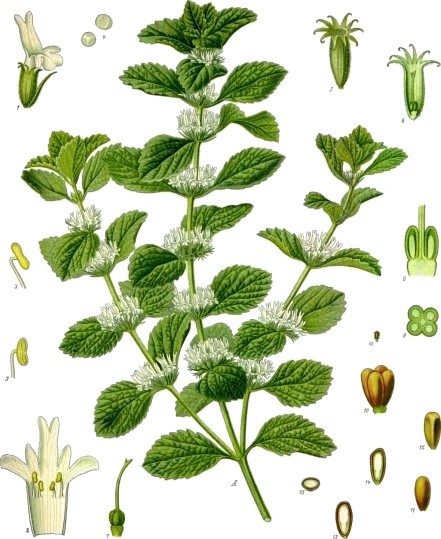
Horehound
Marrubio
- Known today as
- White horehound, Marrubium vulgare.
- Kind
- Plant, in 2 older authorities
- Constituents
- marrubiin, premarrubiin, marrubenol, and 1 more
- Earliest authority here
- Celsus
- In other databases
- Plants of the World Online search · GBIF search · Wikidata search
- In the Canale glossary
- On the Manner of Discerning and Healing the Bewitched, Appendix A: Part Three, Chapter 9: Anointings
Revised October 1, 2026: Tradition, lore, modern assessment, and sources extended. Version 1, first published September 25, 2026.
Horehound: what did Canale use it for?
In the oil; among the amulets (chs. 9–10).
Horehound: how is it taken as a tea?
An ounce of the leaves, fresh or dried, under boiling water, a wineglassful three or four times a day: for an ordinary cold, Grieve says, usually sufficient in itself. In Norfolk and Suffolk it was grown in cottage gardens for tea and candy against coughs.
All the herbal teas of the database. Historical directions, not medical advice.
Horehound: what does modern science say?
A traditional expectorant, recognized by European regulators on the strength of long use rather than clinical trials; still found in cough sweets. Marrubiin, its bitter principle, stimulates the secretions of the bronchi and the appetite; Germany’s Commission E approves the herb for coughs and loss of appetite on the strength of tradition, and it flavours lozenges from Ricola to the horehound drops of New England.
Pharmacognosy & Toxicology
- Constituents
- marrubiin ChEMBLa diterpene lactone bitter, 0.3–1 per cent
- premarrubiinits precursor
- marrubenol ChEMBL
- caffeoylquinic acids
- Mechanism
- Marrubiin is a bitter that raises gastric secretion and is expectorant by the saponin-like vagal route; marrubenol relaxes vascular muscle through calcium channels in animal work and lowers blood pressure in rats.
- Toxic dose
- Safe at tea and lozenge doses; large doses of the juice disturb the heart rhythm in animals.
- Standing
- EMA monograph (2013) for coughs and colds and mild dyspepsia; the standard flavour of American cough drops.
- EMA/HMPC (2013). Community herbal monograph on Marrubium vulgare L., herba (EMA/HMPC/604271/2012). Verified against its record
- El Bardai, S., et al. (2003). “The vasorelaxant activity of marrubenol and marrubiin from Marrubium vulgare.” Planta Medica 69. Verified against its record · doi:10.1055/s-2003-37042
The abstract of each source, beneath its citation. For Club members. About the Club or sign in.
Constituent names open the compound’s record at PubChem, and “ChEMBL” beside a name opens its record at ChEMBL, the European Bioinformatics Institute’s database of bioactive molecules. Where a mechanism line was checked against ChEMBL (ChEMBL 37, read 1 October 2026), the check is shown with the measured value and its source paper, or says plainly that nothing has been measured. Doses are as the references give them, for description only; this is not medical advice. Each source carries the result of its check against Crossref, PubMed, or the authority’s page: see Verification.
Horehound: what lore surrounds it?
Its English name is from the Old English hār hūne, the hoary plant, for the white down on its leaves; “hound” is folk etymology. Horehound candy, boiled from the decoction with sugar, was sold in every American drugstore into the twentieth century and still is in some.
Horehound: what did the older authorities say?
- Celsus
- Gives horehound for the chest in the first century, and Columella for worms in cattle; Pliny says the Egyptian priests prized it, and it was one of the bitter herbs of Passover by some accounts.
- Gerard
- Writes that a syrup of the green leaves and sugar is “a most singular remedie against the cough and wheesing of the lungs.”
Sources
- [41] European Medicines Agency, Committee on Herbal Medicinal Products (HMPC). Herbal monographs, assessment reports and public statements, ema.europa.eu, cited under the herb concerned: aniseed (summary, EMA/305345/2016); Aristolochia (public statement, EMEA/HMPC/138381/2005); asarone (public statement, EMEA/HMPC/139215/2005); caraway (EMA/HMPC/715092/2013); centaury (EMA/HMPC/277493/2015); chicory root (assessment report, EMA/HMPC/113041/2010); cinnamon (EMA/HMPC/246774/2009); clove (assessment report, EMA/HMPC/534946/2010); ethanol in herbal products (reflection paper, EMA/HMPC/85114/2008); fennel (EMEA/HMPC/372839/2016, Rev. 1, 2024); fumitory (draft assessment report, EMA/HMPC/367013/2021); greater celandine (public statement, EMA/HMPC/743927/2010); hops (EMA/HMPC/682384/2013); horehound (EMA/HMPC/604271/2012); mallow (assessment report, EMA/HMPC/749518/2016); marshmallow root (Althaeae radix); melissa (summary, EMA/HMPC/310761/2013); myrrh (assessment report and monograph, EMA/HMPC/96910/2010 and 96911/2010); peppermint oil (assessment report, EMEA/HMPC/349465/2006); pyrrolizidine alkaloids (public statement, EMA/HMPC/893108/2011); rhubarb (EMA/HMPC/113700/2019); sage (Salviae officinalis folium); wormwood (EMA/HMPC/751490/2016). Read in full · the text read
- [104] Readal, M. (2021). Horehound: Herb of the Month. The Herb Society of America Blog, 6 September 2021. Book, not indexed
- Grieve, M. A Modern Herbal, “Horehound, White.” As published on botanical.com.
- Celsus, De medicina IV. Book, seen in reviews
- Gerard, J. (1597). The Herball. Verified against its record · doi:10.5962/bhl.title.99400
Verification
- Checked
- October 1, 2026
- Passes
- Every sentence read against its sources, in the pass over the remaining 343 entries
- The Standing line checked against the authority it names (EMA, WHO, FDA, CITES, Commission E)
- Every dated or regulatory claim checked by category across the database
- Sources
- 7 cited: 1 read in full, 3 verified against its record, 1 book, seen in reviews, 1 book, not indexed, 1 not yet checked. 1 with the abstract on file.
- Corrections
- None were needed.
What was checked, how, and what was found is set out on the Verification page. A checked source is one whose record was found; it does not make the entry medical advice.
Cite This Entry
Version 1 · first published September 25, 2026 · last revised October 1, 2026
- Chicago
“Horehound.” In Materia Medica, edited by B. C. P. Statema. Version 1. The Thinking Press, 2026–. Last modified October 1, 2026. https://thethinkingpress.org/materia-medica/horehound.
- MLA
“Horehound.” Materia Medica, edited by B. C. P. Statema, version 1, The Thinking Press, 1 Oct. 2026, thethinkingpress.org/materia-medica/horehound. Accessed 8 Oct. 2026.
- APA
Horehound. (2026, October 1). In B. C. P. Statema (Ed.), Materia medica (Version 1). The Thinking Press. Retrieved October 8, 2026, from https://thethinkingpress.org/materia-medica/horehound
Club members keep entries on a shelf with private notes, print the plates as cards, and receive an entry by email each week. Create a free account before January 1, 2027 and all of it is yours for good. About the Club
See Also
Sharing caffeoylquinic acids
Drawing on the same sources: Grieve, Celsus, Gerard
Hungary water · Hop · Hyssop · Mithridate · Lavender · Comfrey · Marigold · the bibliography →
Nearby in the alphabet
Houndstongue (Cynoglossum officinale) · Houseleek (Sempervivum tectorum) · Honeyed wine and honeyed water (Wine or water sweetened with honey) · Human fat (Fat rendered from the bodies of the executed) · Honey fungus (from black cords, the “shoestrings,” that spread beneath the bark) · Honey (Honey of bees)
Historical description, not medical advice.